
Hair Service Practice Test
$69.00
- Buy to unlock unlimited access to all Quiz questions and Answers in this Quiz.
- After purchase you can print a PDF of the whole quiz at any point. The PDF will contain the questions and the correct answers.
About this Exam
Welcome to your comprehensive study guide for the Hair Service Practice Test! This certification is the essential gateway for aspiring hairstylists, colorists, and cosmetology professionals. Designed to validate the critical technical skills and theoretical knowledge required for safe and effective salon practice, this exam ensures that you are ready to serve clients in a professional environment. Whether you're finishing your training or looking to officially enter the workforce, this practice guide and the exam itself are designed to boost your confidence and demonstrate your readiness for the real-world challenges and opportunities in the exciting world of hair care.
Ready to test your knowledge?
Buy Now to Access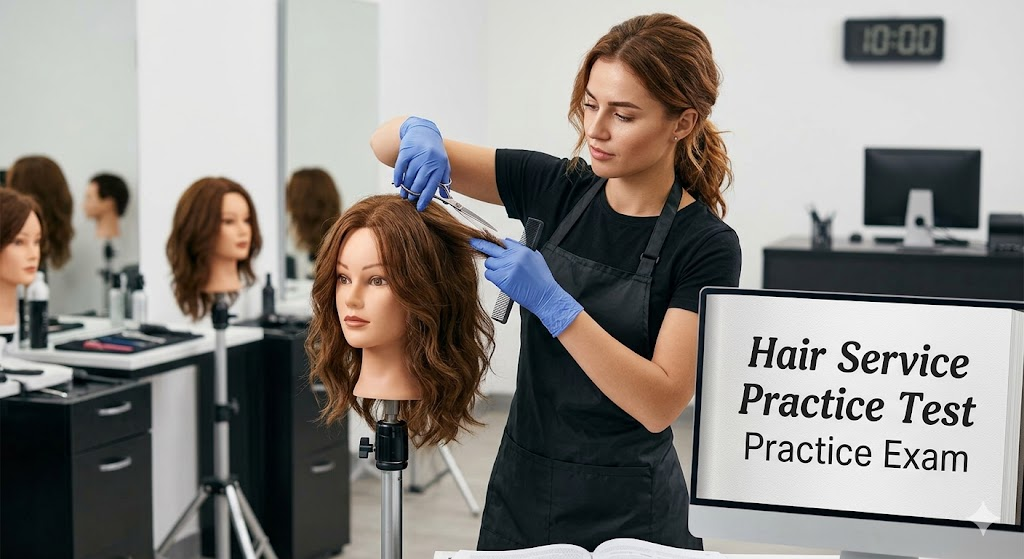
Additional Information
What the Course Entails and Exam Details
This examination does not represent a specific pre-requisite course but rather assesses the competencies typically acquired through formal cosmetology or hairdressing training programs. The exam is divided into theoretical knowledge and practical applications, covering a broad spectrum of services and safety protocols. You can expect to demonstrate your proficiency across these core pillars of hair service:
Core Syllabus and Skills Covered:
Sanitation and Infection Control: The most critical component! You must master decontamination procedures for all tools, equipment, and work surfaces. Understanding state regulations and public health standards is paramount.
Client Consultation and Hair Analysis: The ability to communicate effectively with clients, understand their needs, and analyze hair type, condition, and porosity to recommend appropriate services and products.
Hair Cutting Techniques: A comprehensive range of cutting skills, including blunt cuts, graduated styles, layered techniques, and texturizing, using various tools like shears, razors, and clippers.
Hair Styling and Finish: Mastery of blow-drying, thermal styling (curling irons, flat irons), roller setting, and creative updo techniques to achieve desired looks.
Chemical Services: In-depth knowledge and safe practice of hair coloring (application types, color theory, mixing), permanent waving (sectioning, wrapping, solution types), and chemical hair relaxing.
What to Expect in the Final Exam
While specific details can vary slightly by your location and testing body (such as State Boards of Cosmetology using providers like PSI or Pearson VUE), most Hair Service Practice Test formats follow a standardized structure to ensure minimal competency for licensure or certification. You must be prepared for a multi-part evaluation.
Typical Exam Format:
Written (Theory) Examination: This is usually a computer-based, multiple-choice test.
Number of Questions: 100 to 150 questions.
Time Limit: Approximately 90 to 120 minutes.
Passing Score: Typically ranges from 70% to 75%.
Content Areas: Science of hair and scalp, product knowledge, safety, regulations, and the rationale behind practical techniques.
Practical (Skills) Examination: This is a hands-on assessment, typically conducted on a mannequin in a testing facility.
Services to Perform: Specific tasks like a layered cut, a basic perm wrap, hair color application (simulated), thermal curling, and client protection.
Key Focus: Grading is based not only on the final look but crucially on your process, especially strict adherence to sanitation, safe tool handling, proper timing, and respect for client (mannequin) safety.
Passing Requirement: Often, a passing score on each distinct practical section is required, with a combined practical score commonly in the 70-75% range.
Specific Exam Rules:
Strict dress codes and tool protocols must be followed.
Timed sections for each practical service.
Zero tolerance for sanitation breaches or safety violations.
How to Study and Exam Centers
Preparation is the key to success. Combine theoretical study with dedicated hands-on practice.
Effective Study Strategies:
Theory Review: Utilize standard cosmetology textbooks, your program's curriculum, and online resources. Create flashcards for key terms, chemical definitions, and safety procedures.
Practice Tests: Seek out and complete as many simulated written practice tests as possible. Analyzing why you got questions right or wrong is crucial for identifying knowledge gaps. These practice tests are designed to mimic the real exam's structure and difficulty.
Practical Repetition: Dedicate ample time to practicing each required service on a mannequin. Work on timing your procedures to match the exam limits, paying meticulous attention to every sanitation step. Record yourself or have an instructor/peer critique your technique and safety protocols.
Mock Exams: Set up timed, full mock practical exams to simulate the pressure and flow of the actual day.
Taking the Exam and Exam Centers:
The formal licensure exam is typically administered by or in coordination with your State Board of Cosmetology.
Registration: Follow your specific jurisdiction's process for exam registration, which often requires proving completion of training and paying relevant fees.
Testing Centers: Exams are rarely taken "online" in a home setting but are scheduled at authorized, high-security testing centers across your state, often operated by companies like PSI, Pearson VUE, or at dedicated cosmetology school testing locations. You will receive a specific location, date, and time once you are registered and approved.
Job Opportunities from the Course
Successfully passing this examination is often the required step to unlock your career and is recognized by employers as proof of your technical competency and dedication. Becoming a certified or licensed professional opens countless doors in the dynamic and rewarding beauty industry.
Career Paths and Job Titles:
Professional Hair Stylist: Provide cutting, styling, and basic chemical services in a salon environment.
Hair Color Specialist: Focus purely on technical and creative hair coloring, highlights, balayage, and color correction.
Barber: (Depending on state regulations and license type) Provide cutting, styling, and face shaving services, often with a focus on men's hair.
Salon Manager/Owner: Oversee the operations, staff, and customer service of a full salon.
Session Stylist: Work on film, television, print media, or fashion runway settings, creating diverse and high-impact hair looks.
Hair Care Product Educator: Represent a product brand, training salons and stylists on the proper application and techniques for their product lines.
Platform Artist: Perform and demonstrate advanced techniques at beauty shows and industry events.
Freelance Hairstylist: Build your own clientele for weddings, events, and personal styling services.
Beauty Educator/Instructor: Share your expertise with the next generation of stylists in a cosmetology school or training program.
This guide is your first step towards conquering the Hair Service Practice Test and launching a successful and fulfilling career. Remember to verify the specific details and requirements with your state's licensing body. Good luck, future hair professionals! Be meticulous in your study, precise in your practice, and confident on exam day. Your future in hair is waiting!
Frequently Asked Questions
Reviews
5.0
Based on 0 reviews
Leave a Review
No reviews yet. Be the first to review!