
Hair Service Preparation Practice Test
$69.00
- Buy to unlock unlimited access to all Quiz questions and Answers in this Quiz.
- After purchase you can print a PDF of the whole quiz at any point. The PDF will contain the questions and the correct answers.
About this Exam
The Hair Service Preparation test, often a crucial component of State Board Cosmetology exams or a specialized certification, evaluates your readiness to perform foundational hair services safely and effectively.
It is designed for aspiring cosmetologists, hair stylists, and hairdressers who have completed their initial training and need to demonstrate practical knowledge of procedures before working on clients or advancing to more complex services.
This test focuses on the essential preliminary steps, sanitation protocols, and essential client communication skills that form the base of every successful and safe hair service, and passing it is your gateway to proving your technical expertise in the broader cosmetology licensure process.
Ready to test your knowledge?
Buy Now to Access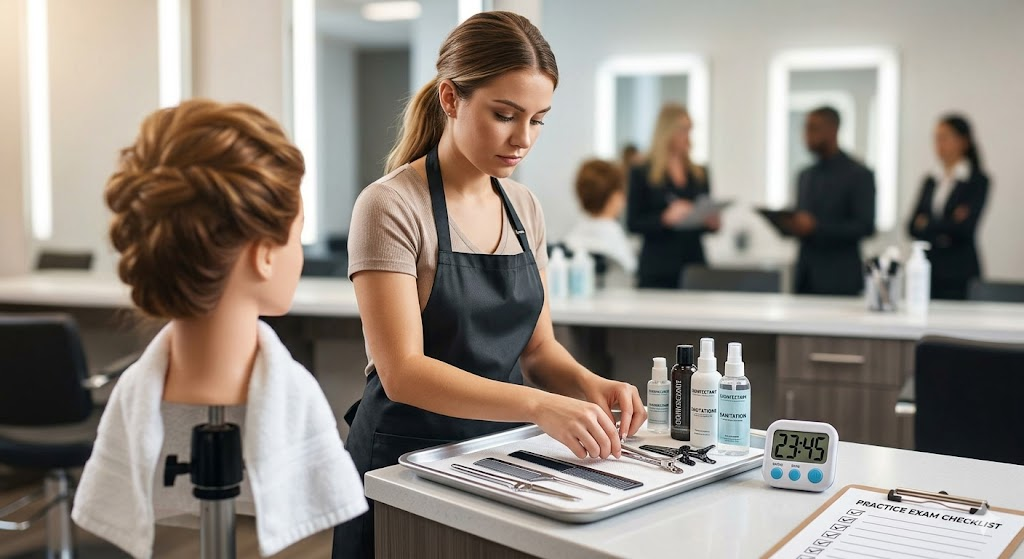
Additional Information
What the Course Entails and Exam Details
This examination covers the core principles that must be understood and demonstrated before you can cut, color, or style.
The scope of knowledge includes:
Client Consultation & Analysis: Assessing a client's hair type, scalp condition, and discussing desired results and potential risks.
Scalp & Hair Disorders: Identifying common conditions (dandruff, alopecia, infectious diseases) to determine service safety or make referrals.
Safety & Sanitation: Proper disinfection of tools, maintaining a sterile environment, handling products safely, and adherence to Universal Precautions.
Draping: Correct techniques for various services (shampooing, cutting, chemical treatments) to ensure client comfort and protection.
Foundational Techniques: Procedures for shampooing, conditioning, scalp massage, basic setting, and product preparation.
Specific Pre-Service Tests: Procedures and protocols for strand tests, patch tests, and test curls.
Health & Safety Regulations: Familiarity with government guidelines, safety data sheets (SDS), and basic first aid in the salon.
The theoretical part generally utilizes multiple-choice questions to test knowledge of these principles, while the potential practical portion demands physical demonstration.
What to Expect in the Final Exam
While exact details are set by individual State Boards or testing agencies, here’s a general overview of what to expect in this comprehensive evaluation:
The final exam almost always consists of both a written theory test and a practical demonstration.
Written Theory Exam: Expect 50 to 100+ multiple-choice questions, which may include matching and labeling, covering all the course subjects. There will be a set time limit (often between 60 to 90 minutes) and a passing score, typically ranging from 70% to 75%. This part assesses your understanding of concepts, products, anatomy, and safety standards.
Practical Exam: This hands-on assessment requires you to physically perform core service-preparation procedures on a mannequin or, in some cases, a live model, under the supervision of proctors and within a strict time limit for each section. Key practical tasks include:
Sanitation setup
Client protection (draping)
Client consultation
Scalp analysis
Shampooing & conditioning
A pre-service test demonstration (e.g., patch or strand test)
Specific Rules: You will likely need to bring your own pre-approved kit with correctly labeled, sanitized tools and supplies. There is often a strict list of allowed and forbidden items. Any major safety or sanitation violation can lead to automatic failure for that section or the entire practical exam.
Always consult your specific state board's candidate information bulletin (CIB) for the precise format, scoring, timing, required kit contents, and rules.
How to Study and Exam Centers
Preparation is paramount. Here are actionable study strategies:
Practice with Real-World Scenarios: Leverage practice questions, online quizzes, and mock theory tests designed for hair service preparation to build your confidence and knowledge recall.
Master the Curriculum: Review your textbook (like Milady or Salon Fundamentals), class notes, diagrams, and any official study guides thoroughly. Use flashcards for key terms, safety rules, and chemical properties.
Practical Hands-On Practice: Don't just read—DO. Use a mannequin head to practice every single step of your potential practical exam in sequence, timed, and using the exact checklist of items you will have on exam day. Focus heavily on smooth transitions, correct tool handling, and unwavering sanitation in every practice session. Ask instructors or peers to observe and critique you using official scoring criteria.
Simulate Exam Conditions: Set up a clean station, time yourself, and work through both a mock written test and a complete mock practical demonstration without interruptions.
Focus on Safety & Sanitation: This is where many students lose critical points. Practice perfect sanitation and client safety habits until they are second nature. This means consistent hand-washing, tool disinfection, correct draping, and product handling.
Exam Centers: The Hair Service Preparation test is typically administered as part of the State Board of Cosmetology licensure exam in your area. You can find official test dates, locations, and registration instructions on your state board's website or through authorized testing centers (which may be specific physical locations, third-party proctoring centers like Pearson VUE, or accredited beauty schools). Your school should also provide detailed information on scheduling your specific exam.
Job Opportunities from the Course
Successfully demonstrating competence in hair service preparation is the first essential step in unlocking various rewarding career paths within the cosmetology industry:
Licensed Cosmetologist: The primary career, allowing you to provide a full range of hair, skin, and nail services.
Hair Stylist: Focused on hair cutting, coloring, styling, and treatments.
Salon Stylist: Working in various salon environments, building a clientele.
Specialized Hair Specialist: With further training/experience, becoming a:
Colorist: Expert in hair coloring techniques and chemistry.
Cutter: Specialist in diverse haircutting styles and trends.
Styling Expert: For events, bridal, or editorial work.
Barber: (Often with a separate license/training).
Stylist Assistant/Apprentice: The common entry-level role, starting with preparations.
Salon Manager or Owner: (Requires experience and additional business skills).
Cosmetology Instructor/Educator: (Typically requires experience and an additional teaching license/certification).
Beauty Retail Specialist / Sales Representative: Working for product brands or supply stores.
Beauty Blogger, Writer, or Influencer: With deep knowledge and experience.
Passing this exam proves you have the foundational skills and dedication to safety that are fundamental to all these exciting opportunities.
Good luck with your studies—you are well on your way to becoming a skilled professional in the beauty world!
Frequently Asked Questions
Reviews
5.0
Based on 0 reviews
Leave a Review
No reviews yet. Be the first to review!