
Halacha Practice Test
$69.00
- Buy to unlock unlimited access to all Quiz questions and Answers in this Quiz.
- After purchase you can print a PDF of the whole quiz at any point. The PDF will contain the questions and the correct answers.
About this Exam
A Halacha examination is a rigorous assessment of an individual's knowledge and practical application of Jewish Law (Halacha). These exams are rarely standalone certifications; rather, they serve as crucial milestones within broader advanced Jewish studies programs, such as those found in a Yeshiva (seminary) or Kollel (post-graduate institute).
The primary purpose of a Halacha exam is to verify that a candidate possesses a profound, text-based understanding of Jewish legal codes and the ability to render accurate, practical decisions (P'sak Halacha) in real-world scenarios. It is designed for students who are committed to extensive textual analysis and are preparing for roles of religious leadership, education, or specialized supervision within the Jewish community.
Ready to test your knowledge?
Buy Now to Access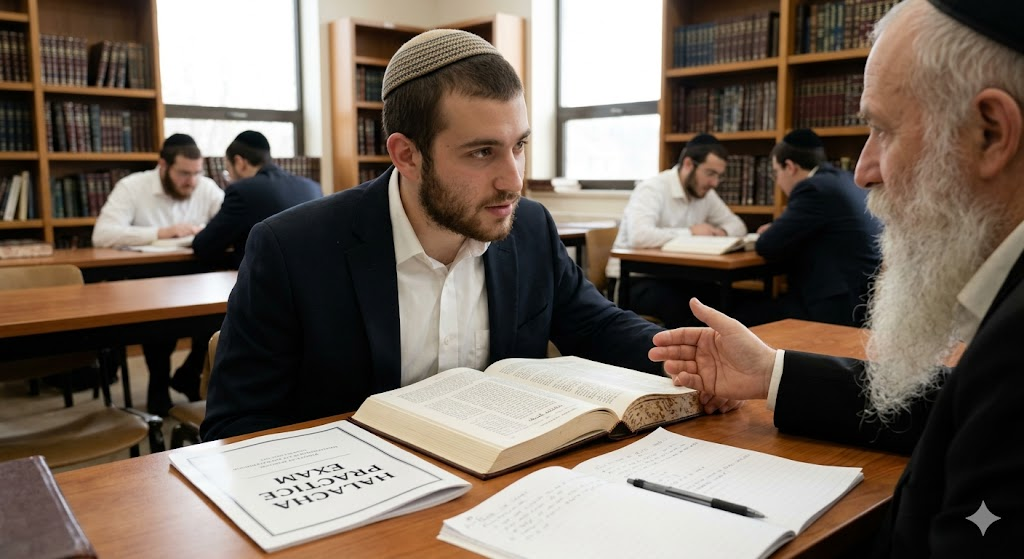
Additional Information
What the Course Entails and Exam Details
The "course" leading to a Halacha exam is not a standard semester-based class but a multi-year journey of intensive textual study. The syllabus is typically built upon the Shulchan Aruch (the Code of Jewish Law) and its primary commentaries.
Core areas commonly covered in a comprehensive Halacha curriculum include:
Orach Chaim (The Way of Life): This section encompasses daily laws, such as the laws of prayer (Tefilla), blessings (Brachot), and the intricate laws of Shabbat and Jewish Holidays (Chagim).
Yoreh De'ah (Teacher of Knowledge): This critical area covers the laws of Kashrut (dietary laws, including the separation of meat and milk, and the laws of kosher slaughter), family purity (Niddah), vows, and other aspects of ritual life.
Even Ha'ezer (The Stone of Help): Advanced curricula include this section, focusing on marriage, divorce, and family law.
Choshen Mishpat (The Shield of Justice): This section is for candidates pursuing Dayanut (judgeship), covering civil law, business ethics, and torts.
Specialized programs may focus intensely on a single area, such as a course solely on the laws of writing sacred texts for a Sofer (Scribe), or the laws of family purity for a Yoetzet Halacha (woman Halachic advisor).
What to Expect in the Final Exam
You should expect the final Halacha examination to be one of the most demanding assessments of your academic career. The format varies significantly between institutions but rarely relies on multiple-choice questions alone.
A final exam typically consists of several of the following components:
Intensive Written Essays: You will be required to write detailed essays analyzing complex Halachic scenarios, tracing the law from its Talmudic origins through the Rishonim (early commentators) to the Shulchan Aruch and contemporary Poskim (decisors).
Oral Examination (Bechina): This is a hallmark of Halacha assessment. A candidate sits before a panel of senior Rabbis or a Beis Din (Rabbinic Court) and must answer probing questions on a wide array of topics, demonstrating not just recall but deep understanding and the ability to synthesize differing opinions.
Specialized Practical Tests: For specific roles, you may have a practical component, such as correctly identifying rendering flaws in a Torah scroll for a Sofer, or demonstrating knowledge of food production lines for a Mashgiach.
Passing Score and Time Limits: There is no universal "passing score." The standard is competence. Examiners look for a high level of clarity, textual mastery, and sound judgment. Time limits are generous for written portions to allow for deep thought, but the oral component requires a swift and accurate response.
How to Study and Exam Centers
Studying for a Halacha exam requires a blend of solitary focus and communal debate.
Core Study Strategies:
Direct Textual Engagement: Focus your study on the Shulchan Aruch, specifically the Mechaber (author, Rabbi Yosef Caro) and the Rema (Rabbi Moshe Isserles), along with their essential commentaries like the Shach, Taz, and Mishna Berura.
Chavrusa learning (Partner Study): This is the most effective study method. Debating texts with a partner clarifies understanding, exposes nuances, and simulates the pressure of an oral exam.
Review and Summarization: Regularly summarize each Siman (chapter) in your own words, noting the final P'sak and the reasoning behind it.
Practicing P'sak: Work through case studies and past exam questions to practice applying abstract laws to concrete situations.
Exam Centers: Halacha examinations are not administered at public testing centers like Pearson VUE. They take place directly at the authorizing institutions. These are typically specific Yeshivas or Kollels in Jewish centers worldwide, such as Jerusalem, New York, or Lakewood. Candidates must register directly with the program providing the certification.
Job Opportunities from the Course
A Halacha certification opens the door to numerous vital roles within the Jewish community. The exact opportunities depend on the level and focus of the ordination or specialized training you receive.
Specific job titles include:
Rabbi / Community Leader: A central role of religious guidance, education, and spiritual leadership.
Dayan: A judge on a Beis Din (Rabbinic Court), presiding over civil disputes and marital law.
Jewish Educator / Teacher: Teaching advanced Halacha in Yeshivas, high schools, or adult education programs.
Kashrut Supervisor (Mashgiach): Overseeing food production to ensure adherence to dietary laws in restaurants, caterers, or factories.
Sofer (Scribe): Writing sacred texts like Torah scrolls, Tefillin, and Mezuzot.
Yoetzet Halacha: A specialized woman advisor in the laws of family purity.
Shliach: A Chabad emissary leading a community and offering Halachic guidance.
A high-level Halacha exam is not just a test of knowledge; it is a test of character and dedication. Embrace the challenge, utilize the tools provided, and join the chain of tradition that has preserved Jewish life for millennia. We wish you immense success in your learning.
Frequently Asked Questions
Reviews
5.0
Based on 0 reviews
Leave a Review
No reviews yet. Be the first to review!