
Ham Amateur Radio Technician Practice Exam
$69.00
- Buy to unlock unlimited access to all Quiz questions and Answers in this Quiz.
- After purchase you can print a PDF of the whole quiz at any point. The PDF will contain the questions and the correct answers.
About this Exam
The Ham Amateur Radio Technician license is the entry point for millions of people around the world into the exciting hobby of amateur radio. This certification is designed for individuals of all ages and backgrounds who wish to explore wireless communications, connect with others locally and globally, experiment with technology, and participate in vital emergency services. It requires no prior technical background, just a curiosity about radio and a willingness to learn the basic principles that make it possible. Earning this license grants you the privilege of operating within a wide range of frequencies, enabling clear communications using everything from handheld radios to sophisticated stations.
Ready to test your knowledge?
Buy Now to Access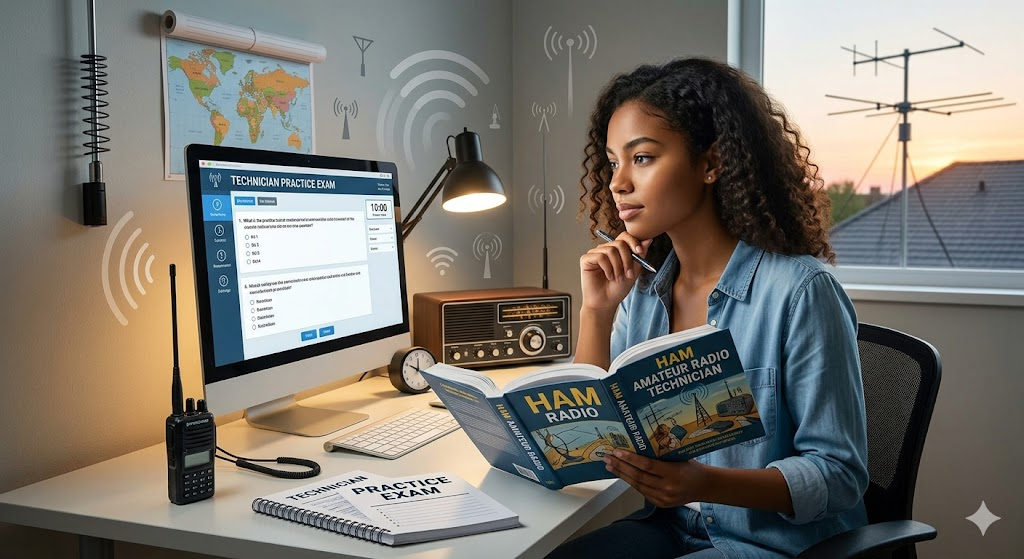
Additional Information
What the Course Entails and Exam Details
While the path to a Technician license doesn't typically involve a mandatory formal "course," aspiring operators study specific, well-defined areas of knowledge. The exam preparation material covers a comprehensive syllabus including:
FCC Regulations: Understanding the rules and governance surrounding amateur radio operations in the United States, license privileges, and prohibited communications.
Operating Practices: The fundamentals of good, courteous radio operation, including calling frequencies, repeaters, and emergency communications.
Basic Electronics Theory: An introductory look at electrical principles, components (resistors, capacitors, transistors), schematic diagrams, and basic arithmetic relevant to electronics.
Radio Wave Propagation: How radio signals travel, including line-of-sight, refraction, and different types of antennas.
Equipment and Station Safety: Knowledge of transceivers, accessories, RF exposure safety, and general station setup guidelines.
What to Expect in the Final Exam
The official Ham Amateur Radio Technician exam is designed to be a straightforward assessment of your foundational knowledge. You can expect:
Format: The exam consists of 35 multiple-choice questions. These questions are drawn from a publicly available pool created by the National Conference of Volunteer Examiner Coordinators (NCVEC).
Passing Score: To pass and earn your license, you must correctly answer at least 26 questions, achieving a score of 74% or better.
Time Limits: While some testing locations might have operational time frames, the exam itself is generally administered without a fixed, strict time limit for individual sections. Most people complete it within 30 to 60 minutes.
Rules & Administration: Exams are administered by pairs or teams of seasoned, accredited hams known as Volunteer Examiners (VEs), functioning under a Volunteer Examiner Coordinator (VEC). There is a small administrative fee (usually around $15) for the exam itself, separate from any subsequent FCC license application fees.
How to Study and Exam Centers
Effective preparation is key to succeeding. Here are actionable study strategies:
Study Guides and Manuals: Utilize official or widely-recommended Technician Class license manuals. These books walk you through the entire question pool, explaining the underlying concepts of each topic.
Practice Exams: Take numerous practice exams online or through mobile apps. Focus on identifying and understanding why you got a question wrong, not just memorizing the answer. Consistent practice boosts confidence.
Online Courses: Many organizations and individuals offer interactive online courses that include video lessons, quizzes, and simulated tests.
Radio Clubs & Mentoring: Local amateur radio clubs are invaluable. They often host classes, provide study groups, and offer the unique resource of "Elmers"—experienced operators willing to mentor newcomers.
You can take the official exam at two primary types of locations:
In-Person Test Sessions: VECs arrange sessions across the country, often hosted by local clubs, schools, or community centers. These are the most common way to test, offering the opportunity to meet other local hams.
Remote/Online Testing: A modern and popular alternative. Many VECs are authorized to provide secure, proctored online exams that you can take from your own home, often using a webcam and video-conferencing technology.
To find a testing session near you, both in-person and online, visit the websites of major VECs like the ARRL or search "ham radio exam near me".
Job Opportunities from the Course
While the Ham Amateur Radio Technician license is primarily for a non-commercial hobby, the foundational knowledge and technical skills you acquire are highly sought after in numerous professional fields. It serves as an impressive credential on a resume and can unlock career paths including:
Radio Frequency (RF) Technician
Broadcast Technician/Engineer
Emergency Communications Specialist
Two-Way Radio Technician
Electronics Test Technician
Wired/Wireless Network Installer
Communications Dispatcher
Public Safety Telecommunicator
Satellite Communications Technician
Technical Support for Radio Equipment Manufacturers
Research & Development Support for Wireless Technology
Earning this license is your first step into a world of continuous learning and boundless exploration, setting you up for success in both a fulfilling hobby and a dynamic professional future. We encourage you to start your journey today!
Frequently Asked Questions
Reviews
5.0
Based on 0 reviews
Leave a Review
No reviews yet. Be the first to review!