
Ham Radio Technician Class Practice Test
$69.00
- Buy to unlock unlimited access to all Quiz questions and Answers in this Quiz.
- After purchase you can print a PDF of the whole quiz at any point. The PDF will contain the questions and the correct answers.
About this Exam
Are you ready to enter the exciting world of amateur radio?
The Ham Radio Technician Class license is your first major milestone on this journey.
This entry-level certification is designed for absolutely anyone with a passion for communication, electronics, and global connection.
It opens the doors to operating on various VHF and UHF bands, enabling you to talk across town or even around the world under the right conditions.
Whether you're a student, a retiree, a tech enthusiast, or someone interested in emergency preparedness, this course and practice test will guide you toward earning your official license.
Ready to test your knowledge?
Buy Now to Access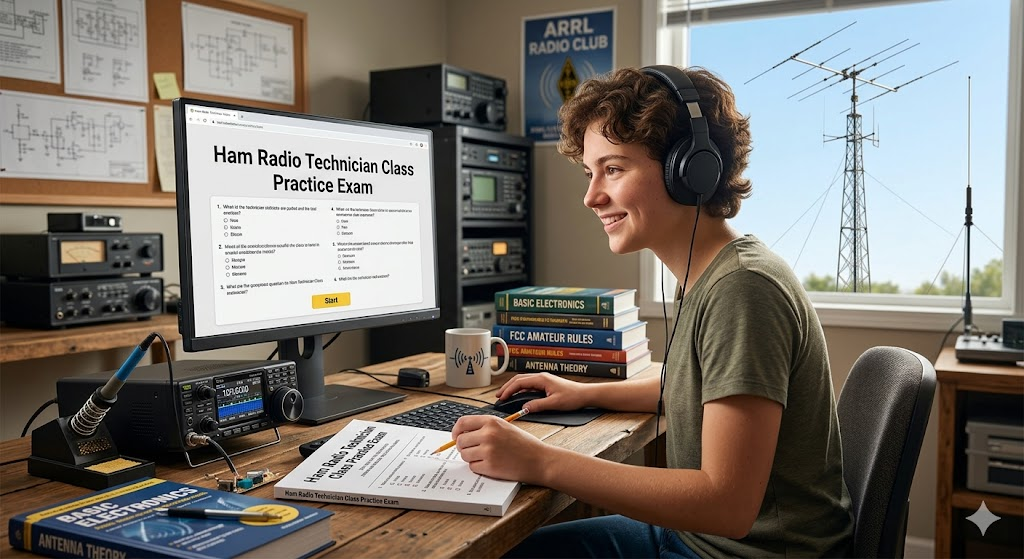
Additional Information
What the Course Entails and Exam Details
The Technician Class curriculum provides a fundamental understanding of radio theory and FCC regulations.
You will explore essential topics such as basic electronics, including Ohm’s Law and circuit components.
Delve into the science of radio wave propagation to understand how signals travel different distances.
The course covers antenna design and basic principles, ensuring you know how to build and choose the right equipment.
Operating procedures and standard practices, including making contacts and public service operation, are also key components.
Crucially, you’ll learn the specific rules, regulations, and safety guidelines mandated by the Federal Communications Commission (FCC) for amateur radio operators in the United States.
Overall, this course equips you with the knowledge needed to operate a station legally and effectively.
What to Expect in the Final Exam
The actual Technician Class licensing exam is a single-session, multiple-choice written test.
You will be presented with a total of 35 distinct questions chosen from a large public pool.
For each question, there are four possible answers, with only one being correct.
To pass the exam and earn your license, you must answer at least 74% of the questions correctly.
This means achieving a score of 26 correct answers or more.
There is no strict time limit for the exam, but most candidates complete it well within one hour.
Remember that unlike higher-level amateur radio exams, there is currently no practical operating test required for the Technician license.
How to Study and Exam Centers
Effective preparation is essential for success, so utilize multiple resources.
Consider obtaining a dedicated study guide book, such as those published by the ARRL (American Radio Relay League).
Leverage online study portals and interactive practice exam websites, which are excellent for checking your progress.
Numerous free and paid mobile applications offer flashcards and simulated test environments for studying on the go.
Connect with local ham radio clubs; members are often incredibly supportive and may offer informal classes or mentoring.
When you are ready, you won't typically find exams at general testing centers like Pearson VUE.
Instead, amateur radio exams are administered by dedicated Volunteer Examiners (VEs), who are licensed amateur radio operators themselves and authorized to conduct testing.
To locate upcoming exam sessions, you can use online search tools provided by organizations like the ARRL or simply check with local ham radio clubs in your area, some of which may even offer online testing options.
Job Opportunities from the Course
Your Ham Radio Technician Class foundation can positively influence numerous career paths and potentially unlock diverse job opportunities in fields where technical expertise and communication skills are highly valued.
Specific potential career directions and related roles include:
Electronics Repair Technician – Utilizes basic electronics principles for troubleshooting and repairs.
RF Communications Technician – Works directly with radio systems and signal transmission.
Emergency Management Specialist (supporting comms) – Applies communication skills and equipment knowledge in critical situations.
Wireless Network Technician – Benefits from a practical understanding of RF propagation and basic antennas.
Technical Sales or Customer Support for Radio Equipment – Deepens product knowledge and customer communication abilities.
Engineering Assistant in Wireless/Telecom – Provides technical support with solid background.
Search and Rescue Operative (Professional and Dedicated Volunteer) – Coordinates communications during operations.
Broadcast Engineer Assistant – Contributes to maintaining radio and TV broadcasting signals.
Remember that while this license demonstrates knowledge, specific roles may require additional training or higher-level certifications, but your foundation remains a significant asset.
Frequently Asked Questions
Reviews
5.0
Based on 0 reviews
Leave a Review
No reviews yet. Be the first to review!