
Hawaii Gun Laws & Firearms Safety Practice Exam
$69.00
- Buy to unlock unlimited access to all Quiz questions and Answers in this Quiz.
- After purchase you can print a PDF of the whole quiz at any point. The PDF will contain the questions and the correct answers.
About this Exam
The Hawaii Gun Laws & Firearms Safety Practice Exam is your essential preparatory tool designed for individuals seeking to navigate Hawaii's stringent firearms regulations and qualify for official certification. This practice exam is ideal for anyone planning to apply for a 'Permit to Acquire' a firearm in the state of Hawaii, as well as professionals needing to meet state-mandated training requirements, such as armed security officers, armored car personnel, or other licensed positions. By offering a comprehensive simulation of the legal and safety questions found on official tests, this practice exam ensures you have the knowledge and confidence required to demonstrate proficiency, responsibility, and adherence to Hawaii law.
Ready to test your knowledge?
Buy Now to Access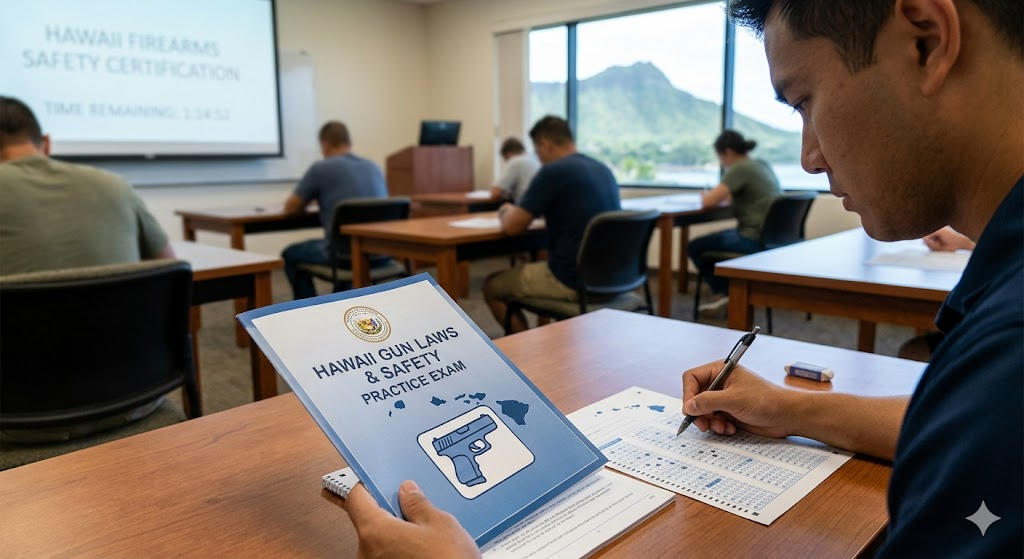
Additional Information
What the Course Entails and Exam Details
The official educational curriculum that this practice exam supports is designed to provide comprehensive knowledge on key legal frameworks and practical safety standards essential for responsible gun ownership and professional carry in Hawaii.
Core topics covered in detail include:
Hawaii Revised Statutes (HRS) Chapter 134: A deep dive into the specific laws governing the ownership, possession, and transport of firearms and ammunition within the state.
Hawaii’s 'Permit to Acquire' Process: Detailed steps, required documentation, waiting periods, and background check procedures.
Safe Gun Handling and Storage: The fundamental and non-negotiable rules of firearms safety, including secure storage methods to prevent unauthorized access, particularly from children.
Use of Force and Deadly Force: Clear definitions and legal thresholds for the justifiable use of physical and deadly force in self-defense, defense of others, and protection of property under Hawaii law, including specific provisions of HRS Chapter 703.
Prohibited Areas and Carry Laws: A comprehensive list of locations where firearms are restricted, including government buildings, parks, and school zones, along with the nuances of Hawaii’s concealed and open carry regulations.
Transporting Firearms in Hawaii: Specific requirements for legally moving firearms and ammunition between a place of purchase, residence, place of business, or approved target range.
Legal Responsibilities of Ownership: Issues related to lost or stolen firearms reporting, ammunition restrictions, and the legal consequences of unlawful possession or negligent use.
This practice exam meticulously reflects the official testing process, which often serves as a prerequisite for professional licensing or personal permits.
What to Expect in the Final Exam
While specific formats may vary depending on the county or authorized testing body, the actual exam you are preparing for typically contains the following elements:
Format: The exam predominantly consists of multiple-choice and true/false questions designed to test both factual knowledge and situational application. Many official exams also include a practical handling and live-fire component at an approved range.
Content Split: Expect a significant emphasis on legal questions (approximately 60-70%) derived directly from the Hawaii Revised Statutes, with the remainder focusing on fundamental firearms safety principles.
Passing Score: Most official safety courses and permit tests require a high passing grade, often 80% or higher. Some sections, particularly on core safety rules, may require a perfect 100%.
Time Limit: You will usually have a set time limit, typically between one to two hours, to complete the written portion of the exam. The practical and live-fire components are assessed separately.
Scenarios: The written exam may use real-world scenarios to assess your understanding of use-of-force laws and lawful decision-making in high-pressure situations.
How to Study and Exam Centers
Successful preparation for the official test involves a structured approach. Use these actionable strategies to ensure your success:
Utilize This Practice Exam: Take this practice test multiple times. Analyze your results, focus on areas of weakness, and use the provided rationales to deeply understand the legal and safety concepts.
Read the Statutes Verbatim: Directly study Hawaii Revised Statutes (HRS) Chapter 134 and Chapter 703. Access these via the official Hawaii State Legislature website. The wording in legal questions often mirrors the exact statutory language.
Enroll in an Approved Safety Course: To get a permit, you must complete an official firearms safety course taught by a state-certified or county-approved instructor. These courses cover the necessary material and provide the required certification.
Create Flashcards: Make flashcards for key legal definitions (e.g., 'loaded firearm', 'crime of violence', 'deadly force'), prohibited locations, and the essential safety rules.
Review Practical Handling: For the practical portion, regularly practice safe handling procedures with an unloaded firearm, following all rules of the 'safety circle'.
The primary exam for a 'Permit to Acquire' is administered directly by the Firearms Unit of your specific county Police Department (e.g., Honolulu Police Department, Maui Police Department, Hawaii County Police Department). Professional certification exams are typically held at authorized private training facilities, certified security companies, or approved firing ranges throughout the state. You will take the final, official exam after completing the required in-person safety course.
Job Opportunities from the Course
Successfully preparing for and passing the official requirements validated by this practice exam is a critical step toward unlocking specialized career paths in Hawaii. A strong command of state gun laws and firearms safety is essential or required for the following job titles:
Armed Security Officer
Armored Car Driver and Guard
Range Safety Officer (RSO)
Firearms Instructor (after additional advanced certifications)
Private Investigator (when carrying a firearm is required for certain cases)
Executive Protection Specialist
Department of Land and Natural Resources (DLNR) Officer (requires specialized state training)
Certain Commercial Property or Business Security Managers (with specific authorization)
Law Enforcement Officer (after extensive police academy training; safety knowledge is a foundational requirement)
Frequently Asked Questions
Reviews
5.0
Based on 0 reviews
Leave a Review
No reviews yet. Be the first to review!