
Hawaii Insurance License Practice Exam
$69.00
- Buy to unlock unlimited access to all Quiz questions and Answers in this Quiz.
- After purchase you can print a PDF of the whole quiz at any point. The PDF will contain the questions and the correct answers.
About this Exam
The Hawaii Insurance License Practice Exam is an essential preparatory tool designed for individuals aiming to launch a career as a licensed insurance producer within the state of Hawaii.
This exam is the mandatory pathway for becoming authorized to sell, solicit, or negotiate specific lines of insurance, such as Life, Accident & Health, Property, Casualty, or Personal Lines. The practice exam serves as a simulation of the actual state-administered licensing test, allowing candidates to assess their knowledge, identify critical areas for improvement, and become familiar with the format and complexity of the questions they will encounter on test day. Passing the official licensing exam is a critical requirement set by the Hawaii Department of Commerce and Consumer Affairs (DCCA) to ensure that all insurance professionals possess the necessary competence to serve Hawaii’s residents ethically.
Ready to test your knowledge?
Buy Now to Access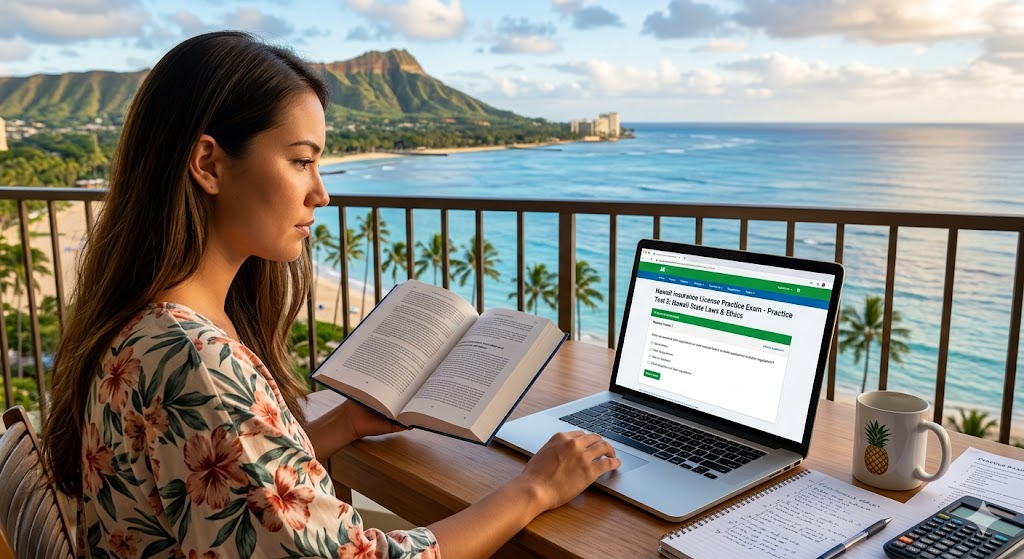
Additional Information
What the Course Entails and Exam Details
To pass the Hawaii Insurance licensing exam, candidates must master a curriculum that blends general insurance concepts with specific Hawaii state regulations. A comprehensive preparation course usually includes the following core topics:
General Insurance Principles: Understanding risk, types of insurers, contract law principles (offer, acceptance, consideration, etc.), and the different categories of insurance policies.
State-Specific Laws and Rules: In-depth knowledge of the Hawaii Revised Statutes (HRS) and Hawaii Administrative Rules (HAR) pertaining to insurance. This includes the powers of the Insurance Commissioner, producer licensing requirements, unfair trade practices, and consumer protection laws.
Lines of Authority Knowledge: Specific modules based on the license you seek (e.g., Life insurance types, health plan provisions, property valuation methods, or casualty liability concepts).
Ethics and Fiduciary Duty: The ethical responsibilities a producer owes to clients, insurers, and the state, including proper handling of premiums and disclosures.
What to Expect in the Final Exam
The actual Hawaii Insurance licensing exam is a formal, computer-based test conducted at secure testing centers. Here is a breakdown of what to expect:
Exam Format: The final licensing exam consists entirely of multiple-choice questions.
Time Limits: Candidates are allocated a specific time limit to complete the exam, which varies depending on the line of authority being tested. Typical time frames range from two to four hours.
Passing Score: To successfully pass the exam, candidates must achieve a minimum scaled score of 70. This score is calculated to ensure consistency across different versions of the test.
No Resources: The exam is a closed-book test; no study materials, phones, or external notes are allowed in the testing area.
How to Study and Exam Centers
Preparation is the absolute key to success. Here are actionable strategies:
Utilize Practice Exams: Take multiple practice exams. This helps build testing stamina and identifies knowledge gaps. Review every incorrect answer thoroughly.
Complete Pre-Licensing Education: Enroll in a state-approved pre-licensing education course from an authorized provider. These courses are mandatory in Hawaii and will provide the foundational curriculum you need.
Study the State Candidate Handbook: Pearson VUE, the current exam administrator for Hawaii, provides a Candidate Handbook containing the complete content outline and specific state laws. Treat this as your primary study guide.
Schedule Your Exam: Hawaii insurance licensing exams are administered by Pearson VUE. You can register and schedule your exam through their online portal. Exams are typically taken at physical Pearson VUE testing centers located on the major islands or at authorized school locations.
Job Opportunities from the Course
Earning your insurance license in Hawaii opens the door to numerous dynamic and potentially lucrative career paths in the financial services sector, including:
Licensed Insurance Producer: The most common path, allowing you to sell a variety of insurance products directly to individuals and businesses.
Independent Insurance Agent: Operating your own agency or working for one that represents multiple insurance carriers, offering clients more choices.
Captive Insurance Agent: Working exclusively for one insurance company, selling only that carrier's products.
Insurance Broker: Actively representing clients, rather than insurers, to find the best possible coverage options.
Claims Adjuster/Examiner: (Note: Adjusting might require a different license classification in some cases, but a producer license is a strong foundation).
Insurance Underwriter: Evaluating risks to determine if an applicant should receive coverage.
Frequently Asked Questions
Reviews
5.0
Based on 0 reviews
Leave a Review
No reviews yet. Be the first to review!