
Hawaii MPJE Practice Test
$69.00
- Buy to unlock unlimited access to all Quiz questions and Answers in this Quiz.
- After purchase you can print a PDF of the whole quiz at any point. The PDF will contain the questions and the correct answers.
About this Exam
The Hawaii Multistate Pharmacy Jurisprudence Examination (MPJE) is a mandatory assessment for pharmacists seeking licensure within the state. The actual Hawaii MPJE (not just a practice test) is the real hurdle. Our comprehensive article and practice test structure are specifically designed to prepare you for this exact challenge. The real exam, which a practice test meticulously mimics, is for individuals who want to practice as licensed pharmacists in Hawaii. It evaluates your comprehensive understanding of the federal laws, state laws, and regulations that govern the practice of pharmacy in Hawaii. This legal knowledge is not just a regulatory requirement; it’s a cornerstone of responsible and effective pharmacy practice, ensuring consumer safety, legal compliance, and the highest professional standards. Pharmacy graduates from accredited institutions, including both home and foreign students, must pass the Hawaii MPJE as part of the state's rigorous licensing process. This study guide and our realistic Hawaii MPJE Practice Exam environment are designed to streamline your study and increase your confidence.
Ready to test your knowledge?
Buy Now to Access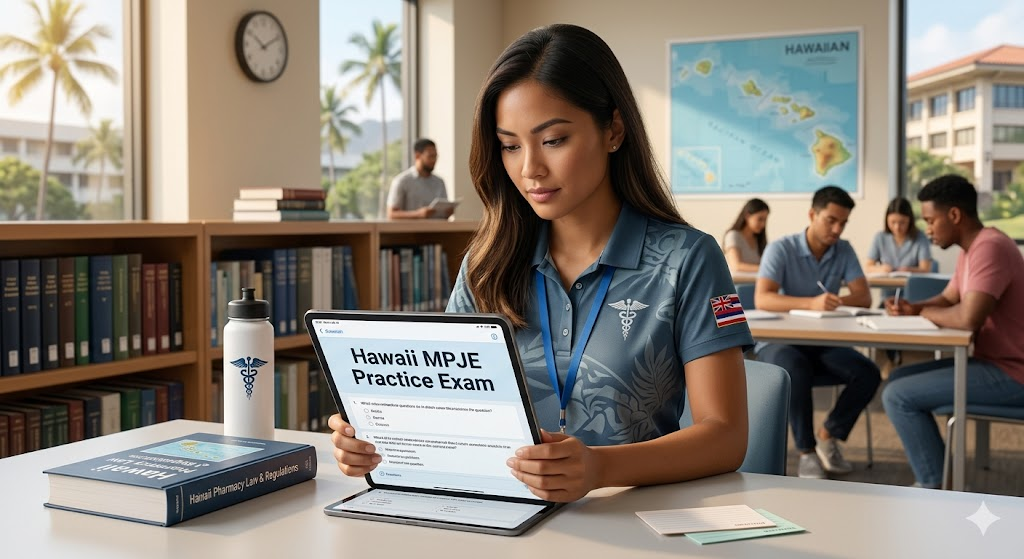
Additional Information
What the Course Entails and Exam Details
This preparation guide and practice test (referred to loosely as the "course" structure the information, but there is no specific required course other than your professional pharmacy education) cover the intricate blend of federal and state pharmacy laws that apply to practice within Hawaii. The areas you need to master, and which are reflected in our Hawaii MPJE Practice Exam and actual exam domains, include:
Pharmacy Practice: This extensive area encompasses the interpretation, preparation, and dispensing of prescriptions; prescription monitoring and reporting; drug utilization reviews; counseling duties; collaborative practice agreements; vaccinations and immunizations; and pharmacist-prescriber relationships. It is a dominant part of both state and federal rules and a major section on the Hawaii MPJE.
Licensure, Registration, and Regulatory Requirements: You must understand the rules regarding the licensing of pharmacists, pharmacy technicians, and the permits for different types of pharmacies in Hawaii. This also covers continuing education (CE) requirements, state board operations, record-keeping, discipline, and facility requirements.
Controlled Substances: This critical section covers the proper handling, distribution, prescribing, and record-keeping for controlled substances. You will need to distinguish between federal schedules and potential unique Hawaii state schedules, handling and disposal regulations, and severe penalties for non-compliance.
Dispensing Requirements and Pharmacy Operations: This covers day-to-day operational laws such as generic substitution rules, prescription refills, specific labeling requirements, and the distinct rules and records for different types of prescriptions, and compounding regulations as they relate to state and federal law.
Stricter Law Principle: A key concept you must internalize is that pharmacists are always bound by the stricter of the state or federal law. Our practice material reinforces this logic.
Prepare by thoroughly studying the Hawaii Revised Statutes Chapter 461 and Hawaii Administrative Rules Title 16, and the corresponding federal laws. The actual Hawaii MPJE will assess your ability to apply these laws in real-world scenarios, making dedicated preparation with tools like a high-quality Hawaii MPJE Practice Exam an absolute necessity.
What to Expect in the Final Exam
While the exact details can vary slightly by year and jurisdiction, the actual, final Hawaii MPJE typically follows a established format:
Exam Format: The exam is a standardized computer-adaptive test (CAT). This means that the difficulty of the questions you receive will adapt based on your answers to previous questions, ensuring that you are adequately challenged and that the assessment is as precise as possible. The vast majority of the questions are selected-response, which commonly include multiple-choice options with a single best answer or sometimes questions that require you to "select all that apply." Once you submit an answer, you are unable to return and change it, requiring careful consideration before moving forward.
Total Questions and Time Limit: You can expect approximately 120 multiple-choice questions on the actual exam. While only 100 of these questions typically count toward your final score (the remaining 20 are pretest questions that do not affect your score and look identical), you should treat every question as if it is scored. The typical time limit is around 2.5 hours, providing a realistic assessment of both your knowledge and your time management skills, similar to the experience we seek to replicate in our realistic Hawaii MPJE Practice Exam mode.
Passing Score: The minimal passing requirement for the Hawaii MPJE is generally a scaled score of 75. A scaled score converts your raw score based on the difficulty of the questions you answered. It is designed to represent a fixed level of performance across different forms of the exam. Rest assured that passing this exam is a standard requirement, and thorough study, combined with consistent practice using tools like a high-quality Hawaii MPJE Practice Exam, can help you reach and exceed this goal.
Registration and Restrictions: To take the actual exam, you must typically register with the National Association of Boards of Pharmacy (NABP) and schedule your appointment at an authorized test center, usually via Pearson VUE. Candidates should be aware of stringent test day rules regarding ID requirements, personal belongings, and scheduling procedures. Candidates are typically permitted up to five attempts per jurisdiction, but hopefully with proper preparation including consistent use of our realistic Hawaii MPJE Practice Exam, you'll succeed on your first try.
Utilizing a comprehensive study guide and multiple high-quality practice exams can significantly improve your performance on test day by familiarizing you with the format, timing, and question types. Our Hawaii MPJE Practice Exam is designed to replicate these key features for your benefit.
How to Study and Exam Centers
Effective preparation for the Hawaii MPJE is a key component to your licensure journey. We encourage a strategic approach:
Start with the Source: Directly download and meticulously read the Hawaii pharmacy statutes and regulations (HRS Chapter 461, HAR Title 16). These are your primary resources and the fundamental information you must master.
Study Federal Laws: Do not neglect the underlying federal laws such as the Controlled Substances Act, the Federal Food, Drug, and Cosmetic Act, and HIPAA regulations. Your preparation material should cover these comprehensively and how they interact with state laws.
Utilize High-Quality Practice Tests: This is absolutely crucial! Regularly engage with realistic practice questions and full-length simulated Hawaii MPJE Practice Exams. Quality practice tests, like the one this study guide supports, provide realistic simulations of the real CAT-format and question style. This practice is vital for identifying knowledge gaps, improving question-answering speed, and reducing anxiety about the actual testing environment and structure. A robust bank of Hawaii MPJE Practice Exam questions will provide invaluable familiarity.
Practice Stricter Law Interpretation: Consistently work through scenarios where both state and federal laws apply, explicitly reasoning through which law is stricter and must be followed. This is a common and essential type of problem on the exam.
Focus on Key Numbers and Limits: Pay close attention to specifics – number of refills, specific documentation timelines, quantity limits for certain substances, required retention periods for records, and licensure requirement numbers. These details are frequently tested. Our Hawaii MPJE Practice Exam and flashcards often reinforce these crucial details.
Maintain a Schedule: Create a consistent study plan that breaks down your study materials into manageable segments and allows for dedicated practice time with full mock exams using a realistic Hawaii MPJE Practice Exam.
Exam Centers and Registration:
NABP: The registration process for the actual Hawaii MPJE is primarily handled through the NABP (National Association of Boards of Pharmacy). You must create an NABP e-Profile, fulfill eligibility requirements, and then register and pay for the exam.
Pearson VUE: The actual test is administered at Pearson VUE testing centers. These centers are located within Hawaii (typically on multiple islands for accessibility) and at other selected locations. You will select a specific testing center and appointment time during the scheduling process after your NABP registration is complete.
Scheduling and Flexibility: Be mindful of scheduling well in advance, especially during popular testing periods, as slots can fill up. Rescheduling or cancellation policies are through Pearson VUE and NABP, so be sure to understand and adhere to their requirements.
By combining solid content knowledge from reliable study materials and source laws with extensive practice through realistic Hawaii MPJE Practice Exams, you'll build the confidence and skill necessary to succeed in your licensure goal.
Job Opportunities from the Course
Successfully passing the real Hawaii MPJE and obtaining your licensed pharmacist certification opens a wide array of career paths in the vibrant healthcare landscape of Hawaii. As a newly licensed pharmacist, your opportunities include:
Community Pharmacist (Staff/Manager): Dispensing prescriptions, providing patient counseling, and managing pharmacy operations in independent pharmacies, major retail chains, or grocery store pharmacies across the Hawaiian islands.
Hospital Pharmacist (Operations/Clinical): Working in diverse roles within hospitals, managing medication distribution systems, reviewing patient charts, and participating in multidisciplinary healthcare teams to optimize therapy.
Clinical Pharmacist Specialist: Specializing in areas such as oncology, ambulatory care, infectious diseases, or critical care, working in clinics and medical centers.
Compounding Pharmacist: Utilizing specialized skills to prepare customized medications, including sterile and non-sterile compounding, adhering to complex state and federal regulations.
Regulatory Affairs Specialist: Ensuring that pharmacy operations and drug-related processes within healthcare facilities or companies comply with intricate state and federal laws and regulations.
Managed Care Pharmacist: Working with health insurance plans, managing formularies, reviewing medication requests, and participating in disease management programs.
Pharmacy Consultant: Providing expert advice on pharmacy practice, legal compliance, and medication safety to long-term care facilities, healthcare organizations, or corporate pharmacies.
Academia (Faculty): Teaching pharmacy students, conducting research, and providing professional development in accredited colleges of pharmacy.
Nuclear Pharmacist: Specializing in the preparation and dispensing of radioactive drugs, which often requires specific additional certification.
Industry Pharmacist: Pursuing diverse roles within pharmaceutical companies in areas such as medical affairs, research and development, clinical trials, or regulatory affairs (though industry roles might be fewer in the state, they are growing).
Your newly acquired license and your demonstrated legal expertise, confirmed by your success on the real exam for which you have prepared so diligently with your source materials and high-quality Hawaii MPJE Practice Exams, will be invaluable across these dynamic sectors, making your comprehensive preparation an essential investment in your future.
Start your focused study today, leverage our Hawaii MPJE Practice Exam resources, and feel confident in your preparation for the legal knowledge vital to practicing as a successful, ethical pharmacist in Hawaii. Good luck!
Frequently Asked Questions
Reviews
5.0
Based on 0 reviews
Leave a Review
No reviews yet. Be the first to review!