
Hawaii Real Estate Salesperson Practice Exam
$69.00
- Buy to unlock unlimited access to all Quiz questions and Answers in this Quiz.
- After purchase you can print a PDF of the whole quiz at any point. The PDF will contain the questions and the correct answers.
About this Exam
Embarking on a career in Hawaii’s real estate industry requires dedication, local knowledge, and the successful completion of the Hawaii Real Estate Salesperson Licensing Exam. This critical step is designed for aspiring real estate agents who wish to operate legally and ethically within the state, facilitating property transactions for clients. The examination assesses whether candidates possess the necessary competence, understanding of general real estate principles, and specific knowledge of Hawaii’s unique laws and regulations. Achieving this license opens the door to a dynamic and potentially lucrative career in one of the world's most desirable locations.
Ready to test your knowledge?
Buy Now to Access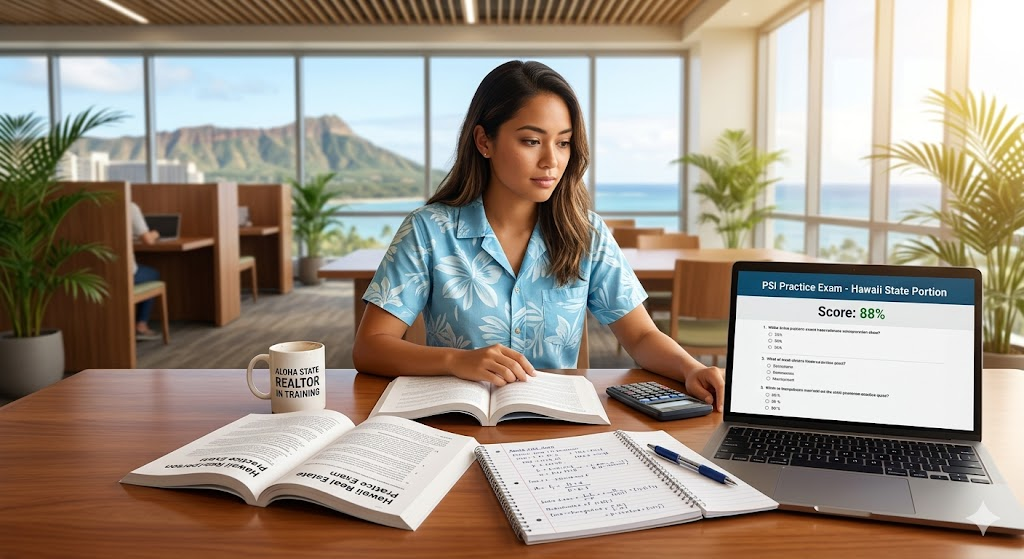
Additional Information
What the Course Entails and Exam Details
The journey to licensure begins with completing a comprehensive 60-hour pre-licensing education course. This course is a mandatory prerequisite and covers a diverse range of topics, ensuring that future real estate professionals are well-equipped. Core content usually includes fundamental real estate principles such as property ownership types, land use controls, and the practical application of agency relationships. Additionally, you will delve into financing methods, property valuation, real estate calculations (math), and standard real estate contracts, with a significant emphasis on Hawaii-specific standard forms. Ethics and professional conduct are also key pillars of the syllabus.
The final licensing exam is divided into two distinct sections. The Uniform (or General) portion focuses on national real estate principles and practices, testing your understanding of concepts applicable across the United States. The Hawaii State portion is exclusively dedicated to the specific laws, rules, and regulations governing real estate transactions in Hawaii. This section covers crucial local details such as professional practices, disclosing material facts, state land utilize controls, local property types like leasehold and CPRs (Condominium Property Regimes), property management, and the nuances of the escrow and closing processes within the islands. A strong foundation in the material covered in your pre-licensing course is essential for success in both exam sections.
What to Expect in the Final Exam
Prepare yourself for a thorough and structured examination experience. The Hawaii Real Estate Salesperson Licensing Exam, currently administered by PSI, is typically a multiple-choice format. The overall exam consists of 130 questions in total: 80 questions dedicated to the national portion and 50 questions focused on Hawaii-specific content. You will have a total of four hours to complete the examination, with specific time limits allotted to each section (usually 2.5 hours for the national part and 1.5 hours for the state part). To achieve a passing score, you must score at least 70% in each section. This means you need to correctly answer 56 out of 80 on the national portion and 35 out of 50 on the Hawaii-specific portion.
The testing environment is formal and standardized. Candidates are required to bring two forms of valid identification, and specific rules regarding personal belongings, including dynamic electronic devices, are strictly enforced. You will generally have access to an online or testing-center-provided calculator for the calculation portion of the exam. The exam covers complex legal concepts and requires practical application, making robust preparation through diverse study methods crucial. If you pass one section but fail the other, you may only need to retake the failed section within a two-year window, provided your pre-licensing school completion certificate remains valid. Passing this exam is a moment of celebration and the direct pathway to applying for your official Hawaii Real Estate Salesperson license.
How to Study and Exam Centers
Effective preparation is paramount. First, ensure you complete an approved 60-hour pre-licensing course and obtain your school completion certificate. Leverage the course materials, including textbooks, study guides, and all resources provided by your education provider. Focus on understanding the core concepts and not just memorizing. Actively using practice exams, such as the comprehensive one implied by this study guide’s theme, is invaluable. This helps you familiarize yourself with the question style, manage your time effectively, and identify specific areas that require further review. Create flashcards for tricky terms, definitions, and Hawaii-specific laws. Real estate mathematics can be challenging, so practice calculations regularly to build confidence. Utilize official candidate handbooks and outlines from the testing agency (PSI) to understand exactly what to expect.
To register for the actual exam, you must create an account and schedule your test through the official PSI website or an approved platform. Pay the required exam fee during the registration process. Hawaii offers several testing center locations throughout the islands, including Honolulu on Oahu, and centers on Kona, Maui, and Kauai. Make sure to choose a location and time slot that is convenient for you. It is essential to arrive early on the day of your exam with the necessary identification, and to be well-rested and prepared to focus. Remote proctoring options may also be available under certain conditions, offering additional flexibility. Always verify the most current details, rules, and testing centers through the official Hawaii Real Estate Commission and PSI channels. Success requires a dedicated study plan and confident execution on test day.
Job Opportunities from the Course
A Hawaii Real Estate Salesperson License opens up an exciting array of career paths within the dynamic real estate sector. Here are some key job titles and roles this licensing course and exam preparation unlocks:
Real Estate Agent: The most common path, this involves representing buyers, sellers, or both in property transactions, providing expert guidance, and earning commissions on successful sales.
Residential Salesperson: Specializing in single-family homes, condominiums, and townhouses, helping clients find their perfect home or successfully market their property.
Commercial Real Estate Salesperson: Focusing on the sale or lease of commercial properties, such as office spaces, retail buildings, and industrial sites, often working with businesses and investors.
Property Manager: Overseeing the day-to-day operations of rental properties (residential or commercial), handling leasing, tenant relationships, maintenance, and financial reporting. A license is typically required in Hawaii for certain property management functions.
Leasing Agent: Assisting landlords and property managers by marketing vacant rental units, showing properties to prospective tenants, and facilitating the leasing process.
Real Estate Consultant/Advisor: Providing specialized knowledge and analysis to individuals or organizations on real estate investment decisions, market trends, and property values.
Path to Real Estate Broker: While a separate license and additional experience/education are required, this salesperson license is the foundational stepping stone on the ultimate path to becoming a Real Estate Broker, who can run their own brokerage or employ other agents.
This guide is your comprehensive starting point. Best of luck with your studies and with achieving your dreams in Hawaii’s real estate market!
Frequently Asked Questions
Reviews
5.0
Based on 0 reviews
Leave a Review
No reviews yet. Be the first to review!