
Hazard Communication (HazCom) Practice Exam
$69.00
- Buy to unlock unlimited access to all Quiz questions and Answers in this Quiz.
- After purchase you can print a PDF of the whole quiz at any point. The PDF will contain the questions and the correct answers.
About this Exam
Welcome to your essential first step toward mastering chemical safety and regulatory compliance in the workplace. The Hazard Communication (HazCom) training and subsequent examination are designed to ensure employees understand the dangers of hazardous chemicals they may work with. This program is based on OSHA's Hazard Communication Standard (HCS), 29 CFR 1910.1200, often referred to as the "Right to Know" standard.
This certification is designed for a broad audience. It is critical for general industry employees, construction workers, manufacturing staff, laboratory personnel, supervisors, and healthcare workers who have potential exposure to hazardous chemical substances. Obtaining this certification demonstrates that an individual can recognize chemical hazards, interpret labels, and access vital safety information, thereby creating a safer working environment for everyone. Using a HazCom Practice Exam is the most effective way to validate your knowledge before taking the official assessment.
Ready to test your knowledge?
Buy Now to Access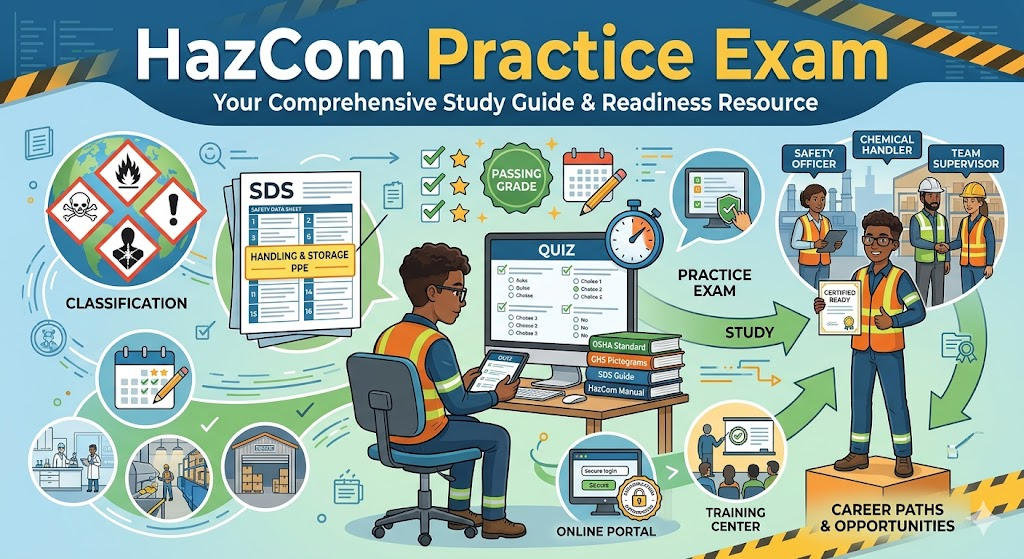
Additional Information
What the Course Entails and Exam Details
A comprehensive HazCom course provides foundational knowledge on how to identify, evaluate, and control chemical exposure hazards. The course ensures that the language of chemical safety is universal and clear, often incorporating the Globally Harmonized System of Classification and Labelling of Chemicals (GHS).
The core curriculum covered includes:
Understanding the HazCom Standard: The history and requirement of OSHA’s "Right to Know" regulations.
Chemical Classification: Identifying physical hazards (like flammability or reactivity) and health hazards (like toxicity or carcinogenicity).
The Globally Harmonized System (GHS): Mastering the standardized approach to chemical classification and hazard communication.
Labeling Requirements: Interpreting signal words, hazard statements, precautionary statements, product identifiers, and the required GHS pictograms.
Safety Data Sheets (SDS): Understanding the format and detailed content of all 16 sections of an SDS, from identification to disposal considerations.
Employee Training Requirements: Knowing what employers are required to provide regarding chemical training and information access.
The associated exam validates your competency in these core areas through a series of knowledge-based questions. By focusing on a detailed review of these topics during your preparation and using a robust HazCom Practice Exam, you can ensure your readiness for the real test.
What to Expect in the Final Exam
While HazCom assessments can vary slightly depending on the specific training provider (such as OSHA 10/30-hour cards, individual company training, or third-party safety organizations), there are common formats you should expect. The examination is designed to test recall and practical application of the HCS guidelines.
The final exam typically includes:
Format: Multiple-choice, true/false, and sometimes matching questions (especially for GHS pictograms).
Number of Questions: Often ranges from 20 to 50 questions, depending on whether it is a standalone module or part of a larger course.
Passing Score: A passing score is frequently between 70% and 80%.
Time Limits: Generally, time is ample, with 30 to 60 minutes usually allotted for the assessment, though many users finish much sooner.
Special Rules: The official exam is often closed-book, meaning you must memorize GHS pictograms and the major sections of an SDS. However, the exam is intended to be practical; questions focus on interpreting real-world labels or reading an excerpt from a sample SDS.
Preparing with a comprehensive HazCom Practice Exam helps you familiarize yourself with these distinct question styles and time constraints.
How to Study and Exam Centers
Effective preparation is key to succeeding on your HazCom assessment. Your study strategy should focus on both active recall and practical application of the safety standards.
We recommend the following actionable study methods:
Review the Regulations: Read OSHA Fact Sheets and the official summaries of 29 CFR 1910.1200.
Memorize GHS Pictograms: Use flashcards to learn the nine GHS health, physical, and environmental hazard pictograms.
Study Sample SDS: Select two or three common workplace chemicals (like bleach or isopropyl alcohol) and read their Safety Data Sheets section by section.
Use the HazCom Practice Exam: Take several practice tests to identify your weak points. Practice interpreting sample labels and identifying SDS sections quickly.
How and Where to Take the Exam
Because HazCom training is mandatory for employers to provide, the examination is usually integrated into a recognized safety training program.
Authorized Online Portals: The most common method. Many students take the exam through OSHA-authorized online training providers, such as OSHAcademy, ClickSafety, or 360training, which issue recognized completion certificates.
Authorized Schools and Training Centers: Some technical colleges, trade schools, and union halls offer in-person OSHA safety courses that include the HazCom assessment.
Employer-Sponsored Training: Many large organizations manage their own training via an internal Learning Management System (LMS). Your supervisor or HR department will provide access to the course and the final test. This is typically not administered through general test centers like Pearson VUE, but rather directly via the training provider's platform.
Job Opportunities from the Course
A HazCom certification—often gained through comprehensive OSHA safety training—is not just about compliance; it is a vital resume-builder that demonstrates your commitment to safety. Nearly every industry that handles chemicals, from cleaning supplies to industrial manufacturing, requires employees who understand these standards.
This training unlocks and enhances many job opportunities, including the following specific job titles:
General Industry: Warehouse Associate
General Industry: Production Operator
Construction: General Laborer
Construction: Painter
Construction: Welder
Manufacturing: Chemical Mixer/Batch Processor
Healthcare: Laboratory Technician
Healthcare: Environmental Services (EVS) Staff
Maintenance and Operations: Facilities Custodian
Maintenance and Operations: HVAC Technician
Safety and Compliance: EHS (Environmental Health and Safety) Coordinator
Safety and Compliance: Safety Officer
Leadership: Frontline Supervisor
Transportation: Fleet Mechanic
Transportation: Dangerous Goods Handler
By completing this course and passing the exam, you make yourself an asset to any employer focused on maintaining a safe, regulation-compliant work environment. Good luck on your HazCom Practice Exam and your journey to becoming a safety leader in your field.
Frequently Asked Questions
Reviews
5.0
Based on 0 reviews
Leave a Review
No reviews yet. Be the first to review!