
Hazardous Locations Practice Exam
$69.00
- Buy to unlock unlimited access to all Quiz questions and Answers in this Quiz.
- After purchase you can print a PDF of the whole quiz at any point. The PDF will contain the questions and the correct answers.
About this Exam
The [Hazardous Locations Practice Exam] is an invaluable tool for professionals aiming to solidify their understanding of the critical safety requirements for working in and designing for potentially explosive atmospheres. This practice exam is designed for engineers, electrical technicians, safety officers, inspectors, project managers, and anyone else who must navigate the complex world of hazardous area classification and equipment standards. Mastering these concepts is essential not only for passing professional certification exams but also for ensuring the safety of personnel and facilities in high-risk industries like oil and gas, chemical processing, mining, and grain handling.
Ready to test your knowledge?
Buy Now to Access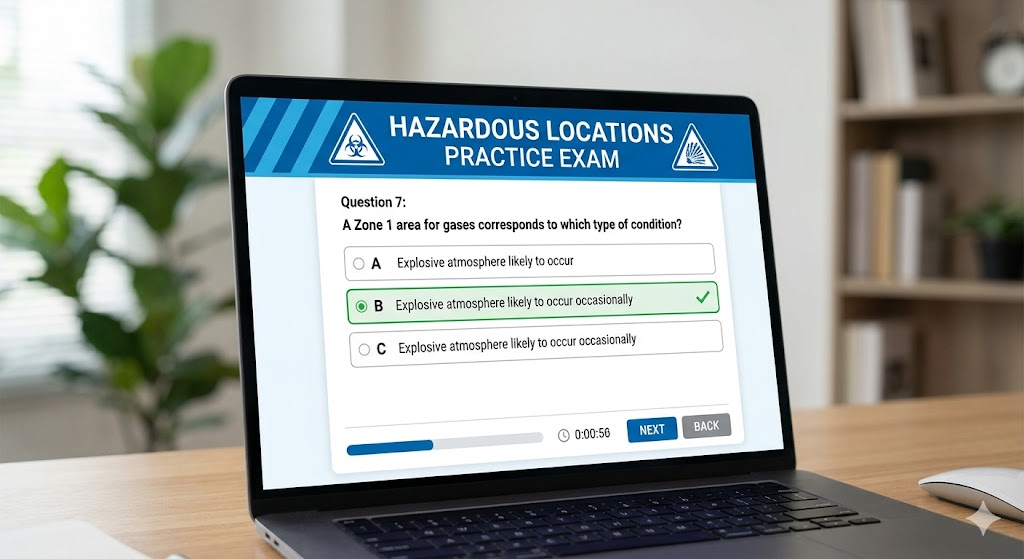
Additional Information
What the Course Entails and Exam Details
This comprehensive practice resource delves into the core topics and essential skills necessary to operate safely and compliantly within hazardous locations.
While the exact syllabus can vary based on specific certifying bodies (such as ATEX in Europe or IECEx internationally), the typical areas covered in both a comprehensive course and this practice exam include:
Understanding Explosive Atmospheres: Identifying the different types of hazards, such as flammable gases, vapours, mist, and combustible dusts, and the conditions required for ignition.
Area Classification: Learning the distinct zone systems (e.g., Zones 0, 1, 2 for gases, and Zones 20, 21, 22 for dusts) and the conditions under which an explosive atmosphere is likely to occur.
Equipment Protection Methods: Detailed knowledge of various standardized protection techniques, including Intrinsic Safety (Ex i), Flameproof (Ex d), Increased Safety (Ex e), Purging/Pressurization (Ex p), and encapsulation (Ex m).
Standards and Regulations: Familiarity with key international standards like IEC 60079 series and EN standards, as well as critical regional regulations like the European ATEX Directive (2014/34/EU and 1999/92/EC) or relevant national electrical codes.
Marking and Identification: Decoding equipment marking to understand its classification, protection level (EPL), gas/dust group, and temperature class.
Installation and Maintenance: Applying proper practices for the installation, inspection, testing, and upkeep of equipment in these specialized environments.
What to Expect in the Final Exam
While individual certification programs vary, a typical final exam for a foundational hazardous locations certification often involves a combination of theoretical knowledge and, in some cases, practical assessment. You can generally expect the following:
Exam Format: The theoretical portion is frequently administered via multiple-choice questions, which test your understanding of principles, definitions, standards, and scenarios. Practical components, if included (common in more advanced or craft-specific modules like CompEx or specific IECEx units), might require demonstrating skills like gland termination or equipment inspection.
Time Limits: A typical multiple-choice exam might last 60 minutes for a foundational level.
Passing Score Requirements: Passing scores often range between 70% and 80%, indicating a solid grasp of the subject matter. Always check the specific requirements of the certification body you are testing with.
Rules: Expectations are set for standard computerized or proctored exam conditions, including bans on external aids, requiring photo identification, and adhering to strict anti-cheating protocols.
How to Study and Exam Centers
Preparation is key to succeeding in any professional examination. We recommend the following strategies:
Leverage this Practice Exam: Use [Hazardous Locations Practice Exam] repeatedly to test your knowledge, identify weak areas, and become comfortable with the types of questions and formatting you will encounter in the actual exam.
Study Official Materials: Utilize the official study guides, reference standards (like the IEC 60079 series), and training manuals provided by the certifying body or authorized training providers.
Understand, Don't Just Memorize: Focus on understanding the principles behind the rules and classifications. Apply your knowledge to real-world scenarios to ensure practical understanding.
Review Weak Areas: After taking practice tests, meticulously review the areas where you struggled and revise the corresponding study material.
Exam Centers:
For the final certification exam, you will typically need to test at an authorized location, which could be:
Authorized Training Providers & Schools: Many major certifications require attendance at or testing through their accredited training centers.
Computerized Testing Centers: Major global providers like Pearson VUE often host computerized theoretical exams for various professional certifications.
Specific Certifying Body Portals: Some bodies may have their own physical centers or even secure online proctoring options for theoretical parts.
Always confirm the authorized testing method and locations with the specific certification body (e.g., CompEx, ExVeritas, regional electrical authorities, individual IECEx CBs) you are seeking certification from.
Job Opportunities from the Course
A certification in hazardous locations opens doors to a diverse range of challenging and rewarding roles across multiple safety-critical industries. The specialized knowledge and demonstrated competence acquired are highly valued and can unlock numerous career paths, including:
Hazardous Area Electrical Technician
Hazardous Locations Engineer
Safety Officer / EHS Specialist
Hazardous Area Inspector / Surveyor
Plant Maintenance Manager in High-Risk Zones
Ex Equipment Design Engineer
Quality Assurance Specialist for Ex Manufacturers
Technical Procurement Officer for Specialist Equipment
Oil and Gas Electrical Supervisor
Chemical Plant Safety Manager
Mining Electrical and Safety Lead
Pharmaceutical Industry Maintenance Lead (Ex Areas)
Grain Handling Facility Safety Coordinator
This practice exam is your first significant step towards demonstrating proficiency in this vital field, enhancing your career prospects, and contributing directly to safer industrial operations worldwide. Good luck with your studies!
Frequently Asked Questions
Reviews
5.0
Based on 0 reviews
Leave a Review
No reviews yet. Be the first to review!