
Hazardous Materials Technician (HMT) (47203W_02) Practice Exam
$69.00
- Buy to unlock unlimited access to all Quiz questions and Answers in this Quiz.
- After purchase you can print a PDF of the whole quiz at any point. The PDF will contain the questions and the correct answers.
About this Exam
The Hazardous Materials Technician (HMT) certification is a crucial qualification for professionals who respond to emergencies involving hazardous substances or who manage these materials in industrial and environmental settings. It is designed for firefighters, industrial emergency response team members, environmental specialists, safety officers, and anyone tasked with managing and mitigating incidents involving dangerous goods. Achieving this level of competency demonstrates a significant understanding of the risks, procedures, and safety measures required when dealing with materials that pose a threat to people, property, and the environment. This study guide is specifically tailored to help you prepare effectively for your HMT (47203W_02) Practice Exam, a valuable tool on your path to full HMT certification.
Ready to test your knowledge?
Buy Now to Access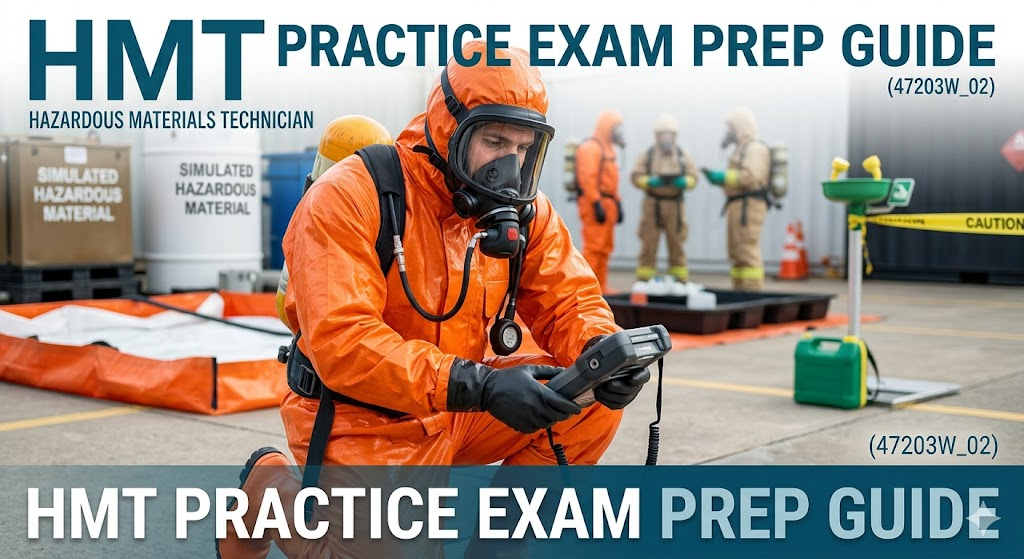
Additional Information
What the Course Entails and Exam Details
A comprehensive Hazardous Materials Technician course, which this practice exam helps validate, covers an extensive syllabus of critical knowledge and practical skills. Students can expect to delve into areas such as:
Regulations & Standards: Understanding OSHA’s HAZWOPER (1910.120), EPA regulations, DOT requirements for transportation, and relevant NFPA standards (like NFPA 472 or the consolidated NFPA 470).
Personal Protective Equipment (PPE): Mastering the selection, use, maintenance, and limitations of varying levels of PPE (Levels A, B, C, and D).
Incident Command System (ICS): Effectively functioning within a recognized Incident Command and Unified Command structure during HMT operations.
Material Identification & Assessment: Identifying hazardous materials, understanding their physical and chemical properties, assessing hazards using detection, monitoring, and sampling equipment.
Atmospheric Hazards: Recognizing and monitoring for flammable, toxic, and oxygen-deficient atmospheres, including IDLH conditions.
Decontamination Procedures: Understanding and performing emergency, technical, and mass decontamination for victims and responders.
Mitigation & Spill Control: Applying appropriate offensive and defensive techniques to confine, contain, or neutralize hazardous materials releases.
Response Planning & Safety: Developing and executing incident action plans, prioritizing safety, and implementing exposure control measures.
Chemical Properties & Toxicology: Understanding the toxic effects of various hazardous materials and their implications for human health.
The specific exam related to the (47203W_02) Practice Exam is typically a written theory test. The final certification program may also include significant hands-on training and a separate practical skills assessment, but this practice exam primarily focuses on the knowledge-based portion. The length, number of questions, and specific passing requirements for the official certification exam can vary considerably depending on the certifying body, your specific jurisdiction, and the state, but are often robust and comprehensive.
What to Expect in the Final Exam
For the actual HMT certification theory exam, you should anticipate a challenging multiple-choice format designed to rigorously test your understanding of all core course topics. While details vary, official exams frequently consist of a substantial number of questions—often 100 or more—that must be answered within a specific time limit, typically ranging from two to three hours. A common passing score is in the realm of 70% to 80% to demonstrate adequate competence.
Expect the questions to range from direct knowledge recall of definitions, regulatory requirements, and standard operating procedures (SOPs) to more complex, scenario-based questions that require you to apply your knowledge to make safety-conscious decisions and choose correct actions in simulated emergency situations. Some exams may be computer-based, potentially utilizing online portals, while others are still delivered in a traditional paper-and-pencil format at physical testing locations. It's essential to confirm the exact format, question count, time limit, and passing criteria with your specific certifying agency or training provider. Be prepared to face strict rules regarding identification, permitted materials, and conduct, as integrity is paramount in these certifications.
How to Study and Exam Centers
Preparation is key to succeeding on both your practice exam and the final HMT certification test. Here are actionable study strategies and information on where to find testing opportunities:
Study Strategies:
Take Practice Exams Regularly: Use the Hazardous Materials Technician (HMT) (47203W_02) Practice Exam frequently. It's an excellent way to familiarize yourself with the type of questions asked, identify your strengths and weaknesses, and gauge your readiness. Review both correct and incorrect answers thoroughly.
Review Standard Reference Materials: Dedicate significant time to studying standard HMT reference texts, such as those published by IFSTA, Jones & Bartlett, and the official NFPA standards and OSHA guidance documents relevant to your jurisdiction. These are the foundations upon which exams are built.
Focus on Areas of Weakness: After taking practice tests, concentrate your efforts on the specific topics where you struggled. Don’t just memorize answers; strive to deeply understand the underlying principles and reasoning.
Understand Regulations and Standards: Pay close attention to relevant OSHA, EPA, DOT, and NFPA requirements, as these are heavily featured in both theory and practice. Knowing the why and how of compliance is crucial.
Practice with Sample Questions and Scenarios: Seek out and solve as many sample questions as possible. Practice analyzing different emergency scenarios to apply your knowledge effectively.
Form a Study Group: Group study can provide fresh perspectives, allow you to clarify concepts with peers, and help you stay motivated and accountable.
Seek Practical Training: If your certification program involves hands-on skills, actively participate and practice procedures whenever possible. Even for the theory exam, a solid understanding of practical application makes the theory more memorable and meaningful. Seek mentorship from experienced HMTs.
Exam Centers & Methods:
Accredited Training Providers: Most HMT training and certification exams are delivered through accredited organizations, which often include local or state fire academies, community colleges, or specialized private safety training schools. Contact your training provider to learn about their specific final exam procedures and locations.
State & Local Agencies: Relevant state emergency response commissions, fire bureaus, or environmental agencies frequently administer or oversee HMT certifications. Check their websites or contact them directly for official exam schedules and locations.
Online Testing Portals: For the written theory component, some certifying bodies utilize secure online testing platforms, which may offer flexibility in scheduling, sometimes with remote proctoring options. Information about this would typically be provided by your training program.
Physical Testing Sites: Many programs still utilize physical test centers for written exams, which can range from classrooms at training academies to authorized independent testing facilities. Specific locations will vary greatly by state and certifying body.
Registration & Information: For detailed and up-to-date information on exam scheduling, registration, applicable fees, location options (physical or online), and allowed materials, always consult the official website or contact office of your chosen certifying organization or the accredited training provider you are working with.
Job Opportunities from the Course
Earning your Hazardous Materials Technician (HMT) certification, validated by success on exams like the HMT (47203W_02), is a valuable credential that unlocks a diverse range of rewarding career paths across both the public and private sectors. This qualification is in high demand in numerous industries and emergency response organizations, reflecting the vital nature of the skills you will possess. Here are some of the specific job titles and career opportunities that this certification can significantly enhance or enable:
Hazardous Materials Technician (HMT)
Firefighter (HazMat Specialty)
Industrial Emergency Response Team Member
Environmental Specialist / Remediation Technician
Industrial Hygienist (HazMat elements)
Safety Officer / Safety Manager (with HazMat focus)
Dangerous Goods Transportation Specialist / Inspector
Chemical Plant Operator / Safety Personnel
Emergency Management Coordinator (HazMat)
HazMat Specialist (e.g., in state/federal environmental agencies)
Industrial Safety Consultant
Remediation Project Manager (Environmental)
Decontamination Specialist
Chemical Safety Inspector
By achieving your HMT certification, you demonstrate not only your technical expertise but also your commitment to safety, professionalism, and the protection of your community and environment, making you a strong candidate for these critical and often-dynamic roles.
Frequently Asked Questions
Reviews
5.0
Based on 0 reviews
Leave a Review
No reviews yet. Be the first to review!