
Hazmat First Responder Awareness (FRA) / First Responder Operations (FRO) Practice Exam
$69.00
- Buy to unlock unlimited access to all Quiz questions and Answers in this Quiz.
- After purchase you can print a PDF of the whole quiz at any point. The PDF will contain the questions and the correct answers.
About this Exam
The Hazmat First Responder Awareness (FRA) and First Responder Operations (FRO) certifications are critical credentials for individuals who may be the first to arrive at the scene of a hazardous materials incident.
These courses are designed for public safety personnel—including firefighters, law enforcement officers, emergency medical services (EMS) providers, and industrial response teams—who are expected to recognize the presence of hazardous materials and initiate the required protective actions.
The Awareness (FRA) level focuses on recognizing hazards, ensuring scene security, and notifying proper authorities.
The Operations (FRO) level builds upon this foundation, training responders to take defensive actions to protect people, property, and the environment from the release of hazardous substances without attempting to stop the leak itself.
This training ensures that first responders can operate safely and effectively during the initial phases of a hazmat emergency.
Ready to test your knowledge?
Buy Now to Access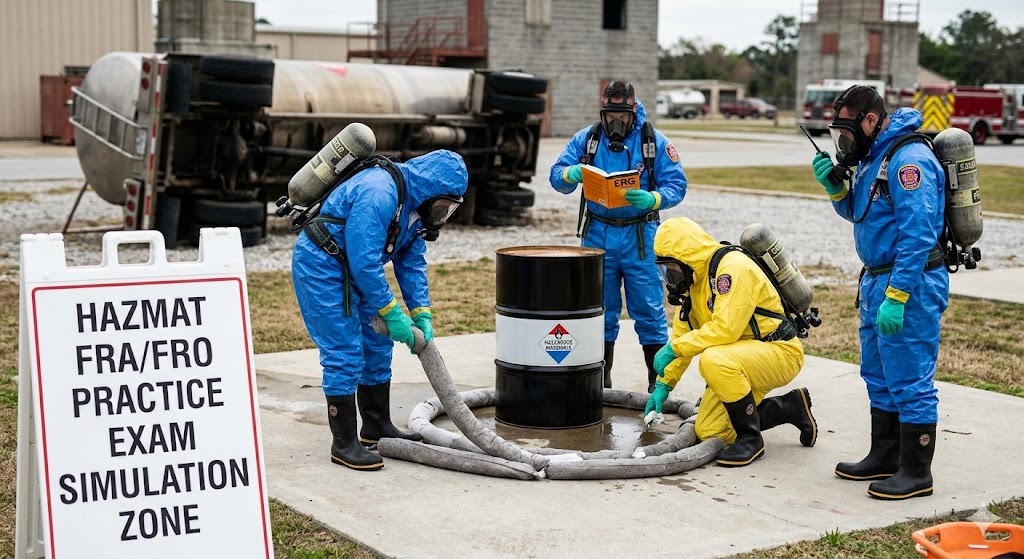
Additional Information
What the Course Entails and Exam Details
The FRA and FRO courses provide essential knowledge and skills based on OSHA’s Hazardous Waste Operations and Emergency Response (HAZWOPER) standard (29 CFR 1910.120) and NFPA 472/1072 standards.
Core topics covered in the training include:
Hazard Recognition and Identification: Using the Department of Transportation (DOT) placarding system, shipping papers, and the Emergency Response Guidebook (ERG).
Basic Toxicology and Risk Assessment: Understanding how hazardous materials affect the body and determining the potential impact of a release.
Scene Safety and Security: Establishing isolation zones, implementing protective actions, and initiating the Incident Command System (ICS).
Personal Protective Equipment (PPE): Understanding the limitations and proper use of dermal and respiratory protection available to first responders.
Defensive Control Measures (FRO only): Learning techniques like diversion, diking, damming, and vapor suppression to contain the spread of a release.
Decontamination Procedures: Basic emergency decontamination procedures for personnel and victims.
What to Expect in the Final Exam
The final exam for Hazmat FRA and FRO is designed to verify that students have met the requisite knowledge and competency levels required by OSHA and NFPA standards.
Format: The written exam typically consists of multiple-choice questions.
For the Operations level, there is often a practical skills evaluation required, where you must demonstrate competency in defensive tactics, using the ERG, and proper PPE donning.
Content: Questions focus on scenario-based problem-solving, interpreting placards and labels, utilizing the Emergency Response Guidebook (ERG), and understanding safety protocols.
Passing Score: Requirements can vary by certifying agency (e.g., state fire training academies), but a passing score of 70% or 80% is common.
Time Limit: Written exams are usually timed, typically allowing between 60 to 90 minutes.
How to Study and Exam Centers
Preparation is key to succeeding on the Hazmat FRA and FRO exams.
Here are actionable study strategies:
Master the ERG: The Emergency Response Guidebook is your most important tool.
Practice looking up chemicals using both the ID number (yellow pages) and the name (blue pages).
Be proficient in using the critical safety information in the orange guides and green tables.
Take Practice Exams: Utilize practice exams that mirror the format and content of the actual test.
Focus on understanding why an answer is correct, rather than just memorizing responses.
Review Scenario-Based Questions: Many exam questions are based on hypothetical emergency scenarios.
Practice applying the standard operating procedures (recognition, isolation, notification) to different situations.
Focus on Key Terms and Definitions: Be fluent in hazmat terminology, such as BLEVE (Boiling Liquid Expanding Vapor Explosion), LEL/UEL (Lower/Upper Explosive Limit), and the different routes of exposure.
Study Local and Federal Regulations: Understand the fundamental requirements of OSHA 1910.120(q) regarding the different levels of responder training.
Exam Centers:
The FRA and FRO exams are typically administered through state fire training academies, specialized emergency response training centers, or an individual’s employer (especially in industrial settings).
Some organizations offer these courses and exams online through accredited training portals.
You should check with your local fire department, EMS agency, or employer for information on authorized training providers and testing locations.
Job Opportunities from the Course
A Hazmat First Responder certification (especially at the Operations level) is essential or highly desirable for numerous public safety and industrial career paths.
These certifications are often mandatory prerequisites for employment and promotion within the emergency services sector.
Completion of this training unlocks or enhances career opportunities in the following roles:
Firefighter (Structural and Wildland)
Law Enforcement Officer (Police and Sheriff)
Emergency Medical Technician (EMT) and Paramedic
Industrial Safety Specialist
Environmental Health and Safety (EHS) Technician
Transportation and Logistics Safety Coordinator
Public Works Employee
Security Guard (at facilities handling hazardous materials)
Highway Patrol Officer
Frequently Asked Questions
Reviews
5.0
Based on 0 reviews
Leave a Review
No reviews yet. Be the first to review!