
HAZMAT Ops Practice Test
$69.00
- Buy to unlock unlimited access to all Quiz questions and Answers in this Quiz.
- After purchase you can print a PDF of the whole quiz at any point. The PDF will contain the questions and the correct answers.
About this Exam
The HAZMAT Ops (Hazardous Materials Operations) certification is a vital credential for emergency responders who arrive first at the scene of a potentially hazardous incident. Unlike the specialized technicians who perform offensive actions to stop a leak, "Operations-level" responders are trained to take defensive measures from a safe distance. Their primary goal is to recognize the danger, notify appropriate authorities, isolate the area, and implement containment and decontamination protocols to protect themselves, the public, and the environment. This certification is essential for firefighters, police officers, and many EMTs and industrial safety personnel, ensuring they can operate safely and effectively during the critical initial phases of a hazmat event.
Ready to test your knowledge?
Buy Now to Access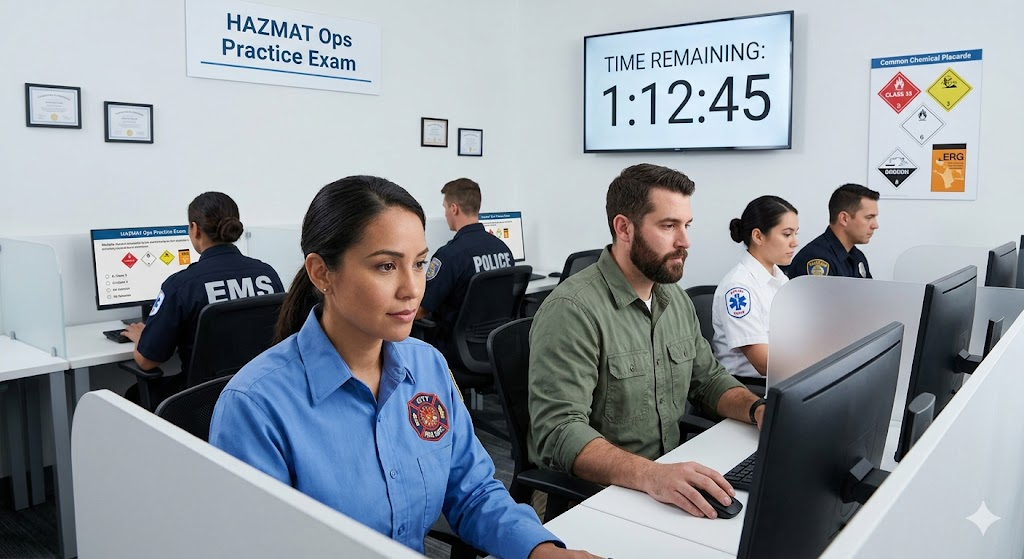
Additional Information
What the Course Entails and Exam Details
The HAZMAT Operations course builds upon the foundational knowledge of the prerequisite Awareness level. The curriculum, which can range from 24 to 40 hours of instruction, is heavily guided by OSHA's HAZWOPER regulations (29 CFR 1910.120) and NFPA standards 1072 or 470. Key subject areas covered include:
Hazard Recognition and Identification: Mastery of reading placards, labels, and shipping documents. Extensive training on utilizing the U.S. DOT Emergency Response Guidebook (ERG).
Physical and Chemical Properties: Understanding basics like boiling points, flammable limits, and reactivity to make quick, safe decisions.
Personal Protective Equipment (PPE): Selection, donning, doffing, and limitations of Level C and other relevant PPE.
Defensive Containment Strategies: Practical skills in diking, damming, diverting, and vapor suppression without directly coming into contact with the released substance.
Decontamination Procedures: Establishing and managing emergency and mass decontamination lines.
Incident Command System (ICS): Understanding roles within a unified command structure.
The final certification involves passing both a cognitive written exam and a series of practical, hands-on skills tests.
What to Expect in the Final Exam
The final certification exam typically consists of two distinct components that candidates must pass individually.
Written Examination:
Format: A multiple-choice, computer-based or paper-and-pencil test.
Number of Questions: Often ranges from 50 to 100 questions.
Time Limit: Generally allowed between 60 and 90 minutes.
Passing Score: Most accredited bodies require a minimum score of 70% to pass.
Practical Skills Assessment:
Format: Evaluated "skills stations" where candidates must demonstrate competency in practical tasks.
Required Skills: Common skills include setting up a decontamination corridor, performing a simulated diking operation, and properly using the ERG and specific detection equipment. Candidates are evaluated on a pass/fail basis.
Prerequisite: Candidates must possess a current HAZMAT Awareness certification.
Upon successful completion of both the written and practical components, the candidate receives their HAZMAT Operations certification, which is recognized nationally and by major accrediting bodies like IFSAC (International Fire Service Accreditation Congress) or ProBoard.
How to Study and Exam Centers
Preparation for the HAZMAT Ops exam requires a blended approach to master both the knowledge and the practical applications.
Actionable Study Strategies:
Utilize a Textbook: The primary resource is often IFSTA’s Hazardous Materials for First Responders or similar approved texts.
Study the ERG: Memorize the sections, know the meaning of the color-coded pages, and understand how to find isolation distances quickly.
Use Flashcards: Create flashcards for critical definitions, hazard classes, and common chemical formulas.
Form Study Groups: Collaborating on practical scenarios and reviewing technical content is highly effective.
Take Practice Tests: Regularly taking a [HAZMAT Ops Practice Test] is the best way to assess your cognitive understanding and build confidence for the written exam.
Where to Take the Exam:
State Fire Academies: These are the most common providers of HAZMAT training and certification.
Municipal and County Fire Departments: Large agencies with their own training divisions.
Industrial Safety Training Centers: Specialized private facilities that provide workplace safety certifications.
Authorized Community Colleges: Many colleges offer fire science or emergency management programs with certification pathways.
Candidates should contact their state’s Fire Fighter Standards & Training Council or equivalent licensing body to find a complete list of authorized test delivery locations and dates.
Job Opportunities from the Course
A HAZMAT Operations certification is a powerful addition to any first responder or safety professional's resume, often serving as a mandatory requirement for employment or promotion. It unlocks career paths in both the public and private sectors.
Potential job opportunities and roles include:
Firefighter (career and volunteer)
Police Officer and Special Response Team Member
Emergency Medical Technician (EMT) and Paramedic
Industrial Health and Safety Officer
Chemical Manufacturing Operator
Environmental Remediation and Cleanup Technician
Hazardous Materials Transportation Specialist (e.g., driver with Hazmat CDL endorsement)
Pipeline and Utility Worker
Port and Transportation Authority Personnel
Code Enforcement Officer
This certification demonstrates a high level of competency and commitment to safety, opening doors to advanced technical training and specialized roles.
Frequently Asked Questions
Reviews
5.0
Based on 0 reviews
Leave a Review
No reviews yet. Be the first to review!