
HCC Coding and Risk Adjustment Practice Test
$69.00
- Buy to unlock unlimited access to all Quiz questions and Answers in this Quiz.
- After purchase you can print a PDF of the whole quiz at any point. The PDF will contain the questions and the correct answers.
About this Exam
The Hierarchical Condition Categories (HCC) Coding and Risk Adjustment Practice Test is an essential tool for medical coders, health information management (HIM) professionals, and clinical documentation specialists aiming to master the complex world of risk adjustment.
This comprehensive simulation is designed to evaluate your readiness for the official certification exam, such as the Certified Risk Adjustment Coder (CRC) from AAPC, and to strengthen your skill in accurately capturing patient complexity to ensure appropriate reimbursement.
It is for anyone who needs to demonstrate their expertise in diagnosing chronic conditions, understanding the CMS risk models, and improving clinical documentation.
Ready to test your knowledge?
Buy Now to Access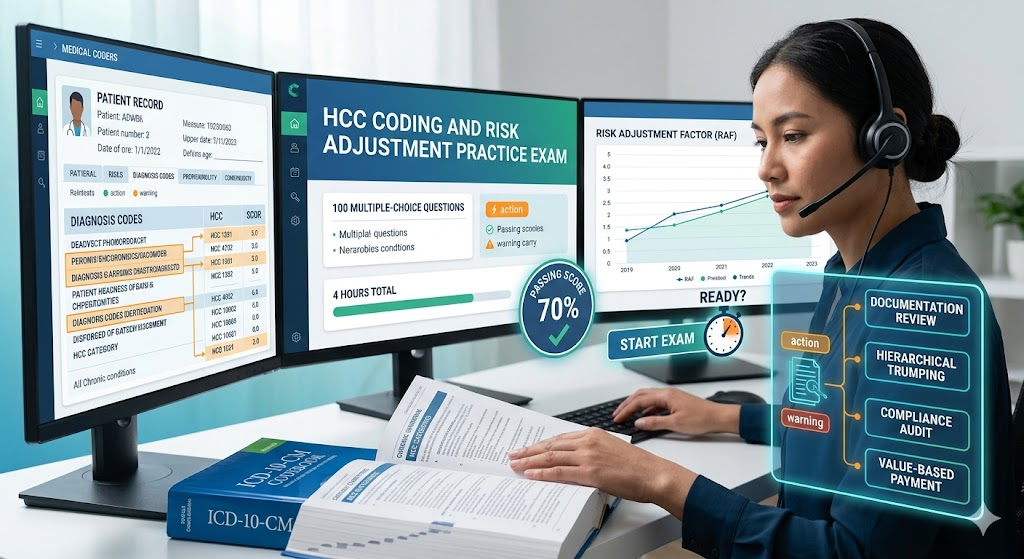
Additional Information
What the Course Entails and Exam Details
This practice test assesses your knowledge and proficiency in the key areas of HCC coding and risk adjustment.
You will encounter scenarios that test your ability to read through a patient’s entire medical record and assign the precise ICD-10-CM diagnostic codes that affect the Risk Adjustment Factor (RAF) score.
The core syllabus and skills covered include:
Deep ICD-10-CM Coding Proficiency: A major focus on coding chronic diseases that are hierarchical condition categories.
The CMS-HCC Risk Adjustment Model: Understanding both the current (V24) and phased-in (V28) models, including the clinical reclassifications, the number of payment HCCs, and how scores are calculated.
Hierarchical trumping: Applying the rules that determine which HCC condition takes precedence in a patient with multiple overlapping conditions.
Documentation Review and Query: Identifying discrepancies or gaps in the medical record and crafting compliant, non-leading queries to providers.
Compliance and Audits: Knowledge of RADV (Risk Adjustment Data Validation) audits and identifying common coding and documentation errors that lead to payment penalties.
Medical Terminology and Pathophysiology: Understanding the interactions of chronic diseases and anatomical structures relevant to documentation quality.
What to Expect in the Final Exam
This practice test is a direct emulation of the final, official certification exam you will eventually take.
While this simulation prepares you, the final certification exam (e.g., CRC) generally has the following strict parameters:
Format: The full final exam consists of 100 multiple-choice questions that assess your general knowledge, along with 10 case-based questions that test your practical coding ability.
Passing Score: You must achieve a minimum score of 70 percent to pass and earn your credential.
Time Limit: You are allowed four hours to complete the entire exam.
Specific Rules: The real exam is open-book, but only your official ICD-10-CM codebook (current or preceding year) is permitted. No external notes or alternative reference guides are allowed. An online calculator is provided.
How to Study and Exam Centers
Preparation for the HCC and Risk Adjustment exam requires a strategic combination of knowledge and practice.
Your study strategy should prioritize these techniques:
Codebook Familiarity: Become exceptionally fast with your official ICD-10-CM book to quickly reference chronic conditions and hierarchy.
Documentation Immersion: Read medical charts and focus on identifying disease pathways, not just codes. Learn to recognize "trumping" relationships without looking them up.
Simulated Exams: Take the practice test multiple times to build your endurance and time management skills.
Official Resources: Thoroughly study the official HCC model and the latest Coding Clinic guidance from the AHA/AAPC.
Exam Centers: The actual certification exams are administered by the certifying body. You can typically choose to take the exam in two ways: online, through a secure portal with a live remote proctor, or in-person on a computer at an authorized physical testing center, such as Pearson VUE, which are located worldwide.
Job Opportunities from the Course
Mastering HCC coding and risk adjustment unlocks specialized and lucrative career paths within the healthcare industry. This expertise is in high demand as healthcare shifts towards value-based care.
Specific job titles and career paths this certification unlocks include:
HCC Coder
Risk Adjustment Coder
Risk Adjustment Analyst
Clinical Documentation Improvement (CDI) Specialist
Risk Adjustment Auditor
HCC Quality Analyst
Risk Adjustment Consultant
Medical Coding Specialist (with HCC specialization)
Frequently Asked Questions
Reviews
5.0
Based on 0 reviews
Leave a Review
No reviews yet. Be the first to review!