
HDI Desktop Support Technician Practice Test.
$69.00
- Buy to unlock unlimited access to all Quiz questions and Answers in this Quiz.
- After purchase you can print a PDF of the whole quiz at any point. The PDF will contain the questions and the correct answers.
About this Exam
The HDI Desktop Support Technician (HDI-DST) certification is a prestigious credential that validates the knowledge and skills required for professionals in the IT desktop support field. It is designed for both new and experienced support professionals who provide in-person or remote support to internal and external customers. The certification, and consequently any associated HDI Desktop Support Technician Practice Test, focuses on a critical blend of technical knowledge, process understanding, and essential customer service and communication skills. It effectively demonstrates that you possess the core competencies necessary to excel in this pivotal role and contribute significantly to your organization's support operations.
Ready to test your knowledge?
Buy Now to Access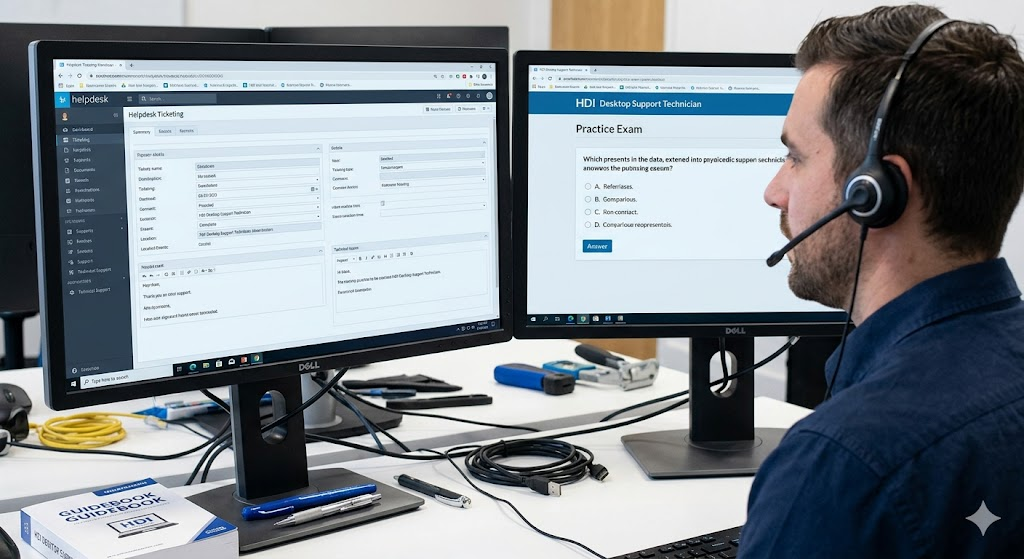
Additional Information
What the Course Entails and Exam Details
The core training curriculum for the HDI Desktop Support Technician certification covers a comprehensive range of topics essential for modern IT support. It begins with an overview of the support center and the evolving role of the desktop support technician, ensuring you understand your place within the larger business framework. You will delve into strategic frameworks, understanding how Service Level Agreements (SLAs) impact your work and prioritization. The course details various service delivery methods and the technologies underpinning them, from telephony to service management systems. Critical processes and operations are a major focus, including IT Service Management (often based on ITIL best practices), security management, knowledge management, and quality assurance. Crucially, the training emphasizes soft skills and operational methodologies. You will learn proven techniques for on-site customer interaction, effective communication across different channels and cultures, active listening, body language, and professional incident documentation. Furthermore, you will master essential problem-solving and troubleshooting skills, including questioning techniques, the seven steps to root cause analysis, and effective time management. There is also a strong component on managing difficult customers, conflict, and stress, ensuring you are equipped for the psychological and challenging aspects of the job. For the exam specifically, you should be aware that the HDI standards weighting usually puts significant emphasis on processes and procedures, performance results, resources, and people management, with leadership, and policy and strategy also considered.
What to Expect in the Final Exam
The official HDI Desktop Support Technician final exam is a rigorously structured assessment. You can expect it to be a multiple-choice examination, possibly including scenario-based questions that require you to apply your knowledge to realistic support situations. The full exam typically consists of 65 questions. Candidates are generally given a time limit of 75 minutes to complete the exam. To successfully achieve your certification, a passing score of 80% is standard and generally required across HDI certifications. The exam is often proctored, frequently administered through secure online platforms or authorized testing centers, ensuring the integrity of the results. It’s important to remember that this exam functions as an audit of your comprehensive knowledge and skills, so a deep understanding of all core domains is critical for success. You will receive a pass/fail result upon completion, along with scores across different categories to understand your areas of strength and improvement.
How to Study and Exam Centers
Effectively preparing for your HDI Desktop Support Technician certification involves a multi-faceted approach, and leveraging a proper HDI Desktop Support Technician Practice Test is a cornerstone strategy. First, and often the most recommended route, is to enroll in the official HDI Desktop Support Technician training course. This course, available in virtual, online, and sometimes public or onsite formats, is comprehensive and usually includes access to the certification exam itself. The course materials—manuals, standards, and workbooks—should serve as your primary study guides. Actively engaging with these resources, understanding the concepts, and practicing the skills is crucial. In addition, dedicate significant time to hands-on experience in a technical support or desktop support role, as this practical application reinforces theoretical knowledge. A crucial component of your study plan should be regular use of reliable, well-structured practice tests. These tests can provide important benefits: they simulate the real exam environment (especially the online interface), offer immediately feedback on incorrect answers, and point you toward specific competencies for further review. They are excellent for identifying knowledge gaps and building confidence before the final audit. While some practice materials are included in training, additional dedicated practice tests can be an invaluable, sometimes optional, resource. Regarding exam centers, the predominant and highly convenient method of delivery for HDI exams is online through the HDI Community Learning Portal. Once registered (often after payment or upon training completion), you typically have a designated window (e.g., up to 12 weeks) to take the proctored online exam from a secure location with an internet connection. This provides great flexibility. Some traditional classroom courses might still administer the exam in person, but online proctoring is the general standard. For non-training pathways, you would register for the exam bundle through HDI and proceed through their specified online platform.
Job Opportunities from the Course
Successfully completing the HDI Desktop Support Technician course and achieving certification unlocks numerous job opportunities in the growing field of IT support and service management. You will be qualified for a range of technical and customer-facing roles, including:
Desktop Support Technician (Levels 1, 2, and 3)
Technical Support Specialist
IT Support Professional
Help Desk Analyst
Service Desk Analyst
IT Support Representative
Field Service Technician
Support Lead or Supervisor (with experience)
On-Site Support Technician
IT Customer Service Representative
Desktop & Mobility Technician
This certification not only makes you more competitive for these roles but also provides a solid foundation for career progression into more advanced technical, operational, or management positions within the broader IT industry.
Frequently Asked Questions
Reviews
5.0
Based on 0 reviews
Leave a Review
No reviews yet. Be the first to review!