
Health Exemption Practice Exam
$69.00
- Buy to unlock unlimited access to all Quiz questions and Answers in this Quiz.
- After purchase you can print a PDF of the whole quiz at any point. The PDF will contain the questions and the correct answers.
About this Exam
Welcome to your definitive resource for the Health Exemption Exam!
This exam is designed as an opportunity for individuals with existing knowledge and proficiency in introductory health and wellness principles to demonstrate their competency. Successfully passing this exam allows students and candidates to bypass standard introductory health or wellness courses, potentially saving valuable time and tuition costs while accelerating their academic and professional journeys. It is a targeted assessment, verifying that you possess the foundational understanding needed in crucial health areas.
Ready to test your knowledge?
Buy Now to Access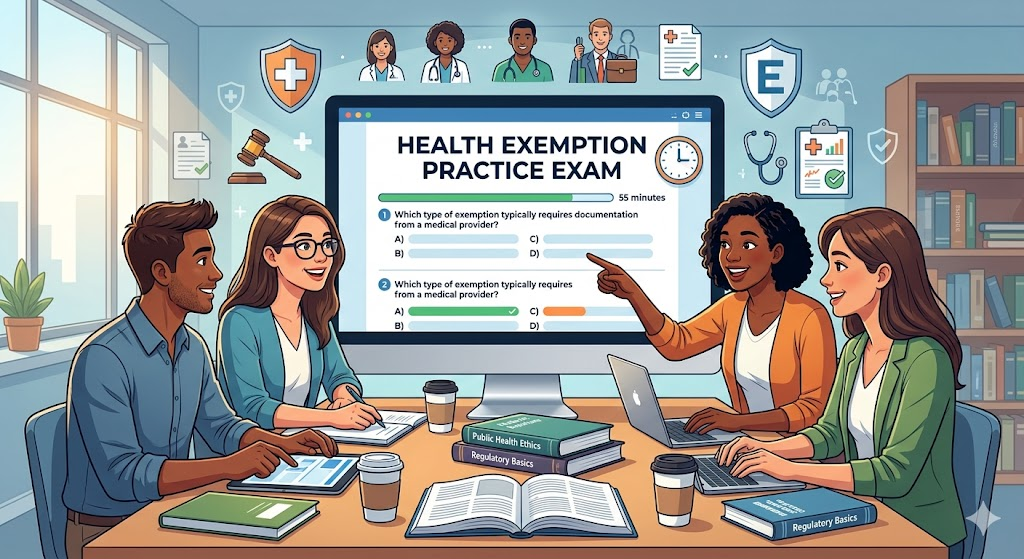
Additional Information
What the Course Entails and Exam Details
While exact specifics can vary depending on the institution or organization administering the exam, most Health Exemption tests encompass a core set of foundational health and wellness topics.
The likely scope includes, but is not limited to:
Concepts of Wellness: Understanding dimensions of health (physical, emotional, social, mental, etc.) and principles for a healthy lifestyle.
Nutrition and Fitness: Basic principles of a balanced diet, essential nutrients, energy balance, and the components and benefits of physical fitness.
Mental and Emotional Health: Understanding common mental health issues, stress management techniques, and promoting positive well-being.
Substance Abuse Prevention: Knowledge about the effects and risks of alcohol, tobacco, and other drugs, as well as prevention and recovery strategies.
Disease Prevention and Management: Basics of infectious and chronic diseases, risk factors, screening, and prevention methods.
Sexual Health: Foundational knowledge of reproductive health, contraception, and sexually transmitted infections.
The specific syllabus, exact topic weightings, and the organization of content will be defined by the body that has developed the particular exam you are taking. It is essential to consult the specific study materials and official details provided by your testing institution or organization.
What to Expect in the Final Exam
While not universal, most Health Exemption exams follow a standardized format. Knowing what to expect on test day can significantly reduce anxiety and help you focus on demonstrating your knowledge. Here are typical features:
Format: The primary component will likely be multiple-choice questions, which efficiently assess a broad range of foundational knowledge and test comprehension of key concepts, definitions, and application scenarios. Some exams might incorporate additional formats like true/false, matching, or short-answer questions.
Questions: You can typically expect a significant number of questions, often ranging from 50 to 100 or more, designed to comprehensively cover the stated topic areas.
Time Limit: A strict time limit, frequently between one and two hours, will apply to ensure candidates can demonstrate efficiency alongside accuracy. This time constraint is crucial, so regular practice is highly recommended to manage your pace.
Passing Score: A minimum percentage, commonly around 70% to 80% of questions answered correctly, is usually required to successfully pass the exemption exam and earn the course credit or exemption. Again, the exact passing score is defined by the specific rules of the testing entity.
Specific Rules: Expect standard examination procedures:
Proctoring: Exams are frequently proctored, either in person by an invigilator at a physical center or through secure online proctoring software which might require you to have a webcam, microphone, and specific technical specifications.
Identification: You will almost certainly be required to present a valid government-issued or institutional ID before beginning the test.
Authorized Materials: Generally, no outside materials, including textbooks, personal notes, smartphones, or unauthorized calculators, are permitted. All needed resources should be built into the digital exam interface, or clearly defined in advance.
How to Study and Exam Centers
Effective preparation is the key to unlocking your success and proving your proficiency. Approach your studies strategically.
Study Materials:
Official Study Guide/Syllabus: The very first step is to obtain and thoroughly review the official study guide, syllabus, or topic list provided by the institution or organization administering the exam. This is the single most accurate guide to what will be covered.
Textbooks: Utilize well-regarded introductory health and wellness textbooks and academic resources. Look for up-to-date editions that cover common health topics.
Online Resources: Refer to reliable health websites such as the Centers for Disease Control and Prevention (CDC), the National Institutes of Health (NIH), and reputable university health websites for foundational information. Be sure to verify the credibility and recency of all online information. There are also many free and paid online introductory health courses and resources that can bolster your study.
Practice Tests: Seek out relevant practice exams and sample questions. (Many resources, including the entity providing the exam or external prep companies, offer these). Practice tests are invaluable for familiarizing yourself with the types of questions you might encounter, identifying your strengths and weaknesses, and learning to manage your time effectively under simulated exam conditions.
Active Recall & Flashcards: Create flashcards (physical or digital) for key terms, definitions, and crucial data points. Use active recall techniques when studying to boost long-term retention.
Study Groups: Collaborate with others who may be preparing for similar exams or have existing health knowledge.
Exam Centers & Formats: The location and method for taking your Health Exemption Exam depend entirely on where you are registered for it.
Online Portals: Many institutions offer the exam through an official, secure online portal. This often involves specific browser requirements and real-time proctoring (human or AI-monitored) through your webcam. Ensure your computer meets all technical specifications and you have a stable internet connection.
Institutional Testing Centers: Physical testing is often handled at a college, university, or other dedicated testing facility. These are structured, quiet environments.
Approved Proctoring Services: Some organizations may utilize network testing centers, or approved external proctoring services (frame this as something to inquire about specifically with your provider, but avoid naming non-standard commercial ones without confirmation).
Authorized Schools: In some vocational or professional contexts, specific authorized schools or training centers might administer the exemption exam for their programs.
Crucially, always verify the approved testing centers and booking procedures directly with the specific institution or organization that has authorized you to take the Health Exemption Exam.
Job Opportunities from the Course
Passing a Health Exemption Exam and demonstrating your proficiency in foundational health principles, while not a stand-alone professional certification for most specific job titles, can support various career paths and open doors. It proves a level of understanding that is valuable in many fields, particularly those focused on well-being, community service, and education. Successful completion of this requirement (often as part of a larger degree or certification path) can be a stepping stone towards numerous opportunities.
Here is a clear list of potential career paths and roles that a solid understanding of these health concepts can support or for which this is a common step/prerequisite (further education/specific certifications are usually required for entry into these fields):
Health Educator (Entry or Associate Level): Helping communities and individuals improve their wellness through education and resources.
Community Health Worker: Acting as a bridge between communities and healthcare/social services, promoting public health.
Fitness Coordinator/Personal Trainer (requires specific certification): Developing and implementing fitness programs, incorporating wellness concepts.
Wellness Coach (requires specific certification): Helping clients achieve personal wellness goals, often incorporating behavior change and foundational knowledge.
Healthcare Administrator: Working in the non-clinical side of healthcare settings, where understanding basic health concepts and policy context is beneficial.
School Teacher (Health/PE Context): Teaching essential health principles and physical education in schools.
Corporate Wellness Coordinator: Designing and implementing health programs for employee well-being within a corporate setting.
Nutrition-related roles: While a degree is needed for registered dietitians, introductory health knowledge supports supporting roles.
Human Resources Specialist (Wellness Focus): Overseeing employee benefits and wellness initiatives.
Further Advanced Degrees and Certifications: Fulfilling a critical prerequisite for advanced professional programs in fields such as nursing, medicine, physical therapy, and other healthcare disciplines. In these cases, the course is a required building block rather than an end-point itself.
Remember, every step you take towards your educational goals is a significant achievement. Prepare diligently, utilize the resources available, and approach the Health Exemption Exam with confidence and a focus on demonstrating your proficiency. Good luck!
Frequently Asked Questions
Reviews
5.0
Based on 0 reviews
Leave a Review
No reviews yet. Be the first to review!