
Health Promotion, Fitness, and Wellness (HPFW) Comprehensive Practice Test
$69.00
- Buy to unlock unlimited access to all Quiz questions and Answers in this Quiz.
- After purchase you can print a PDF of the whole quiz at any point. The PDF will contain the questions and the correct answers.
About this Exam
The Health Promotion, Fitness, and Wellness (HPFW) Comprehensive Practice Test is a crucial tool designed for current and aspiring health and wellness professionals. This certification (often known as a CPHW or similar acronym, depending on the issuing body) provides a credential for individuals who want to work in preventative healthcare, lifestyle coaching, corporate wellness, or community health. The exam is specifically tailored for health coaches, fitness instructors, nutrition specialists, and educators who are passionate about empowering others to make sustainable, positive behavior changes. It validates your knowledge and practical ability to assess client health, design personalized programs, and deliver effective coaching that encompasses physical, mental, and nutritional well-being.
Ready to test your knowledge?
Buy Now to Access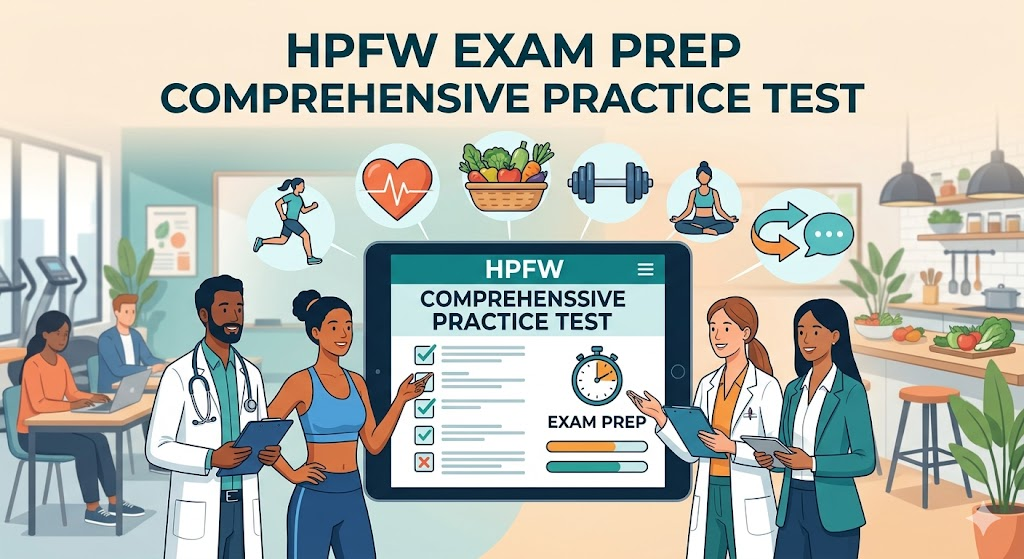
Additional Information
What the Course Entails and Exam Details
This comprehensive course and the accompanying exam cover a broad spectrum of pillars within the health and wellness industry. You will delve into the following core domains, among others:
Foundations of Health Promotion: Understanding the social determinants of health, levels of prevention (primary, secondary, and tertiary), and the models of behavior change (e.g., Transtheoretical Model, Health Belief Model).
Behavioral Change Coaching: Mastering communication and motivational interviewing skills to help clients set realistic goals, overcome barriers, and create lasting lifestyle improvements.
Physical Activity and Exercise: Designing safe, effective, and evidence-based fitness programs across diverse populations, including knowledge of exercise physiology and anatomy.
Nutrition Fundamentals: Acquiring basic, applicable knowledge of macronutrients and micronutrients, dietary guidelines, and principles of effective nutritional coaching (while respecting the scope of practice).
Wellness Assessment and Stress Management: Conducting holistic assessments of a client's well-being and introducing practical tools for managing stress, sleep, and overall emotional resilience.
Program Planning and Evaluation: Creating and managing wellness programs for individuals and groups, as well as tracking their efficacy and ROI.
What to Expect in the Final Exam
You should enter the final HPFW Comprehensive Exam expecting a rigorous assessment of your knowledge. The exact format may vary based on the specific certifying body (e.g., ACE, ACSM, NSHC, or a dedicated private school), but it typically includes a computer-based test composed of multiple-choice questions. A standard format consists of 100 to 150 questions, and you will have a strict time limit (usually two to three hours) to complete it. The passing score required is often between 70% and 80%, signifying a high level of competency. Questions will be designed to test both simple recall and complex, scenario-based application. This means you will need to apply behavioral change theories to specific client challenges, design exercise modifications, and evaluate health data. Some certifications might also require a practical component or a case study analysis, although this is more common for specialized coaching credentials.
How to Study and Exam Centers
Effective preparation for this comprehensive test demands a strategic and structured approach.
Actionable Study Strategies:
Master the Syllabus: Obtain the exact exam blueprint or syllabus and prioritize your study time based on the weight given to each domain.
Utilize Active Recall: Don't just read and highlight; create flashcards (physical or digital via apps like Anki) for key concepts, theories, and fitness/nutrition definitions.
Take Multiple Practice Tests: This is crucial. Full-length, timed practice tests will not only test your knowledge but also your ability to manage time effectively and recognize tricky question wording.
Engage in Scenario Practice: With peers or alone, invent client scenarios and practice how you would apply coaching techniques, design programs, and handle common challenges for them.
Form a Study Group: Collaborative learning is highly effective in this field. Teaching concepts to others and hearing their perspectives can deepen your understanding.
How and Where to Take the Exam: The method for taking the final exam depends entirely on the certifying organization you choose.
Pearson VUE: Many globally recognized health and fitness certifications deliver their exams through Pearson VUE physical testing centers, which offer a secure, proctored environment.
Online Proctoring (e.g., OnVUE): In some cases, organizations allow you to take the proctored exam from your own computer at home, using a webcam for monitoring.
Private Portals and Physical Schools: If you are certified through a specific school or smaller body, they may have their own online testing portal or require you to take the test at their physical premises or authorized regional schools. Always verify the process directly with your certifying body.
Job Opportunities from the Course
A certification in Health Promotion, Fitness, and Wellness opens a broad variety of rewarding career paths. This qualification signals to employers that you possess a holistic approach to helping clients achieve their best self. The list of specific job titles and career paths unlocked by this certification includes:
Wellness Coach / Health & Wellness Coach
Corporate Wellness Coordinator
Health Educator
Community Health Worker
Lifestyle Medicine Program Facilitator
Corporate Wellness Consultant
Health Promotion Specialist
Fitness and Wellness Director
Health and Nutrition Coach
Worksite Health Program Manager
Patient Navigator or Health Liaison
Wellness Program Evaluator
Healthy Eating and Physical Activity (HEPA) Leade
Frequently Asked Questions
Reviews
5.0
Based on 0 reviews
Leave a Review
No reviews yet. Be the first to review!