
Healthcare Accreditation Certification Practice Exam
$69.00
- Buy to unlock unlimited access to all Quiz questions and Answers in this Quiz.
- After purchase you can print a PDF of the whole quiz at any point. The PDF will contain the questions and the correct answers.
About this Exam
Healthcare accreditation is a vital process that demonstrates a healthcare organization's commitment to meeting high-quality standards for patient care and safety. Earning a Healthcare Accreditation Certification signifies expertise in interpreting and applying these rigorous standards, making a professional an invaluable asset in quality improvement, risk management, and regulatory compliance.
This specific practice exam is designed for healthcare professionals, quality managers, compliance officers, administrators, and anyone aiming to achieve this prestigious certification. It is an essential tool to benchmark your current knowledge, identify areas for improvement, and simulate the environment and typical content of the final certification exam. By utilizing this practice resource, you will understand the common themes and required skill levels (recall, application, analysis) for interpreting various accreditation standards, quality improvement principles, and patient safety protocols. The primary goal is to provide a realistic experience and build the confidence necessary to successfully navigate the actual certification journey. Proper preparation with a tool like this practice exam is the cornerstone of passing the official accreditation test.
Ready to test your knowledge?
Buy Now to Access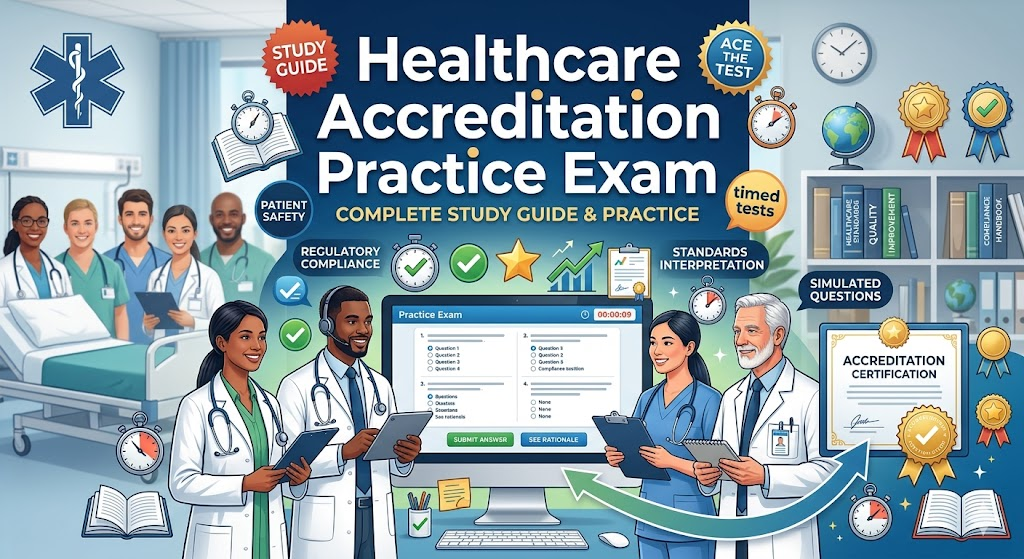
Additional Information
What the Course Entails and Exam Details
While distinct from a full educational course, preparing for the Healthcare Accreditation Certification and this corresponding practice exam requires a deep understanding of core competencies. These usually include:
Understanding Accrediting Bodies: Familiarity with major healthcare accrediting organizations (e.g., The Joint Commission, NCQA, URAC, CARF) and their respective standards.
Quality Improvement Principles: Mastery of frameworks (PDSA cycles, Lean Six Sigma), quality tools, data collection, analysis, and performance metrics.
Patient Safety & Risk Management: Knowledge of safety standards, root cause analysis, event reporting, infection control, and risk mitigation strategies.
Regulatory Compliance & Accreditation Process: Interpretation of relevant federal and state regulations, knowledge of the accreditation survey process, standards compliance, and documentation.
Organizational Leadership & Culture: The role of leadership in driving quality and safety culture, and strategic planning.
The Healthcare Accreditation Practice Exam typically mirrors the real exam in terms of topic distribution. This specific practice test details include:
Format: 125 multiple-choice questions (often, a specific number are scored, and some are non-scored, identical to the structure of leading certification exams).
Question Types: A mix of recall (basic facts), application (interpreting information), and analysis (evaluating complex scenarios) questions.
Time Limit: A simulated timer (e.g., 3 hours) is recommended to practice time management, though the test itself may be accessible in both timed and untimed formats.
Feedback: Immediate, unofficial scoring upon completion, with detailed explanations for correct and incorrect answers to support effective study.
What to Expect in the Final Exam
The actual Healthcare Accreditation Certification exam is a robust assessment of your expertise, and successfully navigating it requires careful preparation and an understanding of its structure. Here are key characteristics of the final exam you will prepare for through this practice test:
Proctored Environment: The official certification exam is taken in a secure, often computer-based testing environment. This could be at a physical testing center or via a live, online-proctored service.
Time Limit: A strict time limit, typically 3 hours, is enforced for completion of the entire test. Time management is crucial.
Number of Questions: The final exam usually contains between 140 and 150 multiple-choice questions, which are divided into scored questions and a set of non-scored, experimental questions. Only the scored questions impact your final result.
Passing Score: The exam uses a scaled scoring system (e.g., typically a minimum scaled score of 600 or higher is required to pass). This means that different versions of the exam with varying difficulties are statistically equated to provide a fair score.
Content Weights: The exam's question count is typically weighted towards specific domains (as outlined in section 2), with Organizational Leadership, Quality Improvement, and Regulatory/Accreditation Standards often carrying significant weight.
Rules & Restrictions: Closed-book exam (no outside resources, notes, or internet access allowed during the test). Strict identification verification and potentially environmental scans (for online tests) are mandatory.
How to Study and Exam Centers
Effective study and knowing how to access both the practice and official exams are key components of your success strategy.
Study Strategies:
Master the Core Material: Thoroughly review the official study guide, handbooks, and standard references from the accrediting body or leading professional associations (e.g., NAHQ for quality, CCB for compliance). Understand the principles and their application to real healthcare settings.
Utilize This Practice Exam Effectively:
Simulate Test Day: Take this practice exam in a single, timed sitting in a quiet, distraction-free environment. Put away all study materials.
Analyze Your Mistakes: Carefully review the detailed rationales for every question you answer incorrectly or even correctly if you weren't certain. Understand why the correct answer is right and why others are wrong, identifying gaps in your knowledge or test-taking traps. Repeat this practice test to see improvement and build fluency.
Focus on Weak Areas: Use your results from practice to prioritize your remaining study time, dedicating more effort to the topics or skills you found challenging.
Active Learning Techniques: Instead of passive reading, incorporate flashcards for key terms and standards, create mind maps, summarize complex concepts in your own words, and discuss challenging scenarios with peers or in study groups.
Spaced Repetition & Recall: Regularly revisit core material in increasing intervals to improve long-term retention. Use the practice test not just once, but periodically as a check of your progress and as a learning tool.
Exam Centers and Access:
Practice Exam Access: This Healthcare Accreditation Practice Exam is typically accessed directly through the online portal or platform of the provider. It is usually entirely online, allowing you to take it from a computer with internet access at your convenience.
Official Certification Exam: The actual certification exam is administered through authorized testing providers. Common locations include:
Physical Testing Centers: Established networks like Pearson VUE or specialized testing centers. Candidates register, pay, and schedule an appointment at a convenient location.
Online Proctored Testing: Many organizations now offer a secure, live online-proctoring option. This allows you to take the exam from a private, approved space, with your identity and environment monitored remotely by a live proctor through your webcam and microphone.
Authorizing Bodies: Some certification programs may facilitate testing directly via their own platform or through specific physical sites for certain organizational members or groups. Be sure to check the specific registration and scheduling requirements on the official website of the certifying body for the most accurate and up-to-date information.
Job Opportunities from the Course
Earning the comprehensive Healthcare Accreditation Certification unlocks a diverse range of rewarding career paths. Successfully using this practice exam to prepare is your first crucial step towards achieving the actual certification and accessing these opportunities. Professionals with this credential are highly sought after by hospitals, clinics, consulting firms, insurance companies, and regulatory agencies. The certification demonstrates your expertise to potential employers, frequently leading to increased responsibility, authority, and salary potential.
The specific job opportunities unlocked by this certification include, but are not limited to, the following positions. Note that specific job titles and descriptions may vary by organization and sector.
Healthcare Quality Specialist / Coordinator: Collects, analyzes, and reports on quality data, develops and implements quality improvement projects, and monitors compliance with standards and regulations.
Accreditation Manager / Officer: Manages all aspects of the organization’s accreditation process, including standard interpretation, survey preparation, on-site visit coordination, and post-survey response.
Healthcare Compliance Officer / Manager: Directs and oversees compliance programs, ensuring adherence to federal and state healthcare laws, regulations, policies, and accreditation standards.
Patient Safety Officer / Director: Develops and leads patient safety initiatives, manages event reporting and analysis, and implements strategies to reduce medical errors and improve safety culture.
Risk Manager: Identifies, assesses, and controls financial, legal, and operational risks within a healthcare setting, integrating risk management with quality and safety efforts.
Infection Control Preventionist: Oversees and implements infection prevention and control programs, analyzes infection rates, and works to maintain compliance with safety and environmental standards.
Director of Quality Improvement: Leads and strategicially directs quality improvement efforts across an organization, setting goals, managing teams, and reporting to leadership on quality and safety metrics.
Healthcare Consultant (Quality & Accreditation): Advises other healthcare organizations on best practices in quality, safety, compliance, and standard adherence, often assisting with survey readiness.
Preparing with this Healthcare Accreditation Practice Exam is your professional commitment to mastering the skills needed to succeed in these critical, dynamic roles and to earn the certification that opens these exciting doors.
Frequently Asked Questions
Reviews
5.0
Based on 0 reviews
Leave a Review
No reviews yet. Be the first to review!