
Healthcare Associated Infections (HAI) Practice Exam
$69.00
- Buy to unlock unlimited access to all Quiz questions and Answers in this Quiz.
- After purchase you can print a PDF of the whole quiz at any point. The PDF will contain the questions and the correct answers.
About this Exam
Healthcare Associated Infections (HAIs) are a critical concern in medical environments, impacting patient safety and healthcare costs globally. This comprehensive practice exam is specifically designed for a wide range of healthcare professionals, including nurses, physicians, medical technicians, quality improvement staff, and hospital administrators. It serves as a powerful diagnostic tool, assessing your foundational knowledge of HAI prevention, control strategies, and the latest clinical guidelines. By taking this practice test, you will build confidence, identify knowledge gaps, and prepare effectively for a culminating certification or career advancement in infection prevention and control.
Ready to test your knowledge?
Buy Now to Access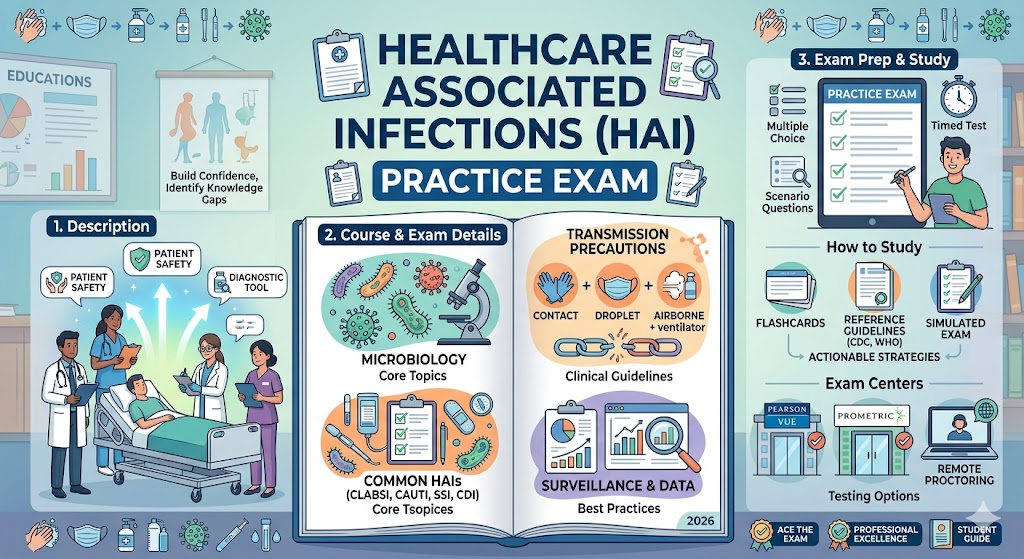
Additional Information
What the Course Entails and Exam Details
The preparatory content and the exam itself delve deep into the core concepts of infection prevention. Key topics covered typically include:
Fundamentals of Microbiology: Understanding key pathogens and their modes of transmission in healthcare settings.
Chain of Infection & Transmission-Based Precautions: Identifying standard, contact, droplet, and airborne precautions and how they are implemented.
Hand Hygiene & Personal Protective Equipment (PPE): Master correct techniques, duration, and the appropriate selection and use of gloves, gowns, masks, and eye protection.
Common HAIs: Comprehensive knowledge of types like Central Line-Associated Bloodstream Infections (CLABSI), Catheter-Associated Urinary Tract Infections (CAUTI), Surgical Site Infections (SSI), and Clostridioides difficile Infection (CDI), including specific prevention bundles for each.
Environmental Hygiene & Sterilization: Best practices for environmental cleaning, disinfection of equipment, and sterilization processes.
Surveillance & Data Analysis: Understanding how to collect, interpret, and report HAI data to drive improvement.
Antibiotic Stewardship: The role of appropriate antimicrobial use in preventing resistance and HAIs.
Regulatory & Ethical Standards: Familiarity with guidelines from bodies like the CDC, WHO, and relevant national healthcare authorities.
What to Expect in the Final Exam
This practice exam meticulously mirrors the structure and question types you can anticipate in a formal certification exam for infection control.
Format: The test consists primarily of multiple-choice questions, which may include scenario-based questions that test your ability to apply your knowledge to real-world clinical situations. You will encounter questions testing recall of facts, understanding of concepts, and application of guidelines.
Passing Score: For this practice test, aim for a high level of proficiency (e.g., above 80%) to demonstrate mastery. However, formal certification exams often require a specific scaled score to achieve a passing grade, which will be clearly outlined by the certifying body.
Time Limit: To simulate real exam conditions and assess your time management, this practice test will likely have a defined time limit (e.g., 60-90 minutes). A typical full certification exam can range from 2 to 3 hours or more.
Specific Rules: Treat this practice test like the real event. Complete it independently in a quiet environment. Understand that in a formal examination setting, specific rules regarding allowed materials, identity verification, and proctoring will apply. For many practice exams, immediate feedback on correct and incorrect answers is provided upon completion, allowing for instant learning and review.
How to Study and Exam Centers
Preparation is key to success on both this practice test and your final certification. Implement these proven strategies:
Utilize This Practice Exam: Take this exam multiple times. Carefully review the explanation for every question you answer, both correct and incorrect. This is one of the most effective ways to solidify your understanding and identify areas that need focused study.
Reference Key Guidelines: Study the official guidelines from authoritative sources like the Centers for Disease Control and Prevention (CDC), the World Health Organization (WHO), and the specific certifying organization. These are the foundations upon which exam questions are built.
Active Learning: Create flashcards for key definitions, precautions, and infection types. Form a study group with colleagues to discuss complex scenarios and teach concepts to each other.
Simulate Exam Conditions: For your final practice attempts, set aside dedicated time, eliminate distractions, and work within the specified time limit to build your stamina and pacing.
Exam Centers: While this practice test is often an online resource accessible from anywhere, your eventual final certification exam (e.g., from organizations like the Certification Board of Infection Control and Epidemiology - CBIC) will require specific registration and testing methods:
Formal Testing Centers: You will likely need to register to take your exam at authorized professional testing centers. These include globally recognized services such as Pearson VUE or Prometric, which offer secure, proctored environments in numerous locations.
Proctored Online Exams: Many certifying bodies now also offer the option for online proctored exams, which you can take from a secure computer in a suitable location, monitored remotely by a live proctor to ensure integrity.
Job Opportunities from the Course
Successfully completing this practice exam and subsequently achieving formal certification in infection control can unlock numerous rewarding career paths across the healthcare spectrum. Potential job opportunities include:
Infection Preventionist / Infection Control Specialist
Hospital Epidemiologist (typically requires a medical degree or advanced public health degree)
Infection Control Nurse
Quality Improvement Coordinator (with a focus on infection control)
Risk Management Officer (with a focus on clinical safety)
Public Health Official (infection prevention & surveillance)
Nurse Manager (in clinical settings with high HAI focus)
Sterilization & Disinfection Manager
Consultant in Infection Control
Healthcare Administrator (with a focus on patient safety
Frequently Asked Questions
Reviews
5.0
Based on 0 reviews
Leave a Review
No reviews yet. Be the first to review!