
Healthcare Economics, Organizations, and Policy Practice Test
$69.00
- Buy to unlock unlimited access to all Quiz questions and Answers in this Quiz.
- After purchase you can print a PDF of the whole quiz at any point. The PDF will contain the questions and the correct answers.
About this Exam
This exam evaluates a candidate's mastery of the economic forces that shape the healthcare industry. It is designed for students of public health, healthcare administration, and business, as well as working professionals seeking to transition into policy-making or management roles. The certification validates your ability to analyze complex issues, such as rising healthcare costs, insurance market dynamics, and the impact of government regulations on service delivery.
Ready to test your knowledge?
Buy Now to Access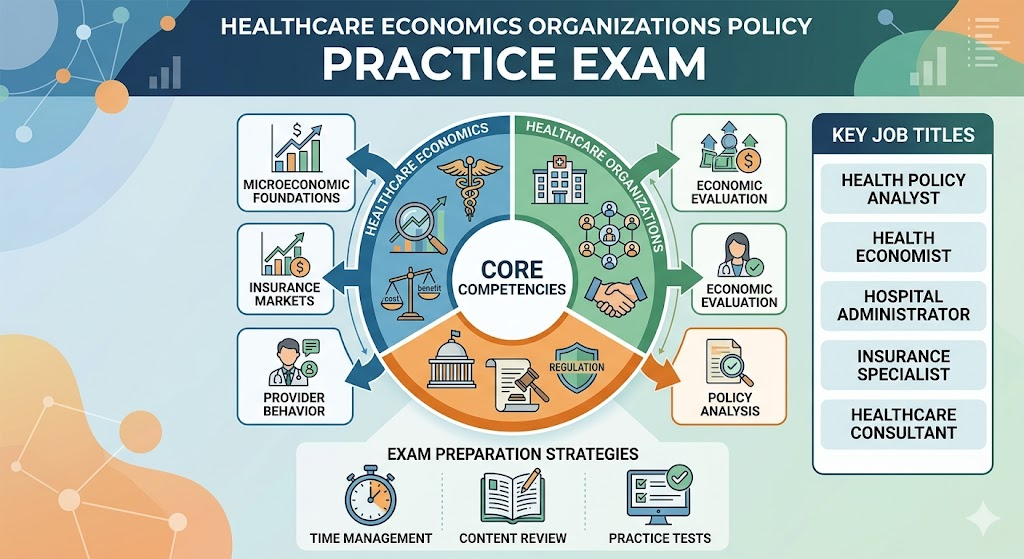
Additional Information
What the Course Entails and Exam Details
The syllabus for this exam covers a broad spectrum of critical topics that intersect economics and health policy. Candidates must demonstrate proficiency in:
Microeconomic Foundations of Healthcare: Analyzing demand and supply for medical services, the concept of scarcity, and market failures specific to healthcare.
Healthcare Financing and Insurance: Understanding risk pooling, moral hazard, adverse selection, and different reimbursement models (e.g., fee-for-service, capitation).
Provider Behavior and Organization: Examining the economic incentives influencing physicians, hospitals, and pharmaceutical companies, and the structure of healthcare delivery systems.
Economic Evaluation: Mastering methodologies like cost-benefit analysis (CBA) and cost-effectiveness analysis (CEA) to assess healthcare interventions.
Healthcare Policy and Regulation: Analyzing the role of government in regulating markets, public health programs (like Medicare and Medicaid), and current health reform debates.
What to Expect in the Final Exam
While specific practice test formats can vary, the final exam typically adheres to a standardized structure designed to test both theoretical knowledge and practical application.
Format: Expect a standardized test composed primarily of multiple-choice questions. A significant portion of these will be scenario-based, requiring you to apply economic principles to real-world policy dilemmas or organizational challenges.
Time Limit: You will typically have between 90 and 120 minutes to complete the exam.
Passing Score: The required passing score generally ranges from 70% to 75%.
Rules: Standard examination rules apply. It is closed-book, and no outside materials or electronic devices are permitted.
How to Study and Exam Centers
Effective preparation requires a multi-faceted approach. To maximize your chances of success, consider these actionable study strategies:
Review Core Textbooks: Focus on standard health economics and policy textbooks. Prioritize sections on insurance markets, economic evaluation methodologies, and government intervention.
Analyze Case Studies: Look for case studies on major health reforms (e.g., the Affordable Care Act) to understand the practical application of policy.
Take Practice Tests: This is your most valuable tool. Use this [Healthcare Economics, Organizations, and Policy Practice Test] to get familiar with the question style, manage your time, and identify knowledge gaps.
Form Study Groups: Discussing complex topics like moral hazard or cost-effectiveness ratios with peers can deepen your understanding.
Exam Centers:
The final certification exam is often administered through global testing networks, such as Pearson VUE or Prometric, which offer numerous physical testing locations worldwide. Additionally, many institutions now offer online proctored exams, allowing you to take the test from your home or office. Be sure to check the specific registration details provided by your exam sponsor for authorized locations and online options.
Job Opportunities from the Course
A strong grasp of healthcare economics and policy is highly valued in the labor market. Completing this course and passing the exam can unlock a wide array of rewarding career paths. Specific job titles include:
Health Policy Analyst
Healthcare Administrator / Hospital Manager
Health Economist
Market Access Manager (Pharmaceutical/Medical Device Industry)
Healthcare Consultant
Insurance Data Analyst
Public Health Program Manager
Health Legislative Aide
By utilizing this study guide and dedicating focused effort to your preparation, you are taking a decisive step toward achieving your educational and professional goals in the dynamic field of healthcare. Good luck with your studies!
Frequently Asked Questions
Reviews
5.0
Based on 0 reviews
Leave a Review
No reviews yet. Be the first to review!