
Healthcare Effectiveness Data and Information Set (HEDIS) Practice Test
$69.00
- Buy to unlock unlimited access to all Quiz questions and Answers in this Quiz.
- After purchase you can print a PDF of the whole quiz at any point. The PDF will contain the questions and the correct answers.
About this Exam
Welcome to your essential first step toward mastering healthcare quality measurement.
The HEDIS Certification Practice Exam is a comprehensive preparatory tool designed to equip you with the knowledge and confidence needed to succeed in official Healthcare Effectiveness Data and Information Set (HEDIS) assessments.
HEDIS, developed by the National Committee for Quality Assurance (NCQA), is the most widely used performance measurement tool in the American healthcare industry, utilized by over 90% of health plans.
This practice test is specifically designed for healthcare professionals, including Registered Nurses (RNs), Medical Coders (CPC/CCS), Data Analysts, and Quality Improvement Coordinators, who wish to validate their expertise in data collection, chart abstraction, and compliance reporting.
Successfully preparing with this guide signals to employers that you are serious about improving patient care through accurate data.
Ready to test your knowledge?
Buy Now to Access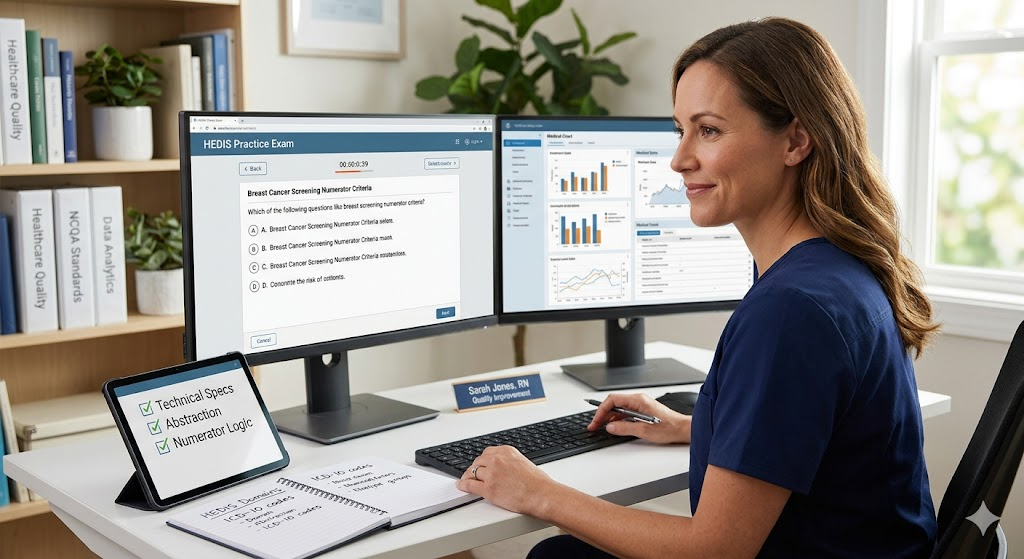
Additional Information
What the Course Entails and Exam Details
This practice guide covers the fundamental pillars of the HEDIS methodology, ensuring you understand the "how" and "why" behind the numbers.
It is structured around the six main domains of care measured by HEDIS:
Effectiveness of Care: Learning specifications for preventive screenings, chronic condition management (e.g., diabetes, hypertension), and behavioral health care.
Access/Availability of Care: Assessing how easily members can access necessary medical services and specialists.
Experience of Care: Understanding the methodologies used to survey patient satisfaction (e.g., CAHPS survey).
Utilization and Relative Resource Use: Measuring the efficiency of healthcare resource allocation.
Health Plan Descriptive Information: Understanding structure, enrollment, and diversity specifications.
Measures Collected Using Electronic Clinical Data Systems (ECDS): Grasping modern data collection from digital health records.
Beyond these domains, the exam focuses heavily on the Technical Specifications. You will need to understand standard terminology such as the "Eligible Population," "Denominator," "Numerator compliance," and "Anchor dates." You must also know the differences between the Administrative Method (claims data only) and the Hybrid Method (claims data plus medical record chart abstraction).
What to Expect in the Final Exam
While specific exam formats may vary slightly depending on the accredited organization administering your final certification, a typical HEDIS competency exam follows a standardized approach.
Exam Format: The test usually consists of 75 to 100 multiple-choice questions.
These are not just rote recall questions; many are scenario-based case studies where you must apply HEDIS Volume 2 Technical Specifications to decide numerator compliance for a specific patient scenario.
Time Limit: Candidates are typically given 90 minutes to 2 hours to complete the examination.
Time management is critical, as scenario analysis can be time-consuming.
Passing Score: Most certification bodies require a passing score of 70% to 80% to demonstrate proficiency.
Exam Rules: Because these are professional certifications, they are almost universally proctored. You will generally not be permitted to use outside notes or textbooks during the final exam, although official practice resources sometimes allow for open-book study to build speed.
How to Study and Exam Centers
Preparation is the absolute key to success in the complex world of HEDIS.
Actionable Study Strategies:
Master the Technical Specifications: Study the NCQA HEDIS Volume 2 publications relentlessly. This is the ultimate rulebook.
Take Multiple Practice Tests: Use this practice exam environment to build your speed and precision. Analyze your wrong answers to identify technical specification misunderstandings.
Practice Chart Abstraction: If your goal is a hybrid role, practice finding data within sample medical records to build "the chase" speed.
Understand Coding Systems: Brush up on your ICD-10-CM, CPT, HCPCS, and UB-04 codes, as these are the triggers for identifying the eligible population.
How and Where to Take the Exam:
Online Proctored Exams: This is now the most common method. You can take the official NCQA or affiliated organizational exams from your home or office computer while being monitored via webcam by a live proctor (using services like Proctortrack or Examity).
Pearson VUE Testing Centers: Some institutions utilize standardized testing centers. These are physical locations globally where you take the computer-based exam in a secure, controlled environment.
Authorized Training Centers: Certain universities or hospital networks offer HEDIS training programs that culminate in an on-site certification exam.
Job Opportunities from the Course
Earning a validation of HEDIS proficiency is highly valued by employers in the managed care and insurance sectors.
This knowledge unlocks distinct non-clinical and quality-focused career paths:
HEDIS Reviewer / Abstraction Specialist: Reviewing medical charts to determine compliance with specific measures during the HEDIS reporting season (usually January through May).
Quality Improvement (QI) Coordinator: Using year-round HEDIS data to identify gaps in care and implement initiatives to improve health plan performance scores.
HEDIS Data Analyst: Analyzing large claims databases to forecast HEDIS rates and monitor improvement.
HEDIS Auditor / Compliance Manager: Verifying the integrity of the data collection process for public reporting.
Health Plan Quality Director: Senior-level management responsible for the overall HEDIS strategy and NCQA Accreditation status of a health plan.
Utilization Management Specialist: Monitoring clinical resource use against HEDIS efficiency benchmarks.
This comprehensive guide should serve as your roadmap to becoming a certified expert in healthcare quality data. Good luck!
Frequently Asked Questions
Reviews
5.0
Based on 0 reviews
Leave a Review
No reviews yet. Be the first to review!