
Hearing Aid Specialist Practice Exam
$69.00
- Buy to unlock unlimited access to all Quiz questions and Answers in this Quiz.
- After purchase you can print a PDF of the whole quiz at any point. The PDF will contain the questions and the correct answers.
About this Exam
Embarking on a career as a Hearing Aid Specialist opens doors to a rewarding profession dedicated to improving people's lives through better hearing. The Hearing Aid Specialist certification, often encompassing a licensure exam, is the vital credential required to practice legally in many jurisdictions.
This certification is designed for individuals who have completed necessary educational requirements and practical training, and are aspiring to work independently to evaluate hearing loss, counsel patients, and fit and dispense hearing aids. It validates that the specialist possesses the foundational knowledge, practical skills, and ethical understanding essential to providing safe and effective hearing healthcare. Successfully passing the associated practice and final exams is a significant milestone on this fulfilling career path.
Ready to test your knowledge?
Buy Now to Access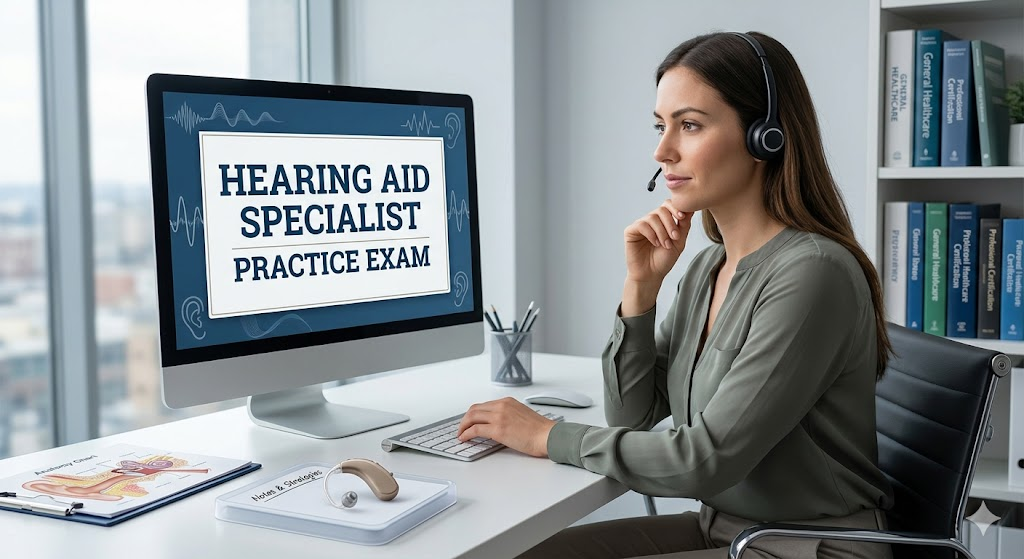
Additional Information
What the Course Entails and Exam Details
A comprehensive course or training program preparing you for the Hearing Aid Specialist certification typically covers a wide range of essential topics. This curriculum integrates theoretical knowledge with hands-on clinical practice. Expect to delve deep into:
Ear Anatomy and Physiology: Understanding the structure and function of the human auditory system.
Hearing Loss Types and Pathologies: Identifying and understanding different forms of hearing impairment and associated conditions.
Audiometric Testing: Mastering pure-tone air and bone conduction testing, speech audiometry, and interpreting audiograms.
Otoscopy and Ear Impressions: Techniques for safely inspecting the ear canal and taking accurate ear impressions for custom earmolds or hearing aids.
Hearing Aid Technology: Understanding different types of hearing aid styles, circuitry, components, and programming.
Fitting and Dispensing: Protocols for selecting, fitting, verifying, and validating hearing aids to meet individual patient needs.
Patient Counseling and Rehabilitation: Communicating effectively with patients, understanding their needs, providing product information, and offering guidance on adjusting to amplification.
Maintenance and Troubleshooting: Skills to clean, maintain, and resolve common issues with hearing aids.
Ethics, Regulations, and Safety: Adhering to professional codes of conduct, understanding state and federal regulations, and implementing infection control and safety protocols.
The specific "exam details" will vary significantly by state and certification body. The primary written exam is often a computer-based, multiple-choice test, like the International Licensing Examination for Hearing Healthcare Professionals (ILE) offered by the International Hearing Society (IHS). This exam assesses knowledge across the domains listed above and typically consists of a set number of scored and potentially unscored pilot questions. Furthermore, many jurisdictions require a separate, rigorous practical examination to demonstrate hands-on competence in areas like audiometry and making ear impressions.
What to Expect in the Final Exam
When you step into the final exam setting, whether it's for a state or national credential, you should be well-prepared and aware of what lies ahead. Here’s a general overview:
Format: The written exam is predominantly multiple-choice, designed to test both your recall of factual information and your ability to apply concepts to realistic clinical scenarios. Questions are often practice-based, assessing critical thinking rather than just memorization. Some exams are computer-delivered, while others might still be paper-and-pencil, depending on the testing body and location. As mentioned, a separate practical, hands-on exam is frequently required.
Passing Score Requirements: Each jurisdiction and certification body sets its own passing score. This isn't usually just a simple percentage; it often involves meeting a specific competence level determined through a rigorous standard-setting process. You must check with your local state board or chosen certifying body (e.g., IHS) for their exact requirements.
Time Limits: You will be under time constraints. For the computer-based written exam (like the ILE), a common time limit is 120 minutes to complete a specified number of questions. Manage your time wisely, and don't get stuck on single, difficult questions.
Specific Rules: Expect standard professional testing protocol. You will need to provide valid, physical photo ID that matches your registration. Prohibited items, including phones, notes, and certain personal belongings, must be stored in secure areas provided by the testing center. Any violation of these rules can result in dismissal and disqualification. You must arrive early, and late arrivals are generally not permitted to take the exam.
How to Study and Exam Centers
Preparation is the absolute key to success on the Hearing Aid Specialist exams. A combination of focused study and hands-on experience is paramount.
Official Prep Materials: Seek out the official study guides, practice exams, and course references provided by the testing entity, such as the International Hearing Society’s ILE Test Prep platform and their Distance Learning for Professionals in Hearing Health Sciences course. These are the most direct ways to understand the exam’s specific content and format.
Textbooks and Manuals: Dedicate time to thoroughly review relevant textbooks and manuals (common references are listed in official guides) covering audiology, ear anatomy, hearing aid fitting, and related fields.
Practice Questions: Work through as many practice questions as possible. Analyze both your correct and incorrect answers to identify knowledge gaps and get comfortable with the multiple-choice format and the practice-based nature of the questions.
Clinical Experience: The ILE is practice-based, so clinical experience is crucial. Ensure you engage in significant hands-on training and clinical practicum, ideally through an apprenticeship or mentorship under a licensed specialist. This is where you apply theoretical knowledge and build the necessary manual dexterity and clinical reasoning.
Hands-on Practice: Physically practice tasks like otoscopy, audiometric testing, and making ear impressions, especially if you also face a separate practical exam.
Study State-Specific Laws: If applicable, dedicate specific study time to the unique regulations and ethical guidelines of the jurisdiction in which you intend to practice.
Exam Centers: The testing process is typically multi-stage. First, you usually must apply through your state's licensing board to establish eligibility. Once approved, the licensing agency forwards your information to the testing organization (like IHS). You will then receive instructions on how to register for and schedule your exam appointment. Computer-based written exams are typically administered at authorized, professional physical testing centers or sometimes specific state facilities. While prominent vendors like Pearson VUE are frequent partners for professional licensure across many fields, you must verify the specific center options provided upon your registration, as they can vary. Note: Study and practice materials can be accessed online, but the final certification or licensure exam itself is almost always a proctored, in-person event at a designated testing location.
Job Opportunities from the Course
Successfully navigating the training and certification/licensure process opens the door to a promising and dynamic career field with excellent growth potential. A qualified Hearing Aid Specialist can pursue various career paths and job titles, including:
Hearing Aid Specialist (HIS) / Hearing Instrument Specialist
Hearing Instrument Dispenser (HID)
Hearing Specialist
Hearing Care Provider (often associated with retail practices or apprenticeships)
Work as an Audiologist's Assistant (in some states, with specific additional training and supervision requirements)
Opportunities within hearing aid manufacturing and sales teams
Opportunities in specialty hearing care clinics and medical practices
Possibility to advance to managerial roles or even clinic ownershi
Frequently Asked Questions
Reviews
5.0
Based on 0 reviews
Leave a Review
No reviews yet. Be the first to review!