
Heart Physiology Practice Exam
$69.00
- Buy to unlock unlimited access to all Quiz questions and Answers in this Quiz.
- After purchase you can print a PDF of the whole quiz at any point. The PDF will contain the questions and the correct answers.
About this Exam
This Heart Physiology Practice Exam is designed for individuals seeking to solidify their understanding of the complex functions of the human heart.
It is ideal for medical students, nursing candidates, paramedic trainees, and those preparing for specialized cardiovascular technology certifications.
This practice exam serves as a crucial tool for assessing readiness before attempting official certification tests, offering a comprehensive review of essential cardiac physiology.
By engaging with this simulation, students can identify knowledge gaps and build the confidence necessary to excel in high-stakes testing environments.
Ready to test your knowledge?
Buy Now to Access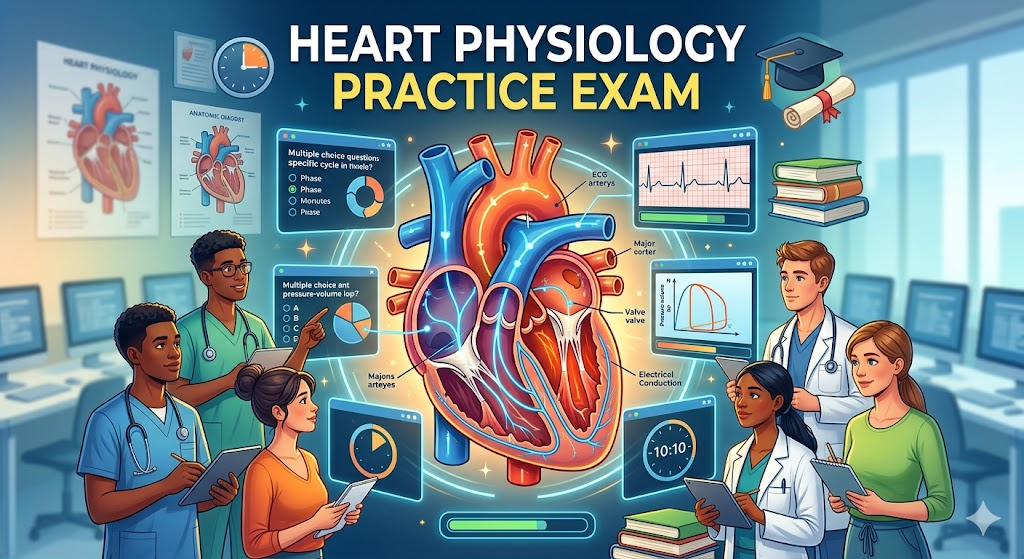
Additional Information
What the Course Entails and Exam Details
The relevant coursework and the subsequent practice exam cover a wide range of critical cardiac topics.
You will encounter questions detailing the macroscopic and microscopic anatomy of the heart and great vessels.
A significant portion of the material focuses on the cardiac cycle, including detailed pressure-volume relationships.
The conduction system, including the generation and propagation of action potentials and basic ECG/EKG interpretation, is also a core focus.
Additional topics include the regulation of cardiac output, blood pressure control mechanisms, and fundamental hemodynamics.
This exam tests both recall of anatomical/physiological facts and the application of concepts to clinical scenarios.
What to Expect in the Final Exam
This practice exam simulates the structure and pressure of an actual final certification.
You should expect a set number of multiple-choice questions (e.g., 50 to 100).
The exam is typically timed (e.g., 60 to 120 minutes) to mirror the pace required for professional licensure.
While passing scores can vary by specific institution or certification body, this practice material is often designed around a 70-80% pass mark for proficiency.
Questions may present diagrams, graphs, or short clinical vignettes requiring interpretive skills.
The exam is typically closed-book and requires focused attention throughout the allotted time.
How to Study and Exam Centers
Effective preparation requires a combination of spaced repetition and active recall.
Utilize reputable physiology textbooks and detailed anatomical charts as your primary study material.
Incorporate dynamic tools such as digital flashcards, dedicated study apps, and educational videos for visual reinforcement.
Taking multiple practice exams is essential for building stamina and improving time management skills.
Review both correct and incorrect answers thoroughly to understand the underlying rationale.
This specific practice material is typically delivered through online educational portals, learning management systems, or within authorized training schools.
Official certification exams are often held at proctored facilities like Pearson VUE centers or authorized university testing labs.
Job Opportunities from the Course
Successfully mastering heart physiology and earning related certifications can significantly enhance your career in healthcare.
Specific job titles and career paths often supported by this knowledge include:
Registered Nurse (especially in ICU or Cardiac Units)
Cardiovascular Technologist
EKG/ECG Technician
Emergency Medical Technician (EMT) or Paramedic
Medical Assistant
Exercise Physiologist
Cardiac Rehabilitation Specialist
Pre-Medicine/Medical Student (as foundational knowledge
Frequently Asked Questions
Reviews
5.0
Based on 0 reviews
Leave a Review
No reviews yet. Be the first to review!