
Heating, Ventilation, and Air Conditioning (HVAC ) Electrical Practice Test
$69.00
- Buy to unlock unlimited access to all Quiz questions and Answers in this Quiz.
- After purchase you can print a PDF of the whole quiz at any point. The PDF will contain the questions and the correct answers.
About this Exam
Welcome to the vital world of Heating, Ventilation, and Air Conditioning (HVAC) electrical systems.
This essential study guide and practice test are designed to sharpen your theoretical knowledge and practical understanding of the electrical principles powering modern climate control units.
Whether you're a student preparing for your first apprenticeship, a new trainee, or a working professional wishing to master fundamental electrical circuits and troubleshooting, this comprehensive guide and practice assessment offer a structured approach.
Our resource is designed to mimic the complexity and format of industry-standard certification exams, ensuring you are well-prepared for the challenges of the field.
The test focuses specifically on the electrical side of HVAC, ensuring that you can confidently interpret diagrams, diagnose component issues, and ensure safe, efficient operation.
Ready to test your knowledge?
Buy Now to Access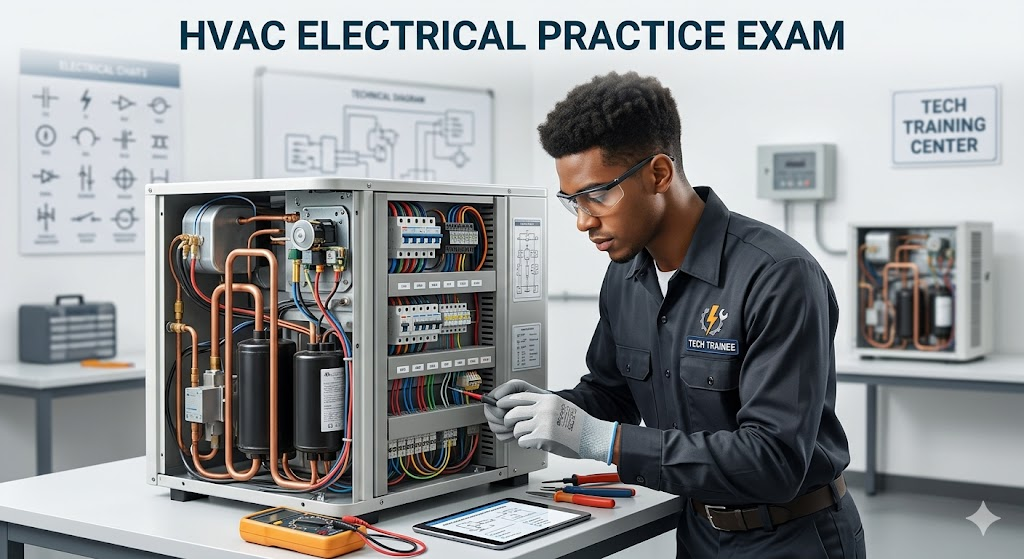
Additional Information
What the Course Entails and Exam Details
This practice assessment covers a comprehensive range of critical HVAC electrical concepts and skills:
Electrical Safety & Codes: Deepen your knowledge of key safety protocols, personal protective equipment (PPE), and relevant electrical codes like the National Electrical Code (NEC) specifically applicable to HVAC installations.
Basic Electricity Principles: Master essential fundamentals including current, voltage, resistance, power (Watts), and the practical applications of Ohm’s Law.
Wiring Diagrams & Schematics: Learn to read and interpret various circuit schematics, line diagrams, and ladder diagrams commonly used in HVAC systems.
System Components: Understand the function, testing, and troubleshooting of crucial electrical components such as motors, capacitors, relays, contactors, transformers, thermostats, and circuit boards.
Control Systems: Explore the sequence of operations for both heating and cooling cycles, focusing on how electrical controls and safety switches manage the system.
Troubleshooting: Practice virtual and scenario-based diagnostic techniques to identify common electrical faults, loose connections, and component failures.
What to Expect in the Final Exam
It's important to understand that as a practice test designed for educational purposes, this guide and accompanying practice assessment do not lead to a single standardized certification with strict official time limits or universal passing scores administered by a central body like a governmental agency.
Instead, you can expect:
Format: A comprehensive set of multiple-choice questions, which may include image-based diagrams to interpret and scenario-based questions requiring diagnosis and problem-solving, structured similarly to major industry certifications like NATE, EPA Section 608, and state licensing exams.
Duration: Practice providers often offer timed options that simulate actual exam constraints, helping you improve your speed and efficiency. These times vary depending on the specific practice resource you select.
Scoring: There is no official "passing" threshold. The value lies in the detailed feedback, often provided with correct answers and explanations, allowing you to gauge your readiness and pinpoint areas needing further study.
Rules: Standard testing integrity rules should always be followed during practice to get an accurate representation of your performance.
The goal is to provide a rigorous assessment environment that thoroughly prepares you for the conditions of real-world licensing and certification.
How to Study and Exam Centers
Effective preparation is key to success in HVAC electrical work and certifications:
Utilize Multiple Resources: Don’t rely on a single source. Combine official textbooks, educational videos, detailed study guides, and, of course, repeated use of this and other comprehensive practice tests to reinforce knowledge.
Understand, Don't Memorize: Focus on grasping the underlying principles. If you truly understand how a sequence of operations or a ladder diagram works, you can apply that knowledge to various scenarios, rather than just matching a memorized answer.
Simulate Exam Conditions: Periodically take practice tests under timed conditions in a quiet environment, without referencing notes, to accurately assess your readiness. Use the score breakdown to create a targeted revision plan.
Practical Experience: Whenever possible, supplement your theoretical learning with safe, supervised, hands-on practice. Seeing real components in a system and using a multimeter can solidify your understanding.
Regarding Exam Centers:
These practice assessments are typically available as online portals through educational platforms, specialized study guide websites, or trade schools. You can often access them from any computer with an internet connection.
It's crucial to understand that practice tests are not typically taken at official professional testing centers. When you are ready to take the actual industry certifications (such as NATE or various state-level HVAC licenses), those formal exams will be administered at authorized testing facilities, such as:
Pearson VUE: A common administrator for many professional certifications.
Specific Physical Testing Centers: Local, authorized centers often associated with educational institutions or industry bodies.
Authorized Schools: Trade schools or colleges may be authorized to host specific certifications for their students.
Always check the requirements of the specific certification body (e.g., NATE, your state’s licensing board) for accurate information on registering for and taking official exams. Our practice guide prepares you to succeed when you reach those centers.
Job Opportunities from the Course
Mastering the electrical components of HVAC systems is a significant asset that opens doors to various rewarding career paths. Successfully completing thorough preparation, including this practice test, is a great step towards obtaining relevant certifications and roles such as:
HVAC Technician
Low-Temperature Field Technician
Commercial Refrigeration Technician
HVAC Controls Specialist
Industrial Refrigeration Technician
Facility Maintenance Technician (with HVAC and electrical expertise)
HVAC Service Manager
Estimator or Inspector with HVAC expertise
Achieving a high level of proficiency in this critical area significantly enhances your employability and potential for career advancement.
Frequently Asked Questions
Reviews
5.0
Based on 0 reviews
Leave a Review
No reviews yet. Be the first to review!