
Helicopter PPL Checkride Practice Test
$69.00
- Buy to unlock unlimited access to all Quiz questions and Answers in this Quiz.
- After purchase you can print a PDF of the whole quiz at any point. The PDF will contain the questions and the correct answers.
About this Exam
The Helicopter Private Pilot License (PPL) is the gateway to the world of rotary-wing aviation.
It is designed for individuals who wish to fly helicopters for pleasure, personal business, or as the initial, critical step toward a professional career in aviation.
Unlike the written knowledge test, the "checkride" is the final hurdle: a practical, hands-on examination with an FAA-designated examiner.
Successfully navigating this exam proves that you have the knowledge, skill, and judgment necessary to safely act as Pilot in Command (PIC) of a helicopter.
A robust practice exam is essential for identifying weaknesses and building the confidence required to pass this intense evaluation.
Ready to test your knowledge?
Buy Now to Access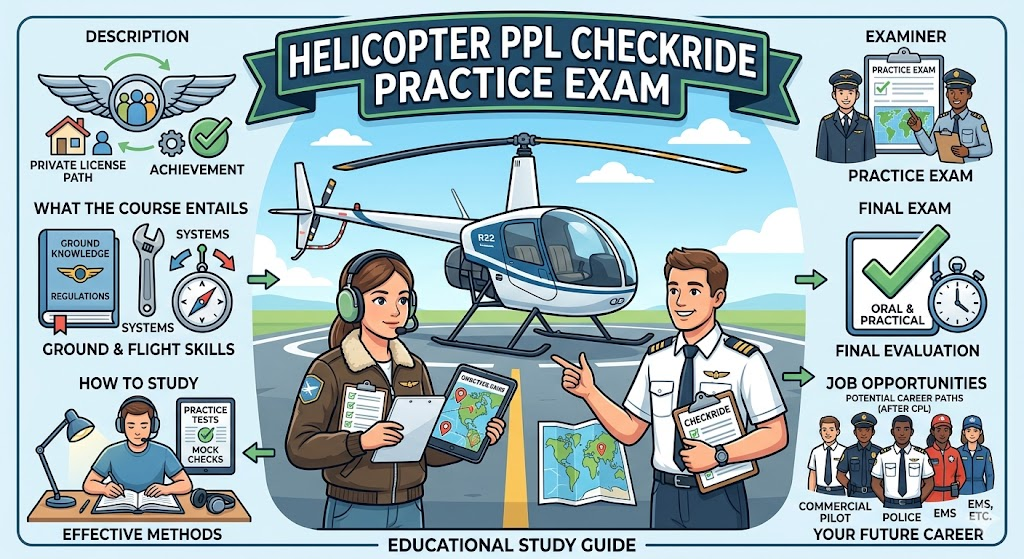
Additional Information
What the Course Entails and Exam Details
To prepare for the checkride, pilots complete a comprehensive ground school and flight training curriculum.
The training covers key theoretical areas such as aerodynamics, helicopter systems, federal aviation regulations, and navigation.
The checkride itself is structured around the FAA Airman Certification Standards (ACS), which is the definitive guide on what tasks must be performed.
Core skills that will be tested include pre-flight preparation, airport and heliport operations, and basic flight maneuvers like hovering and steep turns.
You will also be evaluated on takeoffs, landings, performance maneuvers, and emergency procedures, such as autorotations.
Furthermore, the examiner will assess your understanding of night operations (if applicable), post-flight procedures, and, crucially, aeronautical decision-making.
What to Expect in the Final Exam
The final exam is not a computerized test; it is a dynamic, multi-hour encounter with a Designated Pilot Examiner (DPE).
The checkride is strictly divided into two primary parts: the Oral Exam and the Practical Flight Test.
During the oral exam, the DPE will question you on aviation theory, regulations, and scenario-based judgment for several hours.
You must pass the oral portion before you are allowed to proceed to the aircraft for the flight portion.
In the helicopter, you will demonstrate mastery of the required maneuvers according to the ACS tolerances.
The checkride does not have a "score" but is graded as Satisfactory, Unsatisfactory, or Discontinued (often due to weather).
You have a generous time limit to complete the practical portion of the training, but the checkride is a single event, often lasting 4-6 hours in total.
How to Study and Exam Centers
The best way to study for the checkride is through consistent, realistic practice and repetition.
Utilize specialized Helicopter PPL Checkride Practice Test materials that provide hundreds of potential oral exam questions.
Conduct extensive mock checkrides with your Flight Instructor, asking them to grill you with scenarios and adhere strictly to ACS flight tolerances.
Physical preparation is key: study the Helicopter Flying Handbook and memorize your specific aircraft’s Pilot’s Operating Handbook (POH).
The checkride itself cannot be taken online; it must be scheduled at a physical location, usually your flight school or a designated FAA testing center.
Your flight school will coordinate the scheduling directly with an available Designated Pilot Examiner (DPE).
Job Opportunities from the Course
A Private Pilot License is non-commercial, meaning you cannot fly for compensation or hire.
However, obtaining your PPL is the foundational requirement for the advanced training that leads to these career paths:
Certified Flight Instructor (CFI) Helicopter
Commercial Helicopter Pilot
Emergency Medical Services (EMS) Pilot
Law Enforcement Aviation Pilot
Aerial Tours and Sightseeing Pilot
Utility and Infrastructure Inspection Pilot
Corporate/Executive Transport Pilot
Remember, the PPL itself unlocks personal flight and further specialized training, leading to these advanced, professional helicopter pilot roles. Good luck with your preparation, keep practicing, and blue skies await you!
Frequently Asked Questions
Reviews
5.0
Based on 0 reviews
Leave a Review
No reviews yet. Be the first to review!