
Helm Safety Practice Test
$69.00
- Buy to unlock unlimited access to all Quiz questions and Answers in this Quiz.
- After purchase you can print a PDF of the whole quiz at any point. The PDF will contain the questions and the correct answers.
About this Exam
The Human Element, Leadership, and Management (HELM) certification is a vital qualification for maritime professionals aspiring to leadership roles. Developed in accordance with the International Convention on Standards of Training, Certification and Watchkeeping for Seafarers (STCW), this course focuses on the most critical component of maritime safety: the human factor. It is specifically designed for deck and engineering officers at both operational and management levels who seek to enhance their ability to lead crews effectively, make sound decisions under pressure, and manage resources safely at sea.
By completing this course and passing the associated exam, you demonstrate your commitment to reducing human error, optimizing team performance, and fostering a robust safety culture on board any vessel. This study guide and our practice test will provide the knowledge foundation needed to succeed in this challenging and essential assessment.
Ready to test your knowledge?
Buy Now to Access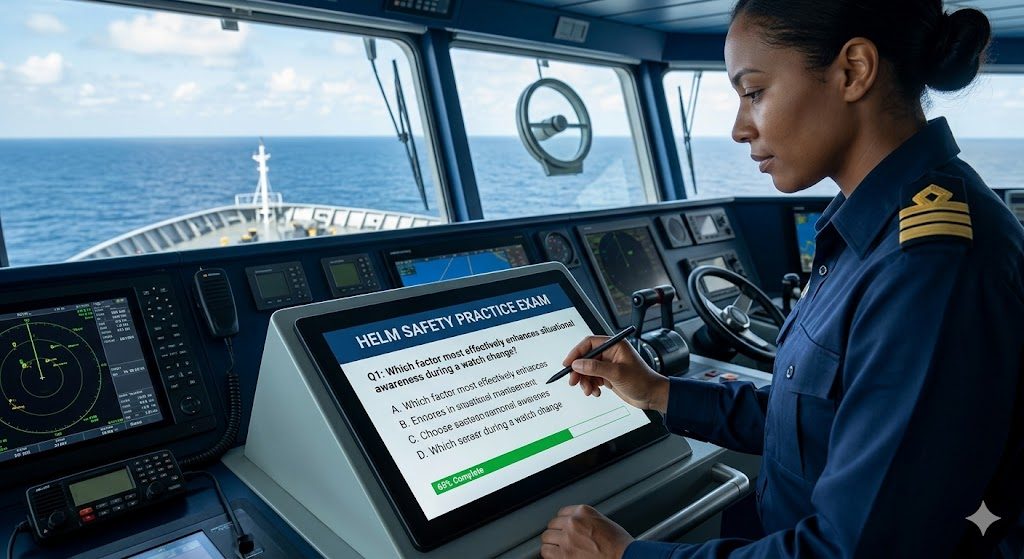
Additional Information
What the Course Entails and Exam Details
A HELM course is not just about learning rules; it is about understanding human behavior and interaction within a dynamic technical environment. The training combines theoretical knowledge with practical scenario-based learning.
The core syllabus typically covers several key domains, including:
Situational Awareness: Techniques for acquiring and maintaining an accurate understanding of the vessel’s environment and operational status to prevent accidents.
Communication: Mastering best practices for clear, assertive, and effective communication, including recognizing and overcoming common barriers on a multicultural vessel.
Teamwork and Leadership: Understanding different leadership styles, motivation techniques, and how to build and maintain high-performing, cooperative teams.
Resource Management: Effective allocation, prioritization, and management of task workloads, personnel, and technical resources.
Decision-Making: Applying structured decision-making techniques, understanding cognitive biases, and managing risks effectively in both standard and emergency situations.
Fatigue and Stress Management: Recognizing the symptoms and causes of fatigue and stress, and implementing mitigation strategies to prevent human error.
Cultural Awareness: Respecting and managing cultural diversity to improve cooperation and reduce conflict on board.
The final course examination aims to assess your competency across all these domains, ensuring you can apply these principles to real-world maritime scenarios.
What to Expect in the Final Exam
The HELM final assessment is typically a multi-part evaluation designed to test both your theoretical knowledge and your practical application skills. While the exact structure can vary slightly depending on the authorized training provider, you can generally expect the following components:
Written/Theoretical Component:
Format: This section often consists of multiple-choice questions, scenario-based problem-solving questions, or short-answer descriptive questions.
Duration: The time limit for the written section is usually strictly enforced, often ranging from 30 to 60 minutes.
Passing Score: Students generally must achieve a score of 70% to 75% or higher to pass this theoretical component.
Content: The questions will focus on interpreting STCW regulations regarding HELM, identifying human factor errors in provided case studies, and selecting the most appropriate leadership or communication style for a given situation.
Practical/Continuous Assessment Component:
Format: In addition to the written exam, instructors continuously assess your performance during practical simulator exercises and workshop scenarios throughout the course.
Content: You will be evaluated on your ability to demonstrate effective leadership, maintain situational awareness, and communicate clearly during simulated navigational or engineering emergencies.
Passing Requirement: You must demonstrate proficiency in these practical skills to the satisfaction of the assessors. Successful completion of the final exam requires passing both the written and practical elements.
How to Study and Exam Centers
Preparation is the key to success in the HELM assessment. Because this exam tests your ability to make critical decisions, passive reading is insufficient.
Actionable Study Strategies:
Engage Actively with Course Material: Don't just read the handouts; take detailed notes during lectures and simulator debriefs. Pay close attention to the models of communication and decision-making presented.
Review Maritime Case Studies: Analyze reports of real maritime accidents. Identify where failures in situational awareness, communication, or leadership contributed to the incident. Practice articulating how HELM principles could have prevented the outcome.
Practice Situational Decision-Making: When using practice tests, focus not just on the correct answer, but why other options are less appropriate in a maritime context. This builds the critical thinking skills evaluated in the final exam.
Collaborate with Peers: Discuss scenario questions with colleagues or classmates. Hearing different perspectives on how to handle a crew conflict or an emergency will broaden your understanding of leadership dynamics.
Exam Centers and How to Take the Exam:
It is essential to understand that the final HELM certification exam cannot be taken as a standalone online test. To receive an approved STCW HELM certificate, you must enroll in and complete a mandatory course through an Authorized Maritime Training Provider.
Physical Testing Centers: The final written exam and practical simulator assessments are administered on-site at approved maritime academies, colleges, or specialized training centers. These centers are authorized by the relevant national maritime authority (e.g., MCA in the UK, USCG in the US).
Authorized Schools: You can find a list of approved HELM course providers on the official website of your national maritime administration. Our [Helm Safety Practice Test] is an excellent tool to measure your readiness before you attend the required physical course.
Job Opportunities from the Course
A HELM certification is not merely a regulatory requirement; it is a significant asset that enhances your employability and opens doors to advanced roles within the global maritime industry. Successfully completing this course and passing the exam unlocks numerous career paths, including:
Captain/Master Mariner
Chief Officer
Second Officer
Third Officer
Chief Engineer
Second Engineer
Officer in Charge of a Navigational Watch (OOW)
Officer in Charge of an Engineering Watch (EOOW)
Dynamic Positioning (DP) Operator
Marine Superintendent (Shore-based)
Maritime Safety Officer (Shore-based)
Port Operations Manager
Vessel Traffic Service (VTS) Operator
Frequently Asked Questions
Reviews
5.0
Based on 0 reviews
Leave a Review
No reviews yet. Be the first to review!