
Herbicide Applicators Practice Exam
$69.00
- Buy to unlock unlimited access to all Quiz questions and Answers in this Quiz.
- After purchase you can print a PDF of the whole quiz at any point. The PDF will contain the questions and the correct answers.
About this Exam
Welcome to your comprehensive study guide for the Herbicide Applicators Practice Exam. This practice exam is a critical tool for anyone pursuing a career that involves the professional application of herbicides, such as agricultural workers, landscapers, park rangers, and forestry technicians.
A passing score on the official exam is a prerequisite in most regions to obtain a license or certification to apply restricted-use herbicides. This practice exam is specifically designed to help you prepare by providing realistic practice questions that mimic the structure, content, and difficulty level of the actual test, ensuring you have the knowledge and confidence to succeed.
Ready to test your knowledge?
Buy Now to Access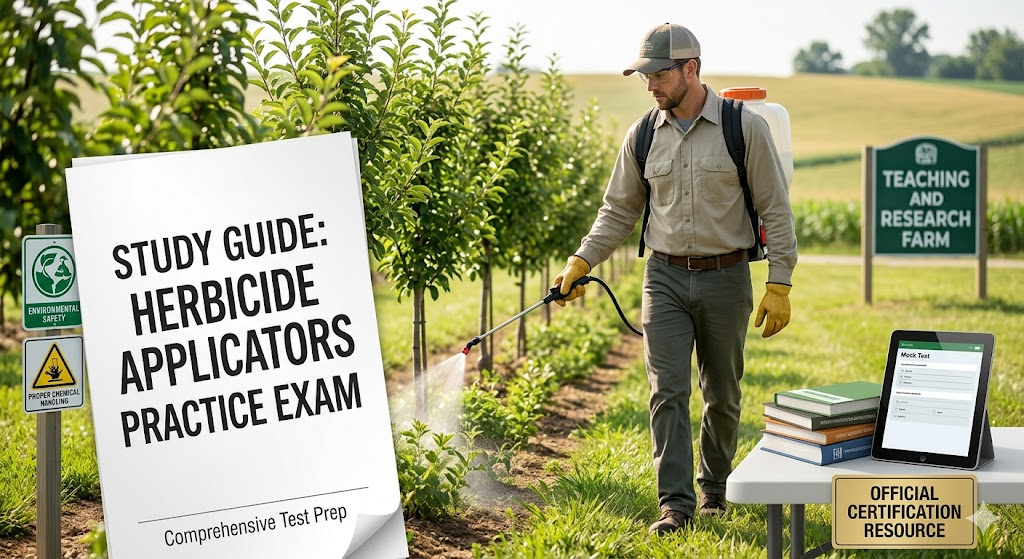
Additional Information
What the Course Entails and Exam Details
This practice guide covers the full spectrum of knowledge required to operate as a certified herbicide applicator. The core topics, or syllabus, are aligned with industry standards and regulatory requirements.
Key areas you will be tested on include:
Pesticide Safety and Personal Protective Equipment (PPE): Understanding proper handling, storage, transport, and the correct use of PPE to minimize exposure risks.
Label Comprehension: Learning to read, interpret, and strictly follow all product label instructions.
Environmental Stewardship: Identifying sensitive areas and applying methods to minimize drift, runoff, and groundwater contamination.
Application Equipment and Calibration: Demonstrating knowledge of different application methods (e.g., boom, backpack, aerial) and how to calculate precise application rates.
Herbicide Classifications and Formulations: Differentiating between selective and non-selective, systemic and contact herbicides, and various formulation types (e.g., granules, liquids, dusts).
State and Federal Regulations: Reviewing the legal landscape, including record-keeping and reporting requirements.
What to Expect in the Final Exam
While the exact structure can vary by jurisdiction, most certified pesticide applicator exams follow a standardized format to ensure fairness and comprehensive assessment.
Format: The exam typically consists of multiple-choice and true/false questions. It may also include short scenario-based problems, especially concerning equipment calibration. In some areas, a practical component or a separate section for specializations (like aquatic or right-of-way) may be included.
Passing Score: A passing score is generally between 70% and 80%.
Time Limits: You will be given a specific time limit to complete the exam, which is typically ample but requires you to manage your time wisely.
Rules: Official exams are proctored. You will not be allowed outside materials, notes, or mobile devices. You will be required to provide a valid photo ID.
How to Study and Exam Centers
Effective preparation is key to passing.
Actionable Study Strategies:
Use the Core Manual: The foundational resource for the exam is the state-specific or national core manual. Read this manual cover-to-cover multiple times.
Take Practice Exams: Leverage this Herbicide Applicators Practice Exam repeatedly. Focus not only on the correct answers but also on why the other options are incorrect.
Create Flashcards: Master definitions, formulas for calibration, and PPE requirements.
Simulate Exam Conditions: Take a timed practice session to get accustomed to the pace and pressure.
Hands-on Practice: If possible, review equipment and practice simple calibration with water under the guidance of a licensed mentor.
Exam Centers and Registration: Registration for the final exam is managed by your local, state, or provincial regulatory agency, usually the Department of Agriculture, Environmental Protection Agency, or a comparable entity. Tests are typically taken in one of the following ways:
Authorized Physical Testing Centers: Locations dedicated to state licensure exams.
Department of Agriculture Offices: Specific test days are often scheduled.
Online Portals: Some jurisdictions offer proctored online exams through services like Pearson VUE or state-managed systems.
Job Opportunities from the Course
A certified herbicide applicator license opens the door to numerous valuable and high-demand roles across several sectors.
Agriculture: Farm Manager, Crops Specialist, Agricultural Chemical Applicator, Pest Control Adviser.
Landscape & Turf: Turf Manager (e.g., Golf Course Superintendent), Sports Field Manager, Commercial Lawn Care Specialist, Groundskeeper.
Public Sector: Park Ranger, Invasive Species Technician, Rights-of-Way Manager (roadsides, railways), Aquatic Vegetation Control Specialist.
Forestry: Forestry Technician, Sylviculturalist, Reforestation Specialist.
Commercial Pest Control: Vegetation Management Specialist.
Sales & Technical Support: Representative for chemical manufacturers or distributors.
A certified applicator is often in high demand and receives higher compensation than non-certified workers due to the technical knowledge and responsibility required for the role.
Frequently Asked Questions
Reviews
5.0
Based on 0 reviews
Leave a Review
No reviews yet. Be the first to review!