
HESI Basic Care and Comfort Practice Exam
$69.00
- Buy to unlock unlimited access to all Quiz questions and Answers in this Quiz.
- After purchase you can print a PDF of the whole quiz at any point. The PDF will contain the questions and the correct answers.
About this Exam
The HESI Basic Care and Comfort exam is a standardized test designed for nursing and allied health students, assessing their knowledge and practical application of fundamental patient care principles.
This certification is typically a requirement within nursing programs (LPN/LVN and RN) to ensure students possess the essential skills to provide safe, effective, and compassionate care.
It is designed for students early in their healthcare education, bridging the gap between theoretical knowledge and clinical practice.
Ready to test your knowledge?
Buy Now to Access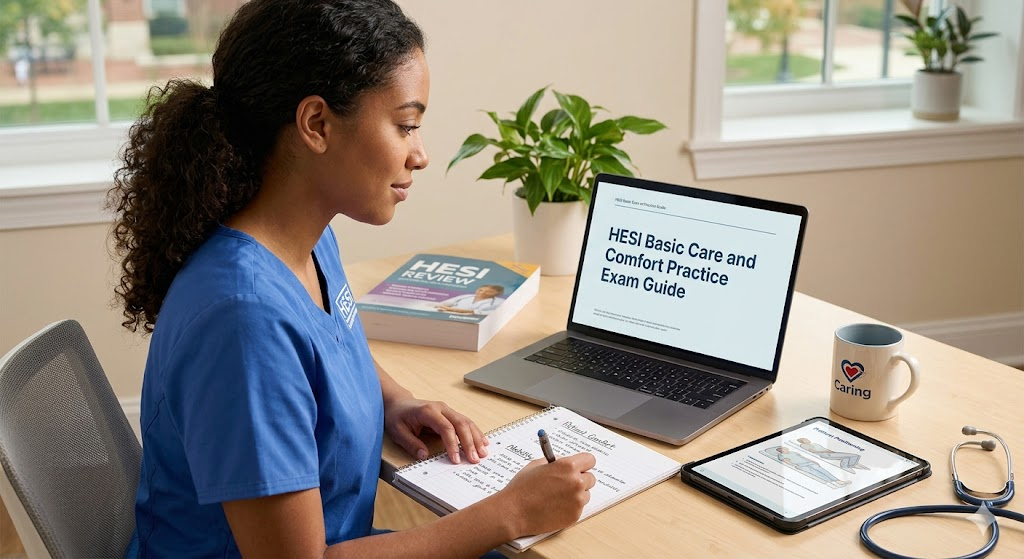
Additional Information
What the Course Entails and Exam Details
This exam covers the core aspects of a patient’s daily needs and the nurse’s role in meeting them.
The syllabus typically includes topics such as:
Personal Hygiene: Bathing, skin care, oral care, and grooming.
Nutrition and Hydration: Assessing dietary needs, assisting with feeding, and monitoring fluid balance.
Mobility and Immobility: Safe patient handling, positioning, range-of-motion exercises, and ambulation assistance.
Rest and Sleep: Factors affecting sleep, sleep promotion strategies, and maintaining a restful environment.
Comfort Measures: Pain management basics, non-pharmacological interventions, and creating a supportive atmosphere.
Elimination: Assisting with bowel and bladder needs, monitoring output, and specimen collection.
Infection Control: Standard precautions, hand hygiene, and personal protective equipment (PPE).
Patient Safety: Fall prevention, environmental safety, and emergency procedures.
What to Expect in the Final Exam
The final HESI Basic Care and Comfort exam is a computer-based test, typically consisting of multiple-choice questions.
While the exact number of questions can vary slightly by institution, it generally includes around 50-75 scored questions.
Passing score requirements are determined by individual nursing programs rather than a universal standard set by HESI. Students are usually required to achieve a specific percentile score (often 75-80% or higher) as defined by their school's policy.
The time limit is also set by the testing center or school, but students usually have a generous amount of time (often 90 minutes to 2 hours) to complete the exam.
Specific rules, such as arriving early with valid photo identification and prohibiting personal items in the testing area, are strictly enforced at all authorized testing centers.
How to Study and Exam Centers
Effective preparation is key to success.
Students should utilize HESI-specific study guides, practice tests, and review their course textbooks. Taking a baseline practice exam helps identify areas needing more focus.
Creating flashcards for key terms, normal vital sign ranges (introduction), and standard precautions can be very effective. Group study sessions can also provide valuable insights and peer support.
Focusing on the rationale behind correct answers during practice is crucial, as HESI questions often assess application and analysis rather than simple recall.
The exam is taken at authorized locations, including:
Nursing Schools: Many institutions administer HESI exams directly to their students.
Pearson VUE Testing Centers: A widespread network of professional testing centers globally.
Prometric Testing Centers: Another common option for standardized healthcare testing.
Other Authorized Computer-Based Testing (CBT) Sites: Specific locations approved by Elsevier (the publisher of HESI).
Students should schedule their exam through their nursing program or the official testing vendor's website and confirm the exact location.
Job Opportunities from the Course
Successfully passing this exam demonstrates a strong foundation in basic patient care, opening doors to various entry-level healthcare roles or serving as a crucial step towards licensure. Key career paths include:
Certified Nursing Assistant (CNA)
Licensed Practical Nurse (LPN) / Licensed Vocational Nurse (LVN) (as part of a broader program)
Registered Nurse (RN) (as part of a broader program)
Patient Care Technician (PCT)
Home Health Aide
Restorative Aide
Hospice Aide
Frequently Asked Questions
Reviews
5.0
Based on 0 reviews
Leave a Review
No reviews yet. Be the first to review!