
HESI Cardiology Practice Exam
$69.00
- Buy to unlock unlimited access to all Quiz questions and Answers in this Quiz.
- After purchase you can print a PDF of the whole quiz at any point. The PDF will contain the questions and the correct answers.
About this Exam
The HESI Cardiology Practice Exam is a powerful tool designed to help nursing students and healthcare professionals master the critical, complex concepts of the cardiovascular system.
HESI exams are widely used across nursing and allied health programs as benchmarks for academic readiness and final licensure success. This specialized practice exam focuses your preparation on one of the most vital areas of medical study, offering a targeted review of cardiac care.
Whether you're gearing up for a HESI specialty exam, preparing for a cumulative exit exam, or solidifying your knowledge for the NCLEX licensure test, this practice resource is an essential component of your study plan. It is ideal for students seeking to assess their understanding, build confidence, and identify specific knowledge gaps before taking high-stakes evaluations. By mirroring the structure and rigor of actual exam questions, the HESI Cardiology Practice Exam provides realistic, actionable insights to ensure you are fully prepared for success.
Ready to test your knowledge?
Buy Now to Access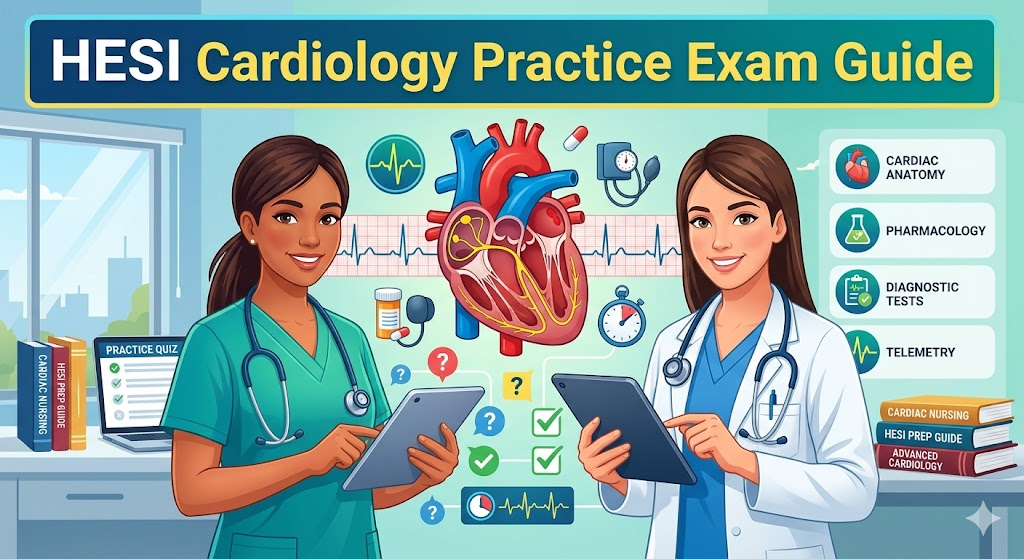
Additional Information
What the Course Entails and Exam Details
This practice resource covers a comprehensive syllabus of cardiology topics essential for competent patient care. You can expect to encounter questions that test your understanding of:
The detailed anatomy and physiological functions of the heart, blood vessels, and circulatory systems.
The pathophysiology of common cardiac disorders, such as coronary artery disease, heart failure, and dysrhythmias.
Critical diagnostic techniques and interpretations, including ECG monitoring, cardiac biomarkers, and imaging.
Nursing interventions and pharmacological treatments related to cardiovascular health.
Patient monitoring and management in both acute and chronic cardiac scenarios, incorporating hemodynamic principles and critical care concepts.
The HESI Cardiology Practice Exam is presented in a flexible, interactive format. It features countless high-quality, realistic practice questions that are modeled after those found on official HESI and NCLEX exams, including next-generation formats. While the specific number of questions can vary within different practice modules or simulated tests, the content is curated to provide a robust assessment of your cardiology expertise.
What to Expect in the Final Exam
While the HESI Cardiology Practice Exam is a preparatory resource rather than a final certification in itself, its structure and final simulated assessments are designed to give you a genuine preview of high-stakes, proctored exam conditions. Here is what you can generally anticipate:
Computerized Testing Format: Like the actual HESI Exit or NCLEX exams, you will typically complete the final practice evaluations on a computer, with one question presented at a time.
Multiple-Choice and Detailed Question Types: The practice final will primarily consist of multiple-choice questions, but may also include illustrative scenarios, prioritization questions, and other critical thinking formats that reflect the complexity of real-world nursing scenarios.
Predictive Scoring & Detailed Feedback: While the practice exam does not have a set "passing" score to grant a qualification, you will receive a comprehensive score report upon completion. This report will detail your performance across different content areas, giving you a predictive indicator of your readiness for an actual proctored exam and, more importantly, a detailed breakdown of where you may need further study.
Time Management Concept: Some simulated practice tests may include a timer to help you build test-taking stamina and better manage your pace, preparing you for the time constraints of an official HESI assessment.
Understanding the Official Final: It is crucial to remember that your official HESI Exit or specialty exams will have strict proctoring, will typically be taken on your school campus or at an authorized testing center, and may not allow you to go back and change previous answers once you have submitted them. Use the practice exam to build the confidence and knowledge needed to excel in this final, formal evaluation.
How to Study and Exam Centers
Effective preparation is the key to success. Utilize these proven study strategies and understand how to access and take your HESI assessments.
Actionable Study Strategies:
Start with a Diagnostic Test: Take an initial practice test to benchmark your current knowledge. Use the results to pinpoint your weak points.
Create a Structured Plan: Develop a study schedule that dedicates consistent, focused time to the specific cardiology topics where you need the most review.
Practice with Purpose: Don't just answer questions; read and understand the rationales provided for both correct and incorrect answers. This is one of the most effective ways to reinforce your understanding and learn from mistakes.
Simulate Exam Conditions: Periodically take full-length practice tests under timed, distraction-free conditions to build stamina and get accustomed to the pressure.
Use Diverse Resources: Supplement your practice with high-quality textbooks, online modules, specific cardiology study guides, and visual aids like anatomy diagrams.
Exam Centers & Access:
Accessing the Practice Exam: The HESI Cardiology Practice Exam is usually accessed online. You will typically log in through a specific portal provided by your educational institution or the practice test provider. You can generally study from any location with a secure internet connection.
Taking Official HESI Exams: Your actual, proctored HESI specialty or exit exams will be coordinated by your school. These are most commonly taken on campus under strict supervision. In some cases, schools may authorize you to take the exam at specific, approved testing centers or potentially utilize remote proctoring services, which would also have stringent security and dynamic monitoring. Always check with your program coordinator for the exact location and scheduling of your official HESI assessments.
Job Opportunities from the Course
A strong foundation in cardiology, validated by success in HESI exams and your resulting licensure/certification, unlocks a wide array of rewarding career paths in a high-demand medical field. Mastering this crucial knowledge is a vital step toward securing specific roles and advancements.
Here is a clear list of some specific job titles and career paths this essential knowledge and qualification support:
Cardiac Care Nurse: Registered nurses who specialize in treating and educating patients with complex heart and blood vessel conditions, often working in specialized hospital units or outpatient clinics.
Cardiovascular Technologist: Professionals who assist physicians in diagnosing and treating cardiovascular and peripheral vascular conditions, often working with sophisticated medical equipment in catheterization labs.
Cardiac Sonographer (Echocardiographer): Specialists who use ultrasound equipment to create images of the heart chambers, valves, and blood flow, providing critical data for diagnosis and treatment.
Vascular Sonographer: Medical professionals who use ultrasound to image the body's vascular system, diagnosing conditions like arterial blockages and blood clots.
Critical Care Nurse: Nurses working in intensive care units, managing and monitoring critically ill patients with acute, unstable cardiovascular conditions.
Telemetry Nurse: Healthcare providers specialized in monitoring the continuous cardiac rhythms of patients using specialized electronic equipment.
Heart Failure Specialist/Nurse Navigator: Dedicated roles focused on the comprehensive care management, education, and support of patients living with heart failure.
Cath Lab Nurse: Nurses who work closely with cardiovascular physicians during interventional procedures in the cardiac catheterization lab.
Phlebotomist with Specialization: Healthcare professionals who can utilize their deep knowledge of vascular anatomy and blood conditions in cardiovascular and phlebotomy settings.
Successfully navigating your cardiology studies, including utilizing resources like the HESI Cardiology Practice Exam, is a pivotal investment in your future and a huge step towards achieving a fulfilling career in cardiovascular care. Good luck with your studies
Frequently Asked Questions
Reviews
5.0
Based on 0 reviews
Leave a Review
No reviews yet. Be the first to review!