
HESI General Chairside Assisting Practice Exam
$69.00
- Buy to unlock unlimited access to all Quiz questions and Answers in this Quiz.
- After purchase you can print a PDF of the whole quiz at any point. The PDF will contain the questions and the correct answers.
About this Exam
The HESI General Chairside Assisting exam is a specialized benchmark assessment created by Elsevier to validate the clinical competency and foundational knowledge of aspiring dental assistants. This exam is a critical step for students who are completing their dental assisting programs or for practicing professionals seeking to verify their understanding of essential chairside procedures before challenging national or state certification tests. It acts as a comprehensive exit exam or an assessment of student readiness, covering the core practical skills and knowledge required to function effectively as a key member of the dental healthcare team.
By taking this assessment, you demonstrate your proficiency in everything from fundamental dental sciences to advanced clinical workflows. For students, it provides a valuable measurement of their preparedness for the workforce and national certification, while for institutions, it offers a standardized tool to gauge the effectiveness of their dental assisting curriculum. Passing this exam signals to future employers that you possess the hands-on expertise and theoretical understanding necessary to succeed in a high-paced dental practice.
Ready to test your knowledge?
Buy Now to Access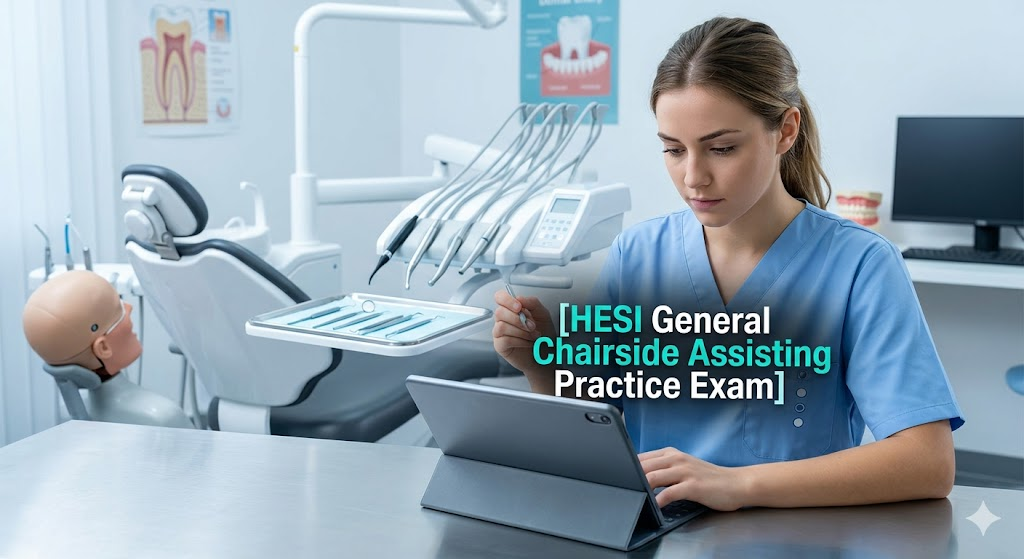
Additional Information
What the Course Entails and Exam Details
This examination does not represent a standalone "course" in the traditional sense, but rather a final evaluation that synthesizes the entire body of knowledge gained during your comprehensive dental assisting training. The content is rigorously structured to map against the core knowledge areas required for general chairside assistance.
The details of the exam are comprehensive and cover crucial domains, often including:
Four-Handed Dentistry: Mastery of ergonomics, instrument transfer techniques, maintaining the operating field, and proficiently assisting the dentist during procedures.
Dental Materials: Understanding the properties, composition, mixing techniques, and applications of common materials like cements, restorative components (amalgam, composite), and impression materials.
Dental Instruments: Comprehensive identification and knowledge of the specific functions and maintenance protocols for all types of chairside and specialty instruments.
Patient Care and Management: Validating skills in greeting, preparing, and positioning the patient, collecting vital signs, medical history review, and assisting with anxiety management.
Clinical Procedures: Step-by-step knowledge of the procedures for restorative work, endodontics, periodontics, oral surgery, and preventative care.
Infection Control: While often tested in a dedicated module, fundamental infection control and sterilization processes are deeply embedded in chairside workflows and are critical knowledge.
What to Expect in the Final Exam
The HESI General Chairside Assisting final exam is typically delivered in a computerized format. It consists entirely of multiple-choice questions designed to test both simple recall and critical, scenario-based application of clinical concepts.
Unlike national certification exams, HESI specialty exams, including the Chairside Assisting test, do not have a universally mandated "passing" score. The minimum required score is set by the individual institution or program administering the test. Many programs utilize a HESI score ranging from 850 to 900 as their benchmark for competency. This score is calculated using a proprietary HESI algorithm that weights the difficulty of the questions, rather than simply counting the percentage of correct answers.
You should contact your program director or instructor to confirm the specific number of questions and the time limit you will face, as these can vary slightly. However, HESI exams are known for including "critical thinking" questions that require you to apply your knowledge to real-world clinical situations, ensuring you can "think on your feet" in a busy operatory.
How to Study and Exam Centers
Effective preparation is key to building the confidence needed to succeed. First, and most importantly, lean heavily on the core textbooks, lab manuals, and clinical checklists provided during your dental assisting program. Focus your initial review on the official HESI review materials and practice exams, as these are the most accurate representation of the question style and content you will encounter.
Next, prioritize practical, simulation-based studying. Review step-by-step workflow procedures for common treatments. Create flashcards for identifying instruments and their functions, and practice mixing different types of dental materials, explaining the rationale for each step. Form study groups to practice instrument transfer and review case studies, simulating real-world operatory scenarios. Practicing under timed conditions will also help you master the pacing required for the computerized exam format.
Regarding the testing location, the HESI General Chairside Assisting exam is almost always administered directly through your accredited educational institution or dental assisting program. Exams are proctored on campus or through authorized, secure testing portals approved by your school. Your program will manage your registration, payment, and scheduling. There is usually no need to visit a general third-party center like Pearson VUE for this specific HESI specialty exam, unless explicitly directed by your institution.
Job Opportunities from the Course
A strong performance on this exam validates your readiness for a successful career. Mastering the knowledge it tests unlocks the path to several rewarding job titles in the dental field.
Completing your training and proving your competency through this assessment allows you to confidently pursue the following career paths:
Registered Dental Assistant (RDA): The foundational title in many states, requiring formal education and examination to perform expanded functions.
Certified Dental Assistant (CDA): By demonstrating readiness for national certification through the HESI exam, you take a major step toward achieving the coveted CDA credential from DANB.
Chairside Dental Assistant: The essential role assisting dentists directly with a wide variety of patient procedures.
Orthodontic Assistant: A specialized dental assisting role focusing on the installation and adjustment of corrective appliances.
Oral Surgery Assistant: Assisting with complex surgical procedures, managing sterile fields, and providing critical pre- and post-operative care.
Laboratory Assistant: Using your knowledge of materials and dental anatomy to fabricate appliances and models in a laboratory setting.
Sterilization Technician: Specializing in infection control, instrument sterilization, and managing dental operatory aseptic protocols.
Frequently Asked Questions
Reviews
5.0
Based on 0 reviews
Leave a Review
No reviews yet. Be the first to review!