
HFC Designer I & II Certification Practice Exam
$69.00
- Buy to unlock unlimited access to all Quiz questions and Answers in this Quiz.
- After purchase you can print a PDF of the whole quiz at any point. The PDF will contain the questions and the correct answers.
About this Exam
The Hybrid Fiber-Coaxial (HFC) Designer I & II Certification is a premier industry credential that validates your expertise in planning, designing, and optimizing HFC broadband networks. These systems are the backbone of modern telecommunications, delivering high-speed internet, digital television, and voice services to millions. This multi-level certification path is designed for network technicians, engineers, outside plant (OSP) designers, and anybody looking to solidify their role in the expanding field of broadband infrastructure. Level I builds a strong foundation in HFC concepts, while Level II proves your ability to handle complex, real-world design challenges.
Ready to test your knowledge?
Buy Now to Access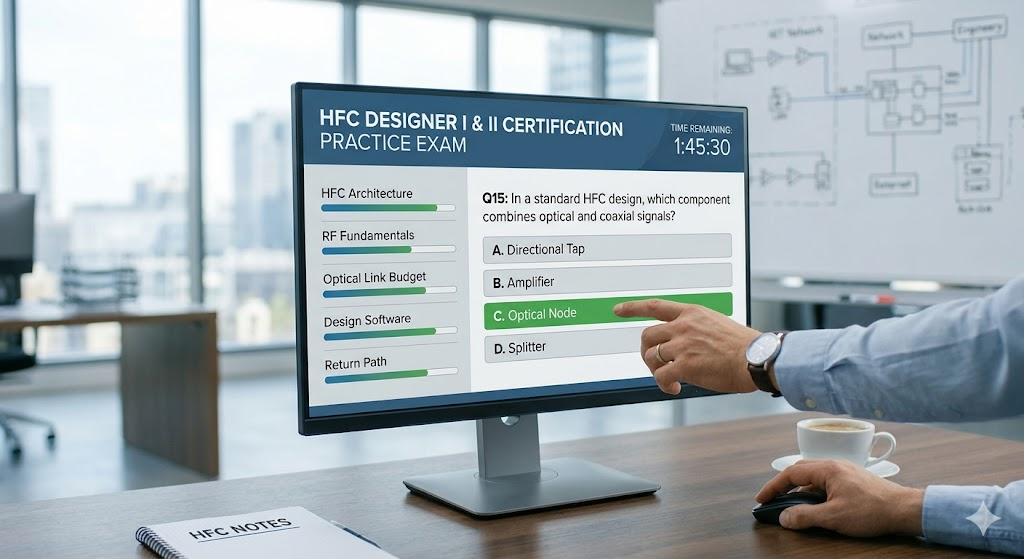
Additional Information
What the Course Entails and Exam Details
This comprehensive certification program covers the entire HFC ecosystem. The combined syllabus includes, but is not limited to, the following core domains:
HFC Architecture: Deep understanding of network topology, from the headend to the customer premises.
Fiber Optic Principles: Optical transmitters, receivers, fiber types, wavelength division multiplexing (WDM), and link loss budgets.
Coaxial Principles and RF (Radio Frequency): Understanding RF signal propagation, modulation techniques, passive and active components, and spectrum management.
Active Devices: Operation and placement of optical nodes, amplifiers (trunk, bridger, line extender), and power supplies.
Passive Devices: Using splitters, couplers, directional taps, and coaxial cables efficiently.
Design Software and Tools: Utilizing industry-standard CAD and GIS-based design platforms (e.g., SpatialNet, Bentley, AutoCAD) for network layout.
Network Calculation: Mastering RF power budget calculations, unity gain, and distortion analysis.
Return Path Design: Essential principles of upstream design to support interactive services.
Industry Standards: Adherence to key standards like DOCSIS (Data Over Cable Service Interface Specification), SCTE, and FCC regulations.
What to Expect in the Final Exam
While exact formats can vary by certifying body, the HFC Designer I & II exam is generally structured as follows to rigorously test your knowledge and practical skills:
Format: A combination of multiple-choice questions, scenario-based problem-solving, and practical design simulations. Level I tends to focus on foundational multiple-choice, while Level II incorporates more direct design applications.
Number of Questions: Expect 80-120 questions in total across both levels.
Time Limit: Approximately 2.5 to 4 hours, providing ample time for careful consideration.
Passing Score: Typically requires a score of 70% to 80% to achieve certification.
Specific Rules: The exam is typically proctored, which means it will be supervised to ensure integrity. It is usually "closed book," though some specialized design tables or calculators may be permitted.
How to Study and Exam Centers
Preparation is the key to success. Employ a multi-faceted study strategy:
Utilize a Practice Exam: The most effective way to gauge your readiness and identify knowledge gaps is by using a specialized [HFC Designer I & II Certification Practice Exam]. This tool mimics the real test environment, style, and difficulty.
Official Study Guides: Review the official curriculum and study materials provided by the certifying organization (e.g., SCTE).
Online and Instructor-Led Courses: Enroll in comprehensive training programs designed specifically for HFC network design. Hands-on design workshops are invaluable.
Gain Practical Experience: Apply concepts in a real-world setting. If you're working in the industry, shadow experienced designers.
Exam Centers and How to Register:
Online Proctoring: For maximum flexibility, the exam is often available through secure online proctoring services, allowing you to take the test from your home or office.
Testing Centers: Certifying bodies like SCTE utilize global networks of authorized testing centers, including major providers like Pearson VUE. These provide a controlled, standardized environment.
Authorized Schools/Organizations: Some local colleges, technical schools, and large telecommunications companies are authorized testing locations for their employees or students. Visit the official certification website to find the nearest location and register for your test date.
Job Opportunities from the Course
Earning your HFC Designer I & II Certification unlocks a variety of career paths within the dynamic telecommunications and broadband sectors. Below is a clear list of potential job titles and roles:
HFC Network Designer
Broadband Network Engineer
OSP (Outside Plant) Designer
CATV Design Engineer
Fiber/Coax Design Specialist
Telecommunications Network Planner
RF (Radio Frequency) Design Engineer
Field Application Engineer
HFC Project Manager
Outside Plant Engineering Lead
By investing in this certification, you prove your commitment to professional excellence and position yourself for growth in an industry crucial to global connectivity. Best of luck on your journey to becoming a Certified HFC Designer!
Frequently Asked Questions
Reviews
5.0
Based on 0 reviews
Leave a Review
No reviews yet. Be the first to review!