
HFRG Defensive Tactics Practice Test
$69.00
- Buy to unlock unlimited access to all Quiz questions and Answers in this Quiz.
- After purchase you can print a PDF of the whole quiz at any point. The PDF will contain the questions and the correct answers.
About this Exam
The HFRG (Human Factor Research Group) Defensive Tactics system, formerly recognized as PPCT (Pressure Point Control Tactics), is a premier subject control system designed for public safety professionals. It stands out by being the first of its kind to be developed through a unique combination of tactical, legal, and medical research. This certification is crucial for individuals who need to manage human resistance in high-stress situations while upholding use of force standards. The system provides tools for controlling resistive behavior through techniques that are not only effective but also legally defensible and medically sound, aiming to minimize injury to both the officer and the subject.
This certification is designed for:
Law Enforcement Officers
Correctional and Detention Officers
Private Security Personnel
Military Police
Other public safety and protective service roles
Ready to test your knowledge?
Buy Now to Access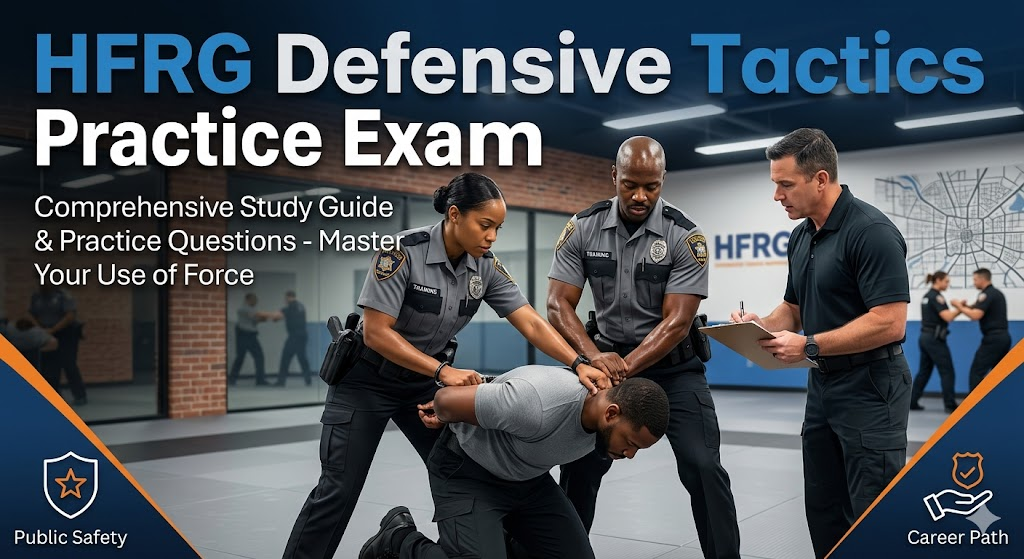
Additional Information
What the Course Entails and Exam Details
The core philosophy of HFRG centers on "Survival Learning" – understanding how the human body and mind respond under the extreme stress of a combat or high-threat situation (the activation of the Sympathetic Nervous System). The course equips students with a series of principles and physical skills based on gross motor skills, which are easier to retain and use effectively during survival stress.
The key modules and skill areas typically covered include:
Use of Force Human Factors: Understanding the physiology and psychology of survival stress.
HFRG Control Principles: The foundation of tactical positioning, the reactionary gap, and the Resistance/Control Continuum.
Tactical Handcuffing: A simple, high-speed system for controlling subjects in standing, kneeling, and prone positions.
Escort Position and Joint Lock Control.
Pressure Point Control Tactics: Utilizing specific nerve pressure points to gain compliant control.
Defensive Counter Strikes: A biology-based striking system utilizing the Fluid Shock Wave Principle.
Intermediate Weapons: Techniques for the use of batons (impact weapons) targeting nerve motor points.
Weapon Retention and Disarming.
Spontaneous Knife Defense: A gross-motor skill system for defending against sudden knife attacks.
Ground Avoidance and Falling: Skills for staying on your feet and falling safely.
The certification process involves a significant time commitment, often culminating in an extensive training course. Successful completion requires demonstrating mastery in both theoretical knowledge and practical skills through a rigorous evaluation process, which includes a written and physical exam.
What to Expect in the Final Exam
The final HFRG examination is a dual assessment that evaluates a candidate's mental comprehension and physical proficiency. Candidates must pass both sections to receive their certification. The exam format and specific requirements are governed by HFRG standards and administered by authorized instructors.
The Written Exam
Format: Often administered via a secure online platform or as a physical paper-based test at the training center.
Content: Questions cover the entire HFRG manual, with a strong emphasis on the "why" behind the techniques. Topics include the legal standard for use of force, the effects of survival stress, medical implications of different levels of force, and identifying the components of the Resistance/Control Continuum.
Rules: Cheating or unauthorized use of materials is strictly prohibited and can lead to immediate disqualification.
The Practical Skills Exam
Format: A hands-on, physical evaluation.
Content: Candidates must demonstrate proficiency in a variety of core HFRG techniques. A qualified instructor will observe and score performance based on speed, accuracy, proper application, and adherence to tactical principles. Key evaluation areas can include:
Proper use of the Resistance/Control Continuum in a scenario.
Tactical handcuffing.
Application of pressure point control.
Defensive striking techniques.
Baton strikes and retention.
Weapon retention and disarming maneuvers.
Passing Score: Both the written and practical portions have high minimum passing score requirements (e.g., 80% or 90%). For instructor-level certifications, the scoring and performance expectations are even higher, including "teach-back" demonstrations.
Recertification: HFRG certifications are time-limited (often 1-3 years), requiring regular recertification to maintain valid credentials.
How to Study and Exam Centers
Effective preparation for the HFRG exam requires a balanced approach of academic study and intense physical practice. Here are actionable study strategies and information on finding authorized testing locations.
How to Study
Master the Manual: Your primary resource is the official HFRG or PPCT student manual. Read it thoroughly, highlight key terms, and understand the core principles, specifically the "Use of Force Human Factors" section and the Resistance/Control Continuum. Use a practice test to identify knowledge gaps.
Practice with a Partner: The physical techniques cannot be learned by reading alone. Find a training partner and practice techniques until they become second nature ("gross motor skill" retention). Focus on "high repetitions" and perfect form over speed.
Visualize Scenarios: Combine your mental and physical training. Mentally walk through scenarios where you identify a threat, decide on the appropriate level of force based on the continuum, and execute the correct technique.
Physical Fitness: Maintain a good level of physical fitness and flexibility. The training and physical exam are demanding.
Focus on 'Why': Always ask "Why do I do this?" for each technique. Understanding the tactical, legal, and medical justification will help you retain the information and apply it correctly.
Exam Centers
Authorized Training Institutes: The most common way to take the exam is to enroll in an HFRG course offered by a licensed and authorized training provider. These include specialized tactical training academies and some police or correctional academies.
Certified Instructors: The practical exam is conducted by HFRG-certified instructors. To find a course and exam near you, contact local law enforcement or security training facilities.
Online Portals: The written portion of the exam is often taken through a secure online learning management system provided by the training organization or HFRG itself. You will receive a secure login and instructions after completing the required course hours.
Job Opportunities from the Course
Earning your HFRG Defensive Tactics certification validates your skills in subject control and use of force, making you a desirable candidate for a wide range of public safety and protective service roles. The certification is recognized across North America and internationally by many agencies.
This course unlocks a career in:
Police Officer (Municipal, State, or Federal levels)
Correctional Officer (Prisons, Jails, and Detention Centers)
Security Officer / Armed Security for critical infrastructure, corporate campuses, or high-risk environments
Private Investigator
Bailiff / Court Security Officer
Military Police Officer
Loss Prevention Specialist
Transport Officer for prisoner or secure high-value transport
HFRG/PPCT Instructor (with additional training and certification)
By following this study guide and dedicating yourself to both the mental and physical training required, you will be well-prepared to earn this essential professional certification and advance your career in public safety.
Frequently Asked Questions
Reviews
5.0
Based on 0 reviews
Leave a Review
No reviews yet. Be the first to review!