
HFRG Pressure Point Control Tactics (PPCT) Instructor Practice Exam
$69.00
- Buy to unlock unlimited access to all Quiz questions and Answers in this Quiz.
- After purchase you can print a PDF of the whole quiz at any point. The PDF will contain the questions and the correct answers.
About this Exam
The Human Factors Research Group (HFRG) Pressure Point Control Tactics (PPCT) Instructor certification is a highly respected credential in the law enforcement and security fields.
This program is specifically designed for police officers, corrections personnel, and security professionals who want to transition into training roles.
By mastering these specialized use-of-force techniques, candidates prove they possess the knowledge required to safely and effectively teach others.
The exam evaluates a candidate's grasp of both the physical tactics and the critical legal, medical, and psychological principles behind them.
Earning this certification demonstrates a deep commitment to maintaining the highest standards of safety and professionalism in defensive tactics.
Ready to test your knowledge?
Buy Now to Access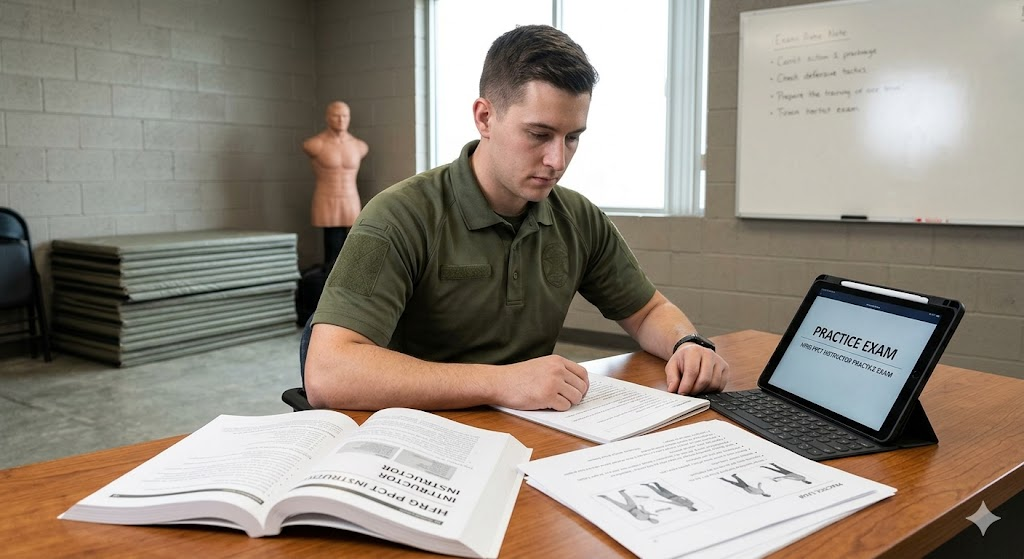
Additional Information
What the Course Entails and Exam Details
The HFRG PPCT Instructor course covers a rigorous and comprehensive syllabus centered around threat pattern recognition and non-lethal force.
Candidates are immersed in the science of the use-of-force continuum and survival reaction times.
The core physical skills taught include tactical handcuffing, joint locks, defensive counterstrikes, and weapon retention strategies.
Additionally, the curriculum heavily emphasizes pressure point control tactics, teaching exactly how and when to apply precise physical pressure to gain subject compliance.
Instructors must also thoroughly understand the medical implications of these techniques to ensure they are teaching safe applications that minimize injury risks.
What to Expect in the Final Exam
The final evaluation for the HFRG PPCT Instructor certification is divided into two distinct components to test both mental and physical readiness.
First, candidates must pass a comprehensive written examination composed of multiple-choice and true-false questions covering tactical theory, legal standards, and physiological factors.
A passing score of at least 80% is typically required on this written portion to prove academic mastery.
Second, there is a demanding practical proficiency exam where candidates must physically demonstrate each technique with absolute precision.
During the practical test, examiners evaluate the candidate's ability to not only execute the moves safely but also clearly explain the teaching steps as an instructor would to a class.
How to Study and Exam Centers
Success on the HFRG PPCT Instructor exam requires a balanced approach of academic study and physical repetition.
You should dedicate significant time to reading the official HFRG manual, focusing closely on the physiological responses to stress and the specific names of motor points.
Using practice exams to test your knowledge of legal terminology and use-of-force justifications is highly recommended to build test-taking confidence.
For the practical portion, consistently rehearsing the physical techniques with a cooperative partner will help build muscle memory and smooth out your instructional delivery.
Because of the hands-on nature of the test, exams are strictly conducted in person at authorized police academies, certified law enforcement training agencies, or specialized security training centers under the supervision of an HFRG Master Instructor.
Job Opportunities from the Course
Achieving this certification opens up numerous advanced career paths in specialized training and tactical coordination.
Law Enforcement Academy Instructor You can become an official trainer at a police academy, teaching defensive tactics to new recruits.
Defensive Tactics Coordinator Many municipal and state agencies hire coordinators to oversee their entire department's use-of-force training and annual recertification programs.
Corrections Training Officer Prisons and detention centers highly value PPCT instructors to train staff on managing non-compliant inmates safely and effectively.
Corporate Security Trainer Large corporations and private security firms often employ certified instructors to train their armed and unarmed security guards in liability-conscious restraint methods.
Use of Force Consultant Experienced instructors frequently work as independent consultants or expert witnesses, advising legal teams and private agencies on the appropriate application of defensive tactics.
Frequently Asked Questions
Reviews
5.0
Based on 0 reviews
Leave a Review
No reviews yet. Be the first to review!