
HFRG Threat Pattern Recognition Practice Test
$69.00
- Buy to unlock unlimited access to all Quiz questions and Answers in this Quiz.
- After purchase you can print a PDF of the whole quiz at any point. The PDF will contain the questions and the correct answers.
About this Exam
Welcome to your comprehensive preparation guide for the Human Factor Research Group (HFRG) Threat Pattern Recognition certification. This specialized program represents the cutting edge in defensive tactics and subject control. It is specifically designed for law enforcement officers, corrections personnel, military units, and high-level security professionals. The course moves beyond traditional physical training by integrating human factors, physics, and physiology into a cohesive system. This system is engineered to help professionals survive and control high-stress, violent encounters by recognizing threat patterns before they culminate in an attack.
Ready to test your knowledge?
Buy Now to Access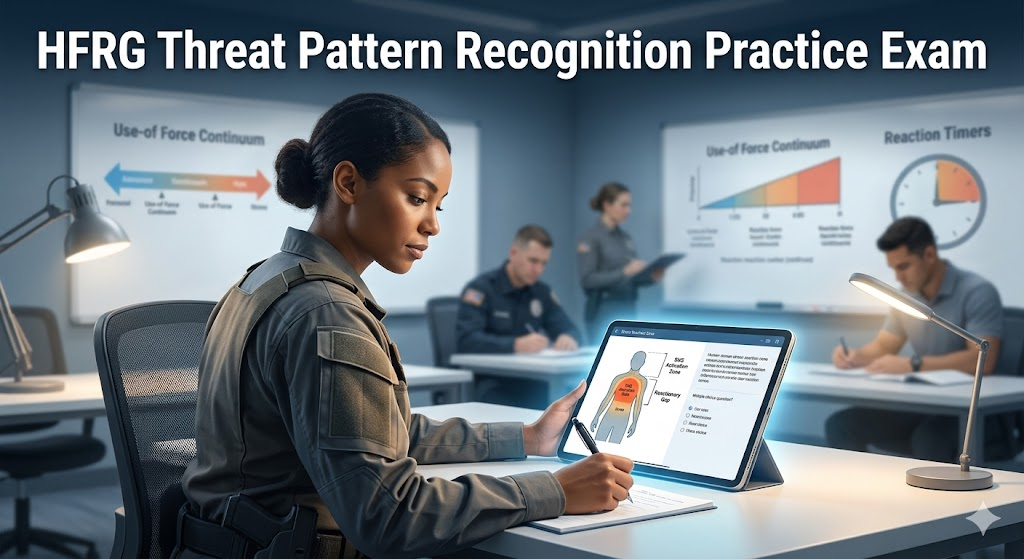
Additional Information
What the Course Entails and Exam Details
The HFRG Threat Pattern Recognition (TPR) course focuses on reducing officer injury and liability through scientifically-backed training mechanics.
Core topics covered in the syllabus include:
Human Factors: Understanding how the human body reacts to sudden, high-stress survival situations.
Threat Pattern Recognition: Identifying pre-attack indicators and situational cues that precede physical aggression.
The Reactionary Gap: Analyzing distance and time management in a confrontation.
Tactical Handcuffing and Subject Control: Efficient and safe methods for securing a subject.
Pressure Point Control Tactics: Utilizing specific digital pressure and striking methods to gain compliance.
Defensive Counterstrikes and Impact Weapons: Techniques for varying levels of resistance.
What to Expect in the Final Exam
The final certification process is rigorous and designed to test both your cognitive understanding and physical proficiency. The exam generally consists of two distinct components.
The first component is a written examination. This includes multiple-choice and true/false questions that assess your knowledge of the HFRG curriculum, physiological principles, legal considerations regarding use of force, and threat identification protocols. A passing score of typically 80% or higher is required on the cognitive portion.
The second component is a physical, skill-based evaluation. You must demonstrate the correct application of various control techniques, defensive counters, and tactical maneuvers. Authorized instructors will assess your form, balance, energy efficiency, and ability to transition between techniques under stress. This portion is usually graded on a Pass/Fail basis, requiring complete proficiency.
How to Study and Exam Centers
Effective preparation is key to success in the HFRG certification.
Study Strategies:
Master the Manual: Your primary HFRG training manual is the ultimate resource. Understand the definitions, the physiology of stress (Survival Stress Reaction), and the specific steps for every physical technique.
Visualization and Mental Rehearsal: Visualize scenarios where you must apply Threat Pattern Recognition. Mentally walking through correct responses helps reduce your reaction time during practical training.
Consistent Practice: Attend all training sessions. The practical exam depends heavily on muscle memory. Drill techniques slowly at first to ensure perfect form before increasing speed and resistance.
Exam Centers:
Because the HFRG certification requires a physical, skill-based evaluation, it is generally not available at standard computer-based testing centers like Pearson VUE.
The certification is administered through authorized police academies, private security training schools, and certified HFRG instructors. You can take the exam at the authorized training facility where you completed your coursework. You can contact HFRG directly or search for local certified trainers to find specialized examination centers in your region.
Job Opportunities from the Course
Earning your HFRG Threat Pattern Recognition certification signals to employers that you have undergone advanced, scientifically recognized training in control tactics and safety. This certification can significantly enhance your resume for a variety of critical roles, including:
Law Enforcement Officer (State, Local, and Federal)
Corrections Officer
Court Security Officer (Bailiff)
Private Armed Security Professional
Corporate Threat Assessment Specialist
Fugitive Recovery Agent
Crisis Intervention Team Member
Frequently Asked Questions
Reviews
5.0
Based on 0 reviews
Leave a Review
No reviews yet. Be the first to review!