
Highway Safety and Vehicle Extrication Practice Test
$69.00
- Buy to unlock unlimited access to all Quiz questions and Answers in this Quiz.
- After purchase you can print a PDF of the whole quiz at any point. The PDF will contain the questions and the correct answers.
About this Exam
The Highway Safety and Vehicle Extrication certification is a crucial qualification, designed primarily for first responders, including firefighters, emergency medical technicians (EMTs), paramedics, and rescue personnel. This essential training equips professionals with the specialized knowledge and hands-on skills required to safely manage traffic incidents and efficiently extricate victims from vehicles involved in accidents. With a strong focus on scene safety, patient care, and precise tool operation, this certification is indispensable for anyone working in the demanding field of emergency vehicle rescue and road safety.
Ready to test your knowledge?
Buy Now to Access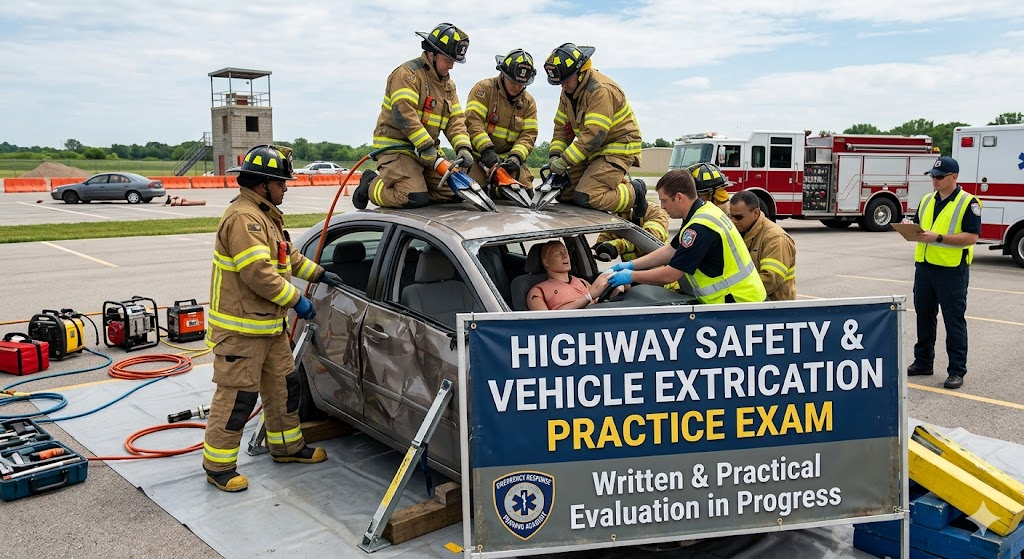
Additional Information
What the Course Entails and Exam Details
This comprehensive course covers a wide array of vital topics, ensuring candidates are thoroughly prepared for real-world scenarios. Core modules often encompass:
Scene Size-Up and Management: Techniques for rapidly assessing an accident scene, establishing command, and implementing effective safety measures for responders and the public.
Traffic Control and Highway Safety: Best practices for positioning emergency vehicles, deploying warning devices, and managing traffic flow to create a safe work zone.
Vehicle Anatomy and Hazards: Understanding modern vehicle construction, identifying potential hazards such as undeployed airbags and alternative fuel systems, and learning to work safely around them.
Stabilization: Methods for securing vehicles in various positions (on wheels, side, or roof) using struts, cribbing, and other stabilization tools.
Extrication Tools and Techniques: Hands-on training with powered hydraulic tools (spreaders, cutters, rams), hand tools, and specialized equipment for forceful entry and disentanglement.
Patient Access and Care: Strategies for gaining access to victims and providing initial medical care, prioritizing life safety throughout the extrication process.
Incident Termination: Proper procedures for demobilizing resources, clearing the scene, and conducting post-incident analysis.
The exact length and depth of the course can vary, but it typically involves a significant number of training hours, often ranging from 40 to hundreds, combining classroom instruction with extensive practical exercises.
What to Expect in the Final Exam
While the exact format can differ depending on the certifying body, you should anticipate a challenging two-part evaluation that assesses both your knowledge and practical ability.
Written Examination: Expect a multiple-choice exam that tests your understanding of theoretical concepts, safety protocols, vehicle anatomy, tool capabilities, and incident management principles. Questions will likely cover all major aspects of the course syllabus.
Practical Skills Assessment: This is a critical component where you must demonstrate proficiency in executing various extrication techniques in a controlled, simulated environment. Evaluators will observe your ability to:
Perform a proper scene size-up.
Establish scene safety zones and fire protection.
Correctly stabilize a simulated vehicle.
Demonstrate safe and effective use of extrication tools.
Access and extricate a simulated patient with care.
Communicate effectively with a team.
Passing Requirements and Time Limits: You will typically need to achieve a minimum score, often 70-80% or higher, on the written exam. The practical assessment is usually a pass/fail evaluation, requiring you to successfully complete all critical tasks safely and within designated timeframes (if applicable). Specific rules regarding the number of attempts permitted for both the written and practical portions will be detailed by the testing authority. Be prepared for potentially no calculator use on the written test and to wear proper Personal Protective Equipment (PPE) throughout the practical assessment.
How to Study and Exam Centers
How to Study Effectively:
Thoroughly Review Course Materials: Dedicate significant time to studying your course textbook, handouts, and any provided online resources. Focus on key terminology, safety guidelines, and standard operating procedures.
Practice with Sample Questions: Actively seek out and answer practice exam questions. This will help you become familiar with the types of questions asked and identify areas where you need additional review. Many training organizations and educational publishers offer such resources.
Engage in Hands-on Practice: Seize every opportunity for hands-on practice with the tools and techniques you've learned. The practical assessment is a direct evaluation of these skills, so confidence and proficiency are key. Review JPR (Job Performance Requirements) criteria if available.
Form a Study Group: Collaborating with colleagues who are also preparing for the exam can be highly beneficial. Discussing concepts, practicing practical skills together, and quizzing each other can enhance understanding and retention.
Review Instructor Feedback: Pay close attention to feedback received during training and practical sessions. Understanding where you can improve will help you refine your skills before the final evaluation. Focus heavily on safety and patient care aspects throughout your practice.
Exam Centers:
The Highway Safety and Vehicle Extrication exam is typically administered by accredited training institutions and specific emergency services agencies. You can take the exam through:
Fire Academies and Regional Training Centers: Many fire departments and state fire marshal offices have dedicated training academies that conduct both the course and the certification exam.
Emergency Services Training Organizations: Various private and public organizations specialize in providing rescue and emergency response training and are authorized to administer certification exams.
Community Colleges and Technical Institutes: Some colleges offer this certification as part of their emergency services programs and serve as testing centers.
Authorized School Portals: In some cases, the written portion of the exam may be administered through an online portal managed by the training institution or a recognized testing service, while the practical assessment will always require a physical testing location.
Pearson VUE and Similar Services: While less common for the practical skills portion, some related written certifications for fire service personnel may be administered through large, established testing center networks. Check with your specific certifying body for current information. Contacting your local fire department or state's emergency medical services office is a great place to start identifying accredited programs and testing locations in your area.
Job Opportunities from the Course
Successfully obtaining the Highway Safety and Vehicle Extrication certification opens up a range of exciting career paths and advancement opportunities within the emergency services sector. This qualification is highly sought after and can significantly enhance your prospects in the following roles:
Firefighter: Many fire departments require or strongly prefer this certification for all active firefighters, as vehicle rescue is a core function of their duties.
Rescue Technician: Specializing in complex rescue operations, including vehicle extrication, this role is dedicated to responding to and managing challenging rescue incidents.
Emergency Medical Technician (EMT) / Paramedic: While their primary focus is medical care, having extrication knowledge is extremely valuable for EMTs and paramedics who may arrive first at an accident scene and need to understand extrication processes.
Highway Patrol / Police Officer: Law enforcement personnel frequently respond to vehicle accidents, and having this training can improve their situational awareness and capability to assist until rescue personnel arrive.
Fire Service Technician: For those focused on the maintenance, operation, and support aspects of fire services, including rescue equipment.
Industrial Rescue Professional: Industries with large vehicle fleets or high-risk environments may employ rescue teams where this certification is essential.
Incident Commander: Advanced personnel with comprehensive training, including vehicle rescue, are often better equipped to command complex multi-agency responses.
Highway Safety Advocate / Educator: While less direct, having first-hand knowledge of crash dynamics and extrication can be very impactful in roles focused on road safety promotion and education.
We hope this study guide proves invaluable as you prepare for this challenging and rewarding certification. Dedication to study and practice is the key to success. Good luck on your exam!
Frequently Asked Questions
Reviews
5.0
Based on 0 reviews
Leave a Review
No reviews yet. Be the first to review!