
Home Health Aide (HHA) Competency Practice Test
$69.00
- Buy to unlock unlimited access to all Quiz questions and Answers in this Quiz.
- After purchase you can print a PDF of the whole quiz at any point. The PDF will contain the questions and the correct answers.
About this Exam
The Home Health Aide certification is a vital credential for individuals passionate about providing high-quality care to patients in their own homes.
This exam evaluates your readiness to safely and compassionately assist the elderly, disabled, or chronically ill with daily living activities.
It is specifically designed for aspiring caregivers, nursing assistants, and healthcare students who want to specialize in home-based patient support.
Earning this certification proves to employers and families that you possess the essential skills required to protect and improve the well-being of vulnerable individuals.
Taking a practice test is the best way to build your confidence and ensure you are fully prepared for the real evaluation.
Ready to test your knowledge?
Buy Now to Access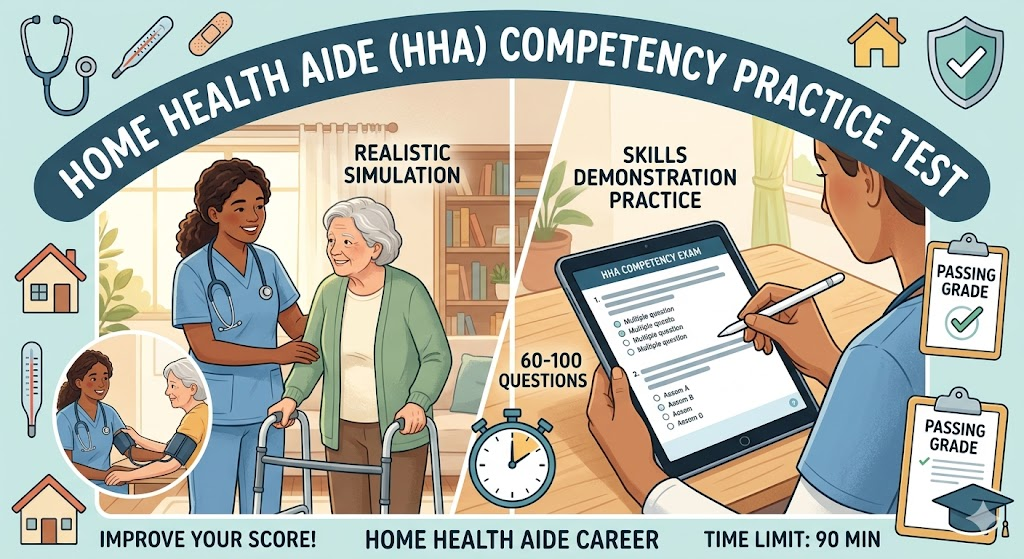
Additional Information
What the Course Entails and Exam Details
A standard Home Health Aide training course covers a wide spectrum of essential healthcare and personal support skills.
You will learn the fundamentals of basic nursing care, including taking vital signs, measuring weight, and observing physical changes in patients.
The syllabus heavily emphasizes personal care techniques, such as bathing, grooming, oral hygiene, and safe transfer methods.
You will also be trained in critical emergency response procedures, infection control protocols, and basic life support.
Additionally, the curriculum covers vital soft skills, including client communication, respecting patient rights, and managing dietary or nutritional needs.
The exam directly reflects these course components, testing your theoretical knowledge and your ability to apply these concepts in real-world home care scenarios.
What to Expect in the Final Exam
The official competency exam typically consists of two distinct parts to thoroughly evaluate your caregiving abilities.
The first part is a written or computerized knowledge test, which generally includes 50 to 100 multiple-choice questions.
You will usually have between one to two hours to complete this written section, depending on your state's specific regulations.
The second part is a clinical skills evaluation, where a registered nurse evaluator will watch you perform a set of randomly selected physical tasks on a volunteer or mannequin.
To pass the written portion, most states require a minimum score ranging from 70% to 80%.
For the practical skills test, you must correctly perform all the critical steps for every assigned task without compromising patient safety.
How to Study and Exam Centers
The most effective study strategy is to regularly take timed multiple-choice practice exams to familiarize yourself with the question formats.
You should also review your state's specific HHA handbook, paying close attention to infection control and patient safety guidelines.
For the clinical skills portion, physically practice the steps out loud with friends or family members to build muscle memory.
When you are ready to take the official exam, the testing locations will vary based on your local state health department.
Many candidates take the test directly at the approved community college, vocational school, or agency where they completed their training.
In some states, testing is administered by third-party organizations like Prometric or Pearson VUE, which offer secure physical testing centers and sometimes online proctoring for the written section.
Job Opportunities from the Course
Successfully passing this exam and obtaining your certification opens the door to a rewarding and rapidly growing field in healthcare.
You will be qualified for a variety of roles that focus on one-on-one patient care and support.
Here are the specific job titles and career paths this certification unlocks:
Certified Home Health Aide (CHHA)
Personal Care Aide (PCA)
Hospice Care Assistant
Live-in Caregiver
Respite Care Worker
Private Duty Aide
Assisted Living Caregiver
Pediatric Home Health Aide
Your dedication to preparing for this exam is the first step toward a fulfilling career that makes a profound difference in the lives of others.
Frequently Asked Questions
Reviews
5.0
Based on 0 reviews
Leave a Review
No reviews yet. Be the first to review!