
Home Inspection Electrical Practice Test
$69.00
- Buy to unlock unlimited access to all Quiz questions and Answers in this Quiz.
- After purchase you can print a PDF of the whole quiz at any point. The PDF will contain the questions and the correct answers.
About this Exam
The Home Inspector Electrical Certification is a critical milestone for anyone aiming to build a successful and trusted career in residential property inspection.
This comprehensive exam is specifically designed to evaluate your knowledge of residential electrical systems, ensuring you can safely and accurately assess a home's wiring.
It is ideal for aspiring home inspectors, electricians transitioning into inspection roles, and real estate professionals who want to deepen their understanding of property safety standards.
By mastering this material, you prove to future clients and employers that you possess the expertise needed to identify dangerous electrical hazards and ensure a home meets accepted safety guidelines.
Ready to test your knowledge?
Buy Now to Access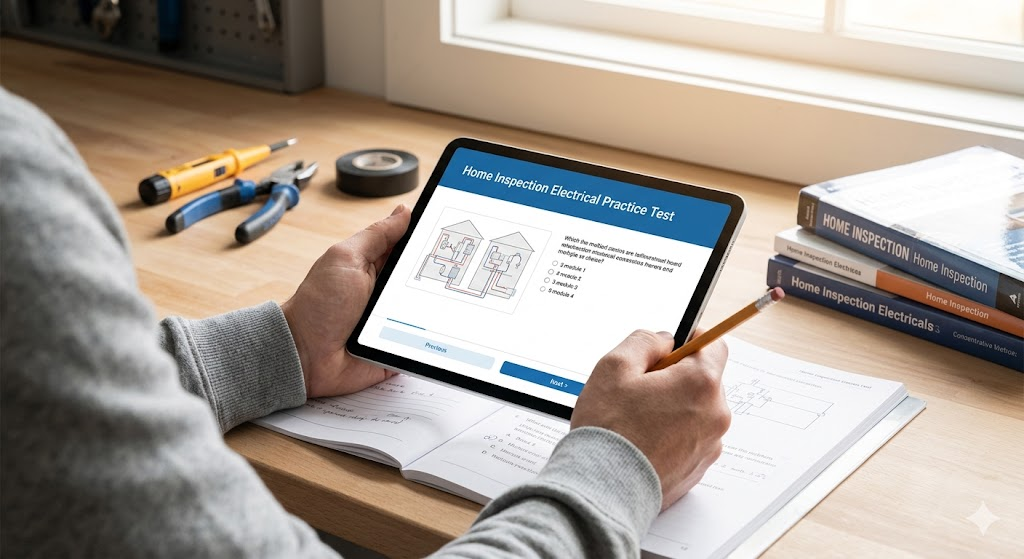
Additional Information
What the Course Entails and Exam Details
Preparing for this exam requires a deep dive into the fundamental and advanced aspects of residential electrical systems.
The syllabus extensively covers the evaluation of service drops, grounding and bonding systems, and the main electrical service panel.
You will also learn to inspect branch circuit wiring, identify appropriate amperages, and understand the crucial functions of GFCI (Ground Fault Circuit Interrupter) and AFCI (Arc Fault Circuit Interrupter) receptacles.
Additionally, the course trains you to spot outdated or hazardous materials, such as knob-and-tube wiring, solid aluminum branch wiring, and double-tapped breakers.
Overall, the curriculum is designed to give you both the technical vocabulary and the practical knowledge required to write clear, accurate, and professional inspection reports.
What to Expect in the Final Exam
The final assessment is typically a rigorous, multiple-choice examination designed to test both your theoretical knowledge and your practical problem-solving skills.
While specific time limits can vary by state or certifying organization, you can generally expect to have between one and two hours to complete the electrical portion of the exam.
Passing scores normally sit around the 70% to 80% mark, demanding a high level of accuracy and a solid grasp of the material.
Many questions will present you with real-world scenarios or photographs of electrical panels and wiring, asking you to identify the specific defect or safety violation shown.
Because safety is the highest priority in home inspection, you must be prepared to answer strict questions regarding current electrical codes and standard safety protocols.
How to Study and Exam Centers
Success on the electrical practice test requires a blend of consistent review and practical application.
Start by taking multiple timed practice exams to familiarize yourself with the question formats and to build your testing endurance.
Create flashcards for common electrical defects, clearance requirements, and grounding rules to help memorize the most highly tested information.
When you are ready to take the official exam, the testing location will depend on your specific certification board, such as InterNACHI, ASHI, or your state's licensing department.
Most official exams are proctored at specialized testing centers like Pearson VUE or PSI, which have physical locations nationwide, though many boards now also offer secure, digitally proctored online exams from the comfort of your home.
Job Opportunities from the Course
Passing your electrical inspection exam opens the door to a wide variety of lucrative and rewarding career paths in the real estate and construction industries.
The most direct route is becoming a Licensed or Certified Home Inspector, where you will work with homebuyers and sellers to evaluate properties before a sale.
You can also pursue a career as a Residential Electrical Inspector, working for local municipalities to ensure new constructions and renovations comply with electrical codes.
Other excellent roles include Real Estate Property Evaluator, Risk Assessment Specialist for insurance companies, and Construction Consultant.
Ultimately, this certification provides the specialized knowledge needed to start your own independent inspection business or join an established, high-volume inspection firm.
Frequently Asked Questions
Reviews
5.0
Based on 0 reviews
Leave a Review
No reviews yet. Be the first to review!