
Homeowners Policy – Section I: Property Coverages Practice Test
$69.00
- Buy to unlock unlimited access to all Quiz questions and Answers in this Quiz.
- After purchase you can print a PDF of the whole quiz at any point. The PDF will contain the questions and the correct answers.
About this Exam
This examination serves as a fundamental stepping stone for professionals entering the property and casualty insurance industry.
It is expertly designed for aspiring insurance agents, claims adjusters, and brokers who need a deep understanding of residential property risks.
Passing this test demonstrates your capability to correctly evaluate policies and protect homeowners from catastrophic financial losses.
Ready to test your knowledge?
Buy Now to Access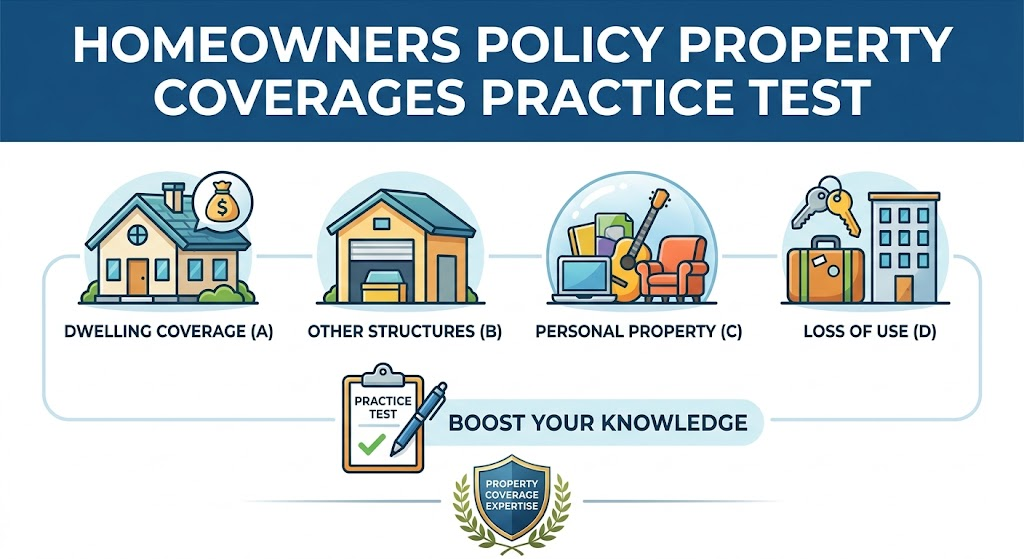
Additional Information
What the Course Entails and Exam Details
The core syllabus revolves around the four primary property coverages embedded in a standard homeowners policy.
Coverage A will teach you how to evaluate the primary dwelling and all immediately attached structures.
Coverage B focuses entirely on unattached structures on the premises, such as fences, storage sheds, and detached garages.
Coverage C provides a deep dive into personal property, outlining how a policyholder's personal belongings are protected worldwide.
Coverage D explains "loss of use" provisions, which cover additional living expenses if a covered peril makes the home uninhabitable.
You will also master critical concepts surrounding standard policy exclusions, endorsements, deductibles, and special limits of liability.
What to Expect in the Final Exam
The final assessment is typically a comprehensive multiple-choice examination featuring between 50 and 100 questions.
Candidates are generally allowed two hours to complete the test, though this can vary slightly by state.
A passing score usually requires answering 70% to 75% of the questions correctly.
You should expect complex, scenario-based questions that require you to apply coverage definitions to hypothetical property damage situations.
While basic calculators are usually provided for deductible math, you are strictly prohibited from bringing outside reference materials or personal electronic devices into the testing area.
How to Study and Exam Centers
Your first step should be to thoroughly review your state-approved pre-licensing textbook or complete all assigned online learning modules.
Taking numerous timed practice exams is the most effective way to identify your weak spots and get comfortable with the pacing.
Create physical or digital flashcards to help you memorize hard facts, such as specific coverage limits for jewelry or watercraft.
When you are fully prepared, you will schedule your exam through an authorized third-party testing administrator like Pearson VUE or Prometric.
Many jurisdictions now offer secure online proctoring, which allows you to take the exam from a quiet room in your home while monitored via webcam.
Job Opportunities from the Course
Earning this certification serves as a gateway to several rewarding career paths.
Licensed Insurance Agent
Property Claims Adjuster
Insurance Underwriter
Risk Management Consultant
Customer Service Representative
Frequently Asked Questions
Reviews
5.0
Based on 0 reviews
Leave a Review
No reviews yet. Be the first to review!