
Hopebridge SAFMEDS Competency Practice Exam
$69.00
- Buy to unlock unlimited access to all Quiz questions and Answers in this Quiz.
- After purchase you can print a PDF of the whole quiz at any point. The PDF will contain the questions and the correct answers.
About this Exam
The Hopebridge SAFMEDS Competency Practice Exam is an internal assessment designed specifically for individuals within the Hopebridge organization, most commonly those undergoing training to become a Registered Behavior Technician (RBT). The primary purpose of this practice exam is to ensure that candidates possess the required fluency—meaning both accuracy and speed—in the fundamental vocabulary and concepts of Applied Behavior Analysis. The SAFMEDS system (which stands for Say All Fast Minute Each Day Shuffled) is an evidence-based precision teaching method used globally in ABA to build flashcard fluency. By mastering this internal competency assessment, you prove that you can recognize and define essential terms in the RBT task list without hesitation, which is a vital skill for delivering effective therapy to children with autism and related disorders. Passing this practice exam is often a prerequisite to attempting the final official BACB RBT Competency Assessment and subsequently, the certification exam. It is an invaluable diagnostic tool that highlights your strengths and helps target any remaining knowledge gaps.
Ready to test your knowledge?
Buy Now to Access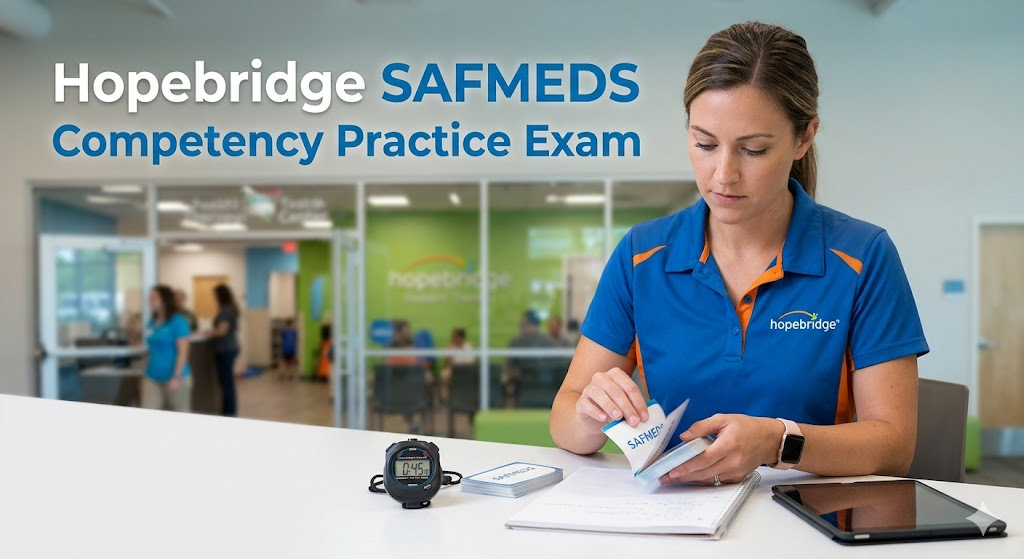
Additional Information
What the Course Entails and Exam Details
The Hopebridge SAFMEDS Competency Practice Exam is not a separate "course," but rather the culminating assessment of the fluency-building portion of your comprehensive RBT training. It directly covers the essential terms and definitions from the entire current Behavior Analyst Certification Board (BACB) RBT Task List. This is because the concepts must be at a "fluent" level for you to understand your supervisor's instructions and to implement behavioral plans correctly. The exam assesses your fluency across all key domains, including:
Measurement: Understanding how to take data (e.g., frequency, duration, latency, inter-response time, partial/whole interval, momentary time sampling).
Assessment: Terminology related to preference assessments, ABC data collection, and assists with functional assessments.
Skill Acquisition: Mastering the language of instruction, such as discrete trial training (DTT), natural environment teaching (NET), task analysis, chaining, prompting, shaping, and token economies.
Behavior Reduction: Recognizing concepts like operational definitions, functions of behavior, antecedent interventions, consequence interventions (reinforcement, punishment, extinction), and differential reinforcement procedures (DRA, DRO, DRI).
Documentation and Reporting: Fluency with terms for objective session notes, communication with supervisors, and compliance with legal/regulatory requirements.
Professional Conduct and Scope of Practice: Understanding the ethical guidelines for RBTs, boundaries of competence, and maintaining client dignity.
The SAFMEDS system utilizes flashcards. Each card has an ABA term on one side and its corresponding definition on the other. For this competency practice exam, you will likely encounter a full set of cards covering all these domains. You will be presented with a card, and you must rapidly and correctly state the missing part (either the definition if the term is shown, or the term if the definition is shown, according to the specific protocol used by Hopebridge). The entire deck is shuffled before each attempt.
What to Expect in the Final Exam
The format of the final Hopebridge SAFMEDS Competency Practice Exam is unique and focuses entirely on response speed. You will not find multiple-choice or short-answer questions here. The entire exam consist of a series of standard "one-minute timings." During each timing, you will work through as many shuffled SAFMEDS cards as possible in exactly sixty seconds. Depending on Hopebridge's exact implementation, this may be done physically with printed cards and an observer, or more likely, using an internal digital SAFMEDS platform.
Your goal is to achieve a set level of mastery, typically defined as reaching a target number of "corrects per minute" with very few "incorrects" or skips. While specific passing scores are determined by Hopebridge’s clinical standards, fluency in SAFMEDS generally means consistently achieving 40 or more correct cards within that one-minute window. You will have to do multiple one-minute timings across different domains (or on the full, comprehensive deck) and meet that target for a set number of consecutive attempts to be considered "competent." Passing requires you to demonstrate immediate, effortless recall of all the core material.
How to Study and Exam Centers
Because the SAFMEDS system is the exam itself, studying for it means doing SAFMEDS every single day. There are no other shortcuts. This creates a powerful feedback loop. To study effectively for this competency assessment, you must commit to a precise practice schedule:
Shuffling: Always shuffle your deck before a new practice block to prevent rote memorization by sequence.
Timing: Use a timer set for exactly one minute for each "practice trial."
Saying: You must say the answers out loud to be considered SAFMEDS. This forces active retrieval. If you use a physical deck, you must flip each card with appropriate "flipping behavior" after saying your answer.
Feedback: Immediately place cards into a "correct" pile or an "incorrect/skip" pile. If you don't know it, skip it instantly; don't waste time thinking during the timing.
Charting: This is crucial. At the end of each minute, count your corrects and incorrects. You must chart these numbers on a Standard Celeration Chart (SCC), which visualizes your learning curve. Seeing your "correct" line move up and your "incorrect" line move down is the core of precision teaching. Your aim is for the points on the chart to reach the "mastery" range.
Practice Daily: Multiple 1-minute trials with 5 minutes of study between them is far more effective than an hour-long cram session.
The Hopebridge SAFMEDS Competency Practice Exam is an internal assessment. It is not taken at external testing centers like Pearson VUE. It is administered directly at your Hopebridge Autism Therapy Center, usually by your training coordinator or a Board Certified Behavior Analyst (BCBA), using internal digital tools or standardized card decks. You will take this test only once you have charted data proving you are within the fluency range.
Job Opportunities from the Course
Passing the Hopebridge SAFMEDS Competency Practice Exam is a major milestone and a crucial prerequisite for subsequent certification, leading to full employment within Hopebridge. Achieving fluency with these terms opens the direct path to the following specific roles:
Registered Behavior Technician (RBT)
ABA Therapist / ABA Paraprofessional
Behavior Technician
Direct Support Professional (focused on ABA)
Lead RBT / Senior Behavior Technician (after gaining experience)
This internal qualification, followed by external certification, is not just a test; it is the license to begin making a real difference in the lives of children and families. Good luck with your SAFMEDS practice!
Frequently Asked Questions
Reviews
5.0
Based on 0 reviews
Leave a Review
No reviews yet. Be the first to review!