
Horse Evaluation CDE Practice Exam
$69.00
- Buy to unlock unlimited access to all Quiz questions and Answers in this Quiz.
- After purchase you can print a PDF of the whole quiz at any point. The PDF will contain the questions and the correct answers.
About this Exam
The Horse Evaluation Career Development Event (CDE) is a competitive activity designed primarily for FFA (Future Farmers of America) and 4-H members. This rigorous event challenges students to apply their knowledge of equine science and industry standards to evaluate various breeds and types of horses. The primary goal is to develop students' skills in observation, logical thinking, and decision-making while fostering a deep understanding of equine conformation, performance, and management. Participants must learn to visually assess horses against ideal standards and defend their placings through oral reasons. This CDE serves as a foundational step for students aspiring to careers in the equine industry, veterinary medicine, or agricultural education, providing them with practical, hands-on experience that goes beyond classroom learning.
Ready to test your knowledge?
Buy Now to Access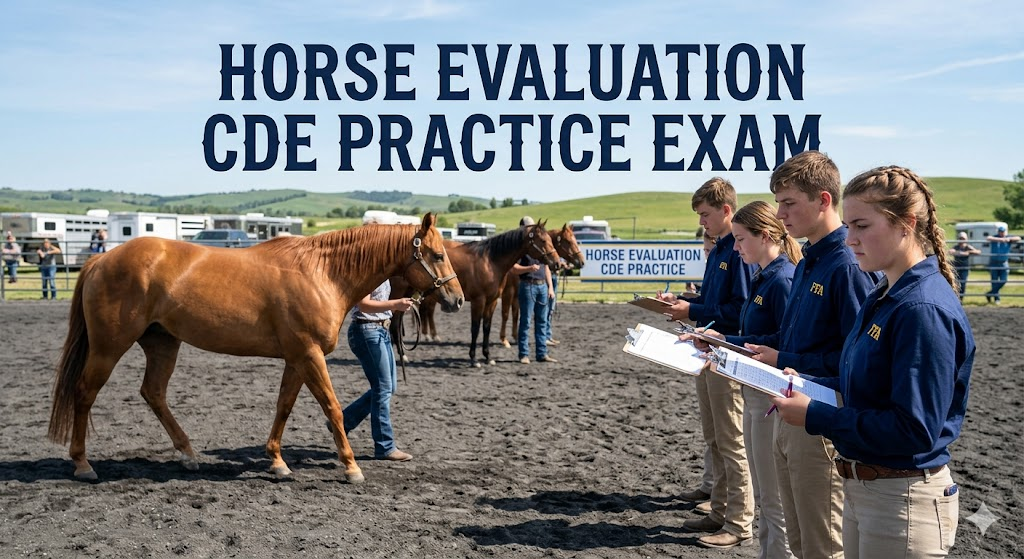
Additional Information
What the Course Entails and Exam Details
To prepare for this comprehensive exam, students must master a wide range of topics that cover both the theoretical and practical aspects of horse evaluation. The specific structure can vary slightly by state, but standard material includes:
Equine Anatomy and Physiology: A deep dive into skeletal and muscular structures to understand how they affect performance and soundness.
Breed Standards and Conformation: Studying the ideal traits for major breeds (like Quarter Horses, Thoroughbreds, and Arabians) and how to evaluate structural correctness, balance, and muscling.
Performance Classes: Understanding the rules and judging criteria for varied disciplines, such as Western Pleasure, Hunter Under Saddle, Reining, and Trail.
Gait Analysis: Identifying and evaluating the quality, rhythm, and correctness of walk, jog/trot, and lope/canter in various breeds.
Industry Trends and Health Management: General knowledge about equine health, nutrition, and current management practices.
Oral Reasons: Learning the structured format and vocabulary needed to clearly and confidently justify the placement of a class to a judge.
The preparation isn’t just about memorizing facts; it’s about training the eye to quickly synthesize information and make accurate comparisons under time constraints.
What to Expect in the Final Exam
While exact formats differ slightly between regional, state, and national levels, a typical Horse Evaluation CDE features three distinct components designed to test different facets of a student's expertise:
1. The Written Exam: This component evaluates general knowledge of equine science, including genetics, health, nutrition, anatomy, and industry terminology. It is usually a multiple-choice section with a set time limit, often consisting of 25 to 50 questions.
2. Live Judging Classes: This is the core of the event. Students will observe and place (from 1st to 4th) several classes of horses. These classes typically include both halter (conformation) classes and performance (movement) classes. Time limits for judging are strict, generally ranging from 12 to 15 minutes per class.
3. Oral Reasons: After placing the live classes, participants must deliver prepared "oral reasons" to a judge. In this section, students defend their ranking of a specific class using precise equine terminology, logic, and confident presentation. Oral reasons are scored based on accuracy, clarity, and delivery style.
Scoring is typically aggregate, combining points from the written exam, placement accuracy in live classes, and the quality of oral reasons.
How to Study and Exam Centers
Preparation is key to succeeding in the competitive CDE atmosphere. Here are effective strategies:
Utilize Official Resources: Review the official National FFA Horse Evaluation CDE Handbook or your state's equivalent for specific rules, scorecard examples, and a bibliography of suggested study materials.
Practice with Visual Aids: Use online platforms that offer video judging classes, such as CDE archive sites, YouTube, or equine evaluation practice software. Practice comparing horses side-by-side.
Develop a "Reasons" System: Memorize standard terminology and develop a consistent structure (opening, critiques, comparisons, and closing) to make your oral reasons delivery smoother and more logical. Record yourself and listen back for flow and clarity.
Attend Clinics and Practices: Take advantage of any practice clinics hosted by local colleges, breeding farms, or 4-H/FFA chapters. Live observation is irreplaceable.
Study Flashcards: Use flashcards for equine anatomy, common diseases, and breed-specific terms.
The exam itself is typically not held in a commercial testing center. Instead, these events are hosted at designated agricultural sites, including university arenas (especially land-grant universities), state fairgrounds, or large equine expo centers during regional or state conventions. National competition occurs at the National FFA Convention. Contact your FFA advisor or 4-H leader for the specific dates and location of your area's event.
Job Opportunities from the Course
Mastery of the skills required for the Horse Evaluation CDE opens doors to numerous rewarding career paths within and adjacent to the equine industry. It provides the professional foundation for roles such as:
Professional Horse Show Judge
Equine Nutritionist or Sales Representative
Barn or Facility Manager
Professional Horse Trainer
Breeding Manager
Agricultural Education Teacher
Veterinary Technician (as a foundation for pre-vet studies)
Equine Insurance Agent or Adjuster
Equine Journalist or Marketer
Farm or Ranch Owner/Manager
Frequently Asked Questions
Reviews
5.0
Based on 0 reviews
Leave a Review
No reviews yet. Be the first to review!