
HOSA Biomedical Debate Practice Test
$69.00
- Buy to unlock unlimited access to all Quiz questions and Answers in this Quiz.
- After purchase you can print a PDF of the whole quiz at any point. The PDF will contain the questions and the correct answers.
About this Exam
HOSA – Future Health Professionals is an international student organization that empowers young people to become leaders in the global health community. Among its numerous competitive events, the HOSA Biomedical Debate challenges students to dive deep into complex, often controversial ethical, social, and moral issues within the medical and biological sciences. Participants develop crucial critical thinking, communication, research, and teamwork skills as they construct and present well-reasoned arguments. This dynamic competition is designed for dedicated HOSA members at the middle school, secondary, and postsecondary/collegiate levels who are passionate about healthcare, policy, and public discourse. This study guide and practice material is specifically crafted to help students prepare effectively for the initial, decisive written component of this challenging event.
Ready to test your knowledge?
Buy Now to Access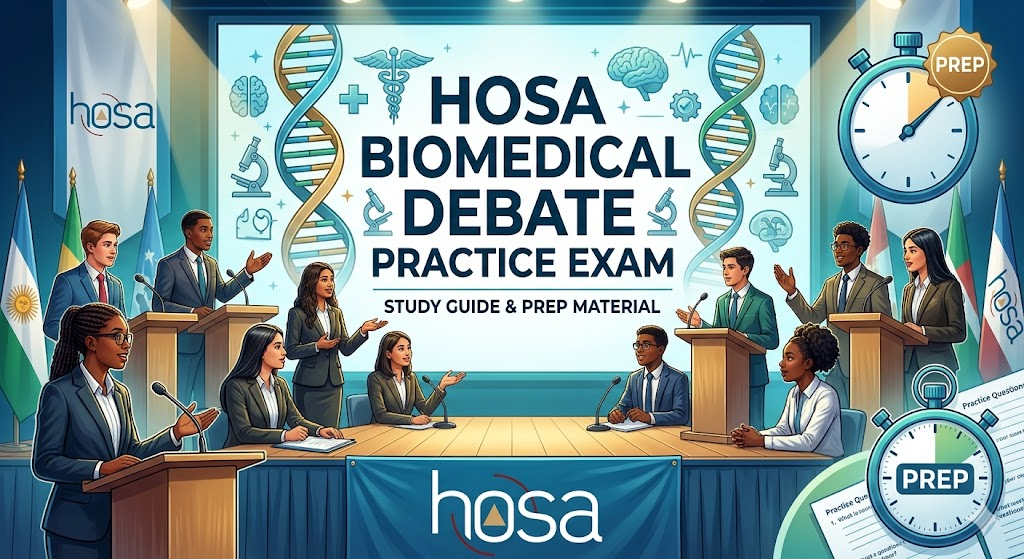
Additional Information
What the Course Entails and Exam Details
While not a conventional academic course, preparation for the HOSA Biomedical Debate event is an intensive co-curricular activity that builds a broad range of knowledge and skills.
Participants must extensively research the specific biomedical issue chosen as the annual topic by HOSA.
This involves understanding the scientific principles behind the issue, as well as its historical, ethical, economic, and social implications.
The core activities include constructing persuasive arguments, anticipating rebuttals, collaborating effectively with teammates, and honing public speaking abilities.
Successful preparation involves deep analysis of ethical theories and their application to modern healthcare challenges, structured presentation techniques, and a thorough understanding of the specific debate format used in the competition.
The initial round, which this practice material simulates, often involves a crucial written exam that acts as a primary qualifier, determining which teams advance to the subsequent debate rounds. This practice test mimics the typical style and scope of that essential written hurdle.
What to Expect in the Final Exam
For many participants, the "final exam" on their journey to the competitive stage is the qualifying written test. This test is the focus of this study guide. It typically consists of approximately 50 to 100 multiple-choice questions administered within a set time limit, often around 60 to 90 minutes.
The qualifying exam content covers a wide spectrum: from fundamental knowledge about HOSA, health science career pathways, and the specific biomedical issue of the year, to ethical principles and principles of debate terminology and structure. Success on this test requires both specific and broad knowledge, and is vital as the team's average score dictates whether they progress to the live debate portion of the event.
Please note that this practice exam is a comprehensive representation of the style and content areas likely to be encountered in the qualifying test and should be used as a primary tool to gauge readiness and identify areas for further study. The actual live debate rounds, which occur after the qualifying test, are evaluated on different parameters, including public speaking, argument quality, and team collaboration. This practice test specifically targets the written qualifier, your essential first step towards debate success.
How to Study and Exam Centers
Preparation should be structured and multifaceted, with a heavy emphasis on utilizing official HOSA competitive event guidelines and resources.
Students should obtain and thoroughly read the general rules and event-specific guidelines provided by HOSA. This is the foundation of their preparation.
Extensive research into the current year's debate topic is paramount, looking at multiple viewpoints, recent news, scientific papers, and ethical analysis. Forming study groups or debate teams is essential for practice rounds, sharing research, and receiving constructive feedback on both argumentation and presentation skills.
Utilizing specialized practice materials like this HOSA Biomedical Debate Practice Exam is crucial. It allows you to simulate the actual test environment, familiarize yourself with multiple-choice question formats, and understand how knowledge is applied. Reviewing key biomedical ethics cases, principles of argumentation, and even HOSA general history can also provide a strategic advantage.
regarding Exam Centers, the written qualifying tests are often administered through a school-designated online platform or at specific school or local testing locations. In some regions, the qualifier might be hosted at a regional conference site. At higher competition levels, like state or international leadership conferences, specialized testing centers or proctored online sessions are standard. Students should consult their HOSA chapter advisor for precise details about where and how their specific competition's written qualifier will be conducted.
Job Opportunities from the Course
Potential career paths and roles that leverage skills from HOSA and the Biomedical Debate event include:
Healthcare Policy Analyst
Medical Ethicist
Patient Rights Advocate
Biomedical Research Associate
Health Communication Specialist
Healthcare Administrator
Medical Writer
Public Relations in Biotech
Specialized Healthcare Lawyer
Ethics & Compliance Officer in Health Organizations
Patient Navigator
Frequently Asked Questions
Reviews
5.0
Based on 0 reviews
Leave a Review
No reviews yet. Be the first to review!