
HOSA Biomedical Laboratory Practice Test
$69.00
- Buy to unlock unlimited access to all Quiz questions and Answers in this Quiz.
- After purchase you can print a PDF of the whole quiz at any point. The PDF will contain the questions and the correct answers.
About this Exam
The HOSA Biomedical Laboratory Science competitive event is designed to challenge students interested in the dynamic field of medical laboratory science.
It provides a unique opportunity for Future Health Professionals to demonstrate their knowledge of essential clinical procedures, lab safety, and diagnostic testing methods.
This competition is ideal for ambitious students aiming for careers as medical lab technicians, scientists, or researchers, fostering critical thinking skills vital for the healthcare sector.
Ready to test your knowledge?
Buy Now to Access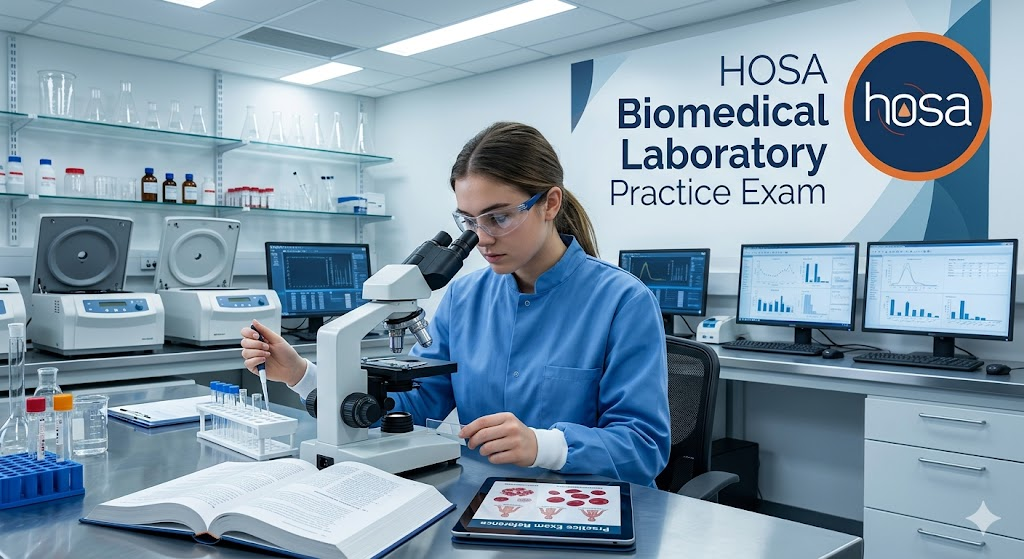
Additional Information
What the Course Entails and Exam Details
This event encompasses a broad range of topics fundamental to the biomedical laboratory.
Participants must master concepts in laboratory safety, infection control, and the proper use and maintenance of laboratory equipment.
The syllabus covers critical areas such as microbiology (including sterilization techniques), hematology (understanding blood composition and clotting), and clinical chemistry (analyzing body fluids).
Students will also be tested on their knowledge of urinalysis, immunology, and standard operating procedures for handling specimens.
What to Expect in the Final Exam
The competition typically consists of two distinct rounds.
Round 1 is a written, multiple-choice test designed to assess comprehensive theoretical knowledge of the topics outlined in the guidelines.
Students who excel in Round 1 may advance to Round 2, which focuses on the hands-on performance of specific laboratory skills.
These skills are judged by experts using a rigorous rubric and may include procedures like streaking an agar plate, performing a Gram stain, or correctly using a microscope.
The time limit for the written test is usually around 60 to 90 minutes, while the practical skills section varies depending on the specific procedures assigned.
How to Study and Exam Centers
Effective preparation requires a multi-faceted approach.
Start by thoroughly reviewing the official HOSA competitive event guidelines, as they detail the exact percentage of questions allocated to each topic and list the official references.
Utilize textbooks focused on medical laboratory fundamentals and create flashcards for key vocabulary and diagnostic values.
For Round 2, practice the required laboratory skills repeatedly under the supervision of a teacher or advisor to ensure precision and adherence to safety protocols.
Taking timed practice tests is also essential to improve speed and accuracy.
The preliminary written exam (Round 1) is typically administered online or at designated testing sites at the school level.
State and International Leadership Conferences serve as the primary venues for the subsequent rounds and practical skills assessments.
Job Opportunities from the Course
Mastering the knowledge required for this HOSA event serves as an excellent foundation for numerous careers.
Potential job opportunities include:
Medical Laboratory Technician
Medical Laboratory Scientist
Clinical Laboratory Assistant
Biomedical Research Assistant
Public Health Lab Technician
Phlebotomist
Quality Control Technician
Frequently Asked Questions
Reviews
5.0
Based on 0 reviews
Leave a Review
No reviews yet. Be the first to review!