
HOSA CPR/First Aid Assessment Practice Test
$69.00
- Buy to unlock unlimited access to all Quiz questions and Answers in this Quiz.
- After purchase you can print a PDF of the whole quiz at any point. The PDF will contain the questions and the correct answers.
About this Exam
The HOSA CPR/First Aid Assessment is a competitive event for students who aspire to become healthcare professionals.
It is specifically designed for two-person teams, testing their ability to provide immediate, life-saving care in critical scenarios.
This assessment is not just about memorizing facts; it is about demonstrating critical thinking, rapid decision-making, and seamless teamwork.
Completing this event shows that you possess the core knowledge of Basic Life Support (BLS) and first aid, proving your dedication to the health and safety of others.
Ready to test your knowledge?
Buy Now to Access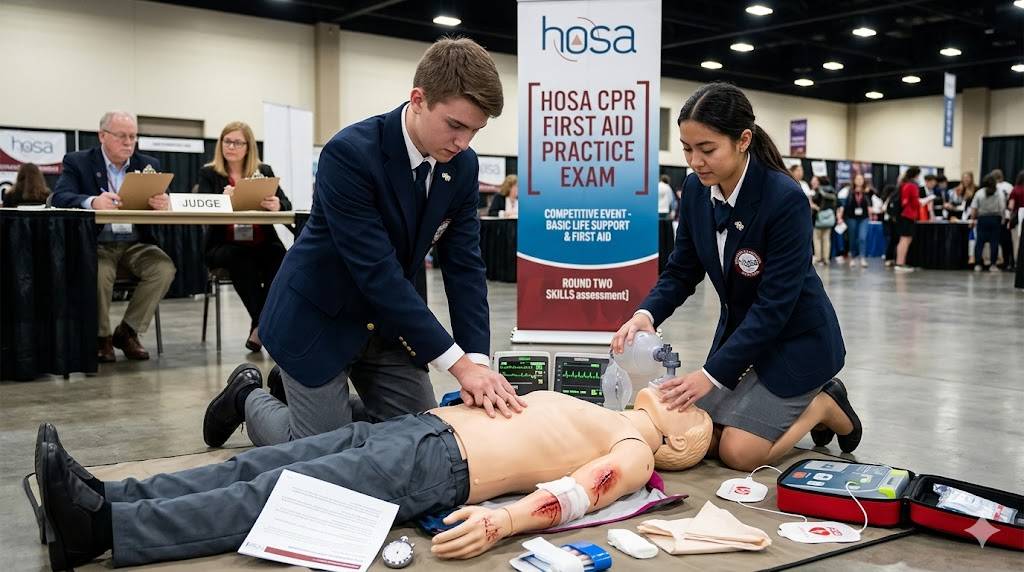
Additional Information
What the Course Entails and Exam Details
This event tests a broad range of life-saving skills and underlying concepts.
Competitors must be proficient in the official guidelines from the American Heart Association (AHA) and the American Red Cross (ARC) for Healthcare Providers.
The core syllabus and skills covered include:
Basic Life Support (BLS): High-quality CPR for adults, children, and infants; use of an Automated External Defibrillator (AED); airway obstruction relief; rescue breathing; and advanced airway considerations.
Anatomy and Physiology: Essential understanding of the body's systems relevant to emergency response, including the circulatory, respiratory, and musculoskeletal systems.
First Aid Basics: Scene safety, personal protective equipment (PPE), patient assessment, and calling for Emergency Medical Services (EMS).
Medical Emergencies: Recognizing and treating conditions like heart attacks, cardiac arrest, stroke, and breathing issues.
Injury Emergencies: Managing bleeding, shock, bone and joint injuries, and soft tissue trauma.
Environmental Emergencies: Responding to heat-related illnesses, cold-related injuries, and poisoning.
What to Expect in the Final Exam
The full HOSA CPR/First Aid event is a two-round process.
Here is what you need to know about the exam components:
Round One: Written Test
Format: A comprehensive multiple-choice examination.
Question Count: Typically, 50 questions in total.
Time Limit: You will have 60 minutes to complete the test.
Purpose: This round filters the top teams, as only a limited number of high-scoring teams advance to Round Two.
Round Two: Skills Assessment
Format: A hands-on performance based on a secret, written scenario.
Time Limit: Your team has a maximum of 12 minutes to read the scenario and perform all necessary life-saving care.
Skills: The scenario requires a First Aid skill (like controlling bleeding) and a BLS skill (like 2-person CPR with an AED). Teamwork is paramount.
Passing Score: To be recognized as an award winner, teams must earn a combined score of 70% or higher on the skill assessment (excluding the written test score).
Tie-Breaker: In the event of a tie, the higher averaged team score from Round One will determine final placement.
How to Study and Exam Centers
Preparation for the HOSA CPR/First Aid event requires a strategic and consistent study plan.
Here are actionable strategies to excel:
Effective Study Methods
Use the Official Resources: Build your knowledge on the foundations. Study the latest guidelines from the American Heart Association (e.g., BLS for Healthcare Providers) and the American Red Cross. HOSA provides specific textbooks as references.
Form a Study Team: Since the event is a two-person event, practice with your partner. Read together, test each other, and practice the skills as a unit. Simulating the scenarios as a team is crucial for timing and communication.
Utilize Practice Tests: Taking a practice test, like this one, is one of the best ways to familiarize yourself with the question style of Round One. Focus on why certain answers are correct and apply that logic.
Active Recall and Spaced Repetition: Create flashcards for key protocols, anatomy terms, and rescue ratios. Revisit difficult topics over several days or weeks.
Host Mock Conferences: Practice is everything. Find scenarios from previous HOSA guidelines and simulate the Round Two experience, from dressing in proper attire to managing a stressful scenario within the time limit. Ask an advisor or teacher to act as a judge.
Exam Centers and How to Take the Test
Where to Take It: HOSA competitive events are held at various levels. The primary test centers are authorized physical locations for your State Leadership Conference (SLC) and the annual HOSA International Leadership Conference (ILC).
Testing Information: All written tests (Round One) are administered through HOSA’s official secure online portals. Students access these through specific computers or testing labs at the conference venue under strict supervision.
Eligibility: To take part, you must be a member of HOSA in good standing and register for the event through your school's HOSA advisor.
Job Opportunities from the Course
A strong performance and certification in CPR/First Aid through HOSA prove your life-saving abilities.
This knowledge is a valuable first step that can lead to many job titles and career paths in healthcare and emergency services:
Certified Nursing Assistant (CNA)
Emergency Medical Technician (EMT)
Lifeguard
Physical Therapist Assistant (PTA)
Dental Assistant or Hygienist
Home Health Aide
Home Hospice Worker
Security Guard or First Responder
Firefighter
Phlebotomist
Frequently Asked Questions
Reviews
5.0
Based on 0 reviews
Leave a Review
No reviews yet. Be the first to review!