
HOSA Dental Terminology Practice
$69.00
- Buy to unlock unlimited access to all Quiz questions and Answers in this Quiz.
- After purchase you can print a PDF of the whole quiz at any point. The PDF will contain the questions and the correct answers.
About this Exam
The HOSA Dental Terminology competitive event is an engaging and essential challenge designed for future health professionals aspiring to enter the dental field. This event is created specifically for HOSA members in the Secondary and Postsecondary/Collegiate divisions. It provides a platform for students to master the specialized language, definitions, prefixes, suffixes, and anatomical terms unique to dentistry. By preparing for this exam, you will build a foundational vocabulary that is critical for clear communication, precise documentation, and patient safety in all areas of oral health care. It’s the perfect event for anyone with their sights set on becoming a dentist, dental hygienist, dental assistant, or oral health specialist.
Ready to test your knowledge?
Buy Now to Access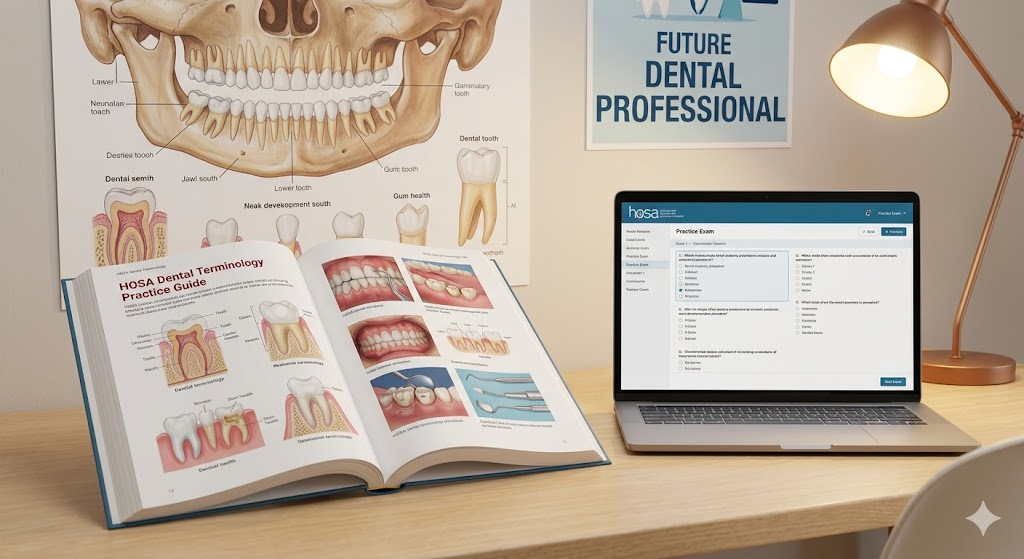
Additional Information
What the Course Entails and Exam Details
This knowledge-based event focuses on a comprehensive understanding of the language common to all dental careers and specialties. The official HOSA Test Plan provides a clear breakdown of the core topics covered, structured as follows:
Dental Specialties: (40%) This is the largest section and includes the terminology, related procedures, and spelling associated with various fields such as General Dentistry, Oral and Maxillofacial Surgery, Cosmetic Dentistry, Pediatric Dentistry, Prosthodontics, Endodontics, Orthodontics, Periodontics, Implant Dentistry, and the dental office laboratory.
Instruments and Materials: (10-20%) You must identify and know the purpose of various dental hand instruments, rotary instruments, and materials used in restorative and laboratory procedures.
Anatomy & Physiology of Head and Oral Structures: (10%) This includes knowledge of head and neck anatomy, tooth morphology, the structures of the oral cavity, and their physiological functions.
Prefixes, Suffixes, and Combining Forms: (10%) Mastering word parts is essential for dissecting and defining unfamiliar dental terms.
Infection Control and Emergency Care: (10%) Topics cover protocols for aseptic technique, sterilization, and handling medical emergencies in a dental setting.
Radiography: (5-10%) Key terminology related to taking, processing, and interpreting dental X-rays.
Pharmacology & Pain Management: (10%) Basics of common dental drugs and pain control methods.
Ethical and Legal: (5%) Foundational concepts of dental ethics and law.
The exam assesses knowledge at various cognitive levels, from simple recall to higher-order application and analysis.
What to Expect in the Final Exam
The final HOSA Dental Terminology exam is a timed, written test. At standard Regional and State level competitions, you can expect a comprehensive exam consisting of 100 multiple-choice items. You will have a maximum of 90 minutes to complete this portion. The questions are designed to be challenging, incorporating sample test questions that may ask you to identify a specific part of a tooth’s surface, select the correct suffix for a condition, or recognize a specific hand instrument used for a procedure.
A critical and unique component of this exam is the set of 20 tie-breaker questions administered simultaneously with the original test. Unlike the main test, correct spelling is required for an item to be considered correct in the tie-breaker section. In the event of a tie score, your performance on successive sets of five tie-breaker questions will determine the winner. While you must check your specific Area/Region/State guidelines for any process variations (such as online or pre-conference testing), the official ILC (International Leadership Conference) guidelines are the ultimate standard, sometimes using a shorter 50-item test format in 60 minutes for Round One. No reference materials, open books, or personal electronics are permitted during testing.
How to Study and Exam Centers
Effective preparation is key to success in this highly competitive event. To study successfully, create a consistent study plan focused on the official HOSA reference materials, which often include the latest editions of "Dental Terminology" by Dofka and "Wheeler's Dental Anatomy, Physiology and Occlusion" by Nelson. Make extensive use of flashcards (both physical and digital, like Quizlet or Anki) to memorize definitions, but crucially, focus heavily on spelling of all terms. For the tie-breaker, practicing spelling is just as important as knowing the definitions. Use diagrams of the oral cavity and tooth anatomy to visualize anatomical terms. Practice with sample tests and past HOSA questions to familiarize yourself with the question style and time constraints. Focus your study on the percentage breakdown of the Test Plan to ensure you allocate the appropriate time to higher-weight topics.
Regarding exam centers, you do not take this exam at a private testing facility like Pearson VUE. The "exam centers" are the actual sites of the HOSA competitive events. Depending on your state’s process, this may include pre-conference online testing or in-person testing at your Regional, State, or the International Leadership Conference (ILC). Your school's HOSA advisor will provide specific details on when and where you will compete and test.
Job Opportunities from the Course
While this competitive event is an academic challenge, the specialized vocabulary you acquire unlocks many exciting and essential career paths in the thriving dental industry. Mastering dental terminology is the first step toward a future in a wide variety of roles, including:
Dentist (General or Specialist): Orthodontists, Endodontists, Oral and Maxillofacial Surgeons, Pediatric Dentists, Periodontists, Prosthodontists
Dental Hygienist
Dental Assistant (Certified or Registered)
Dental Laboratory Technician
Oral Health Educator
Dental Office Administrator / Business Manager
Dental Sales or Insurance Representative
Dental Research Assistant
This comprehensive study of dental terminology provides you with a significant advantage, demonstrating your commitment to the field and ensuring a smooth transition into any post-secondary dental education program.
Frequently Asked Questions
Reviews
5.0
Based on 0 reviews
Leave a Review
No reviews yet. Be the first to review!