
HOSA Extemporaneous Writing Practice Test
$69.00
- Buy to unlock unlimited access to all Quiz questions and Answers in this Quiz.
- After purchase you can print a PDF of the whole quiz at any point. The PDF will contain the questions and the correct answers.
About this Exam
Welcome to your guide for the HOSA Extemporaneous Writing Practice Exam! While this is not a traditional certification exam, it is a vital practice tool designed specifically for active members of HOSA (Future Health Professionals) who are preparing for the highly competitive Extemporaneous Writing event. This dynamic event encourages students in secondary and postsecondary/collegiate divisions to improve their ability to analyze complex healthcare information and express themselves clearly and persuasively through writing, all under significant time pressure.
This study guide article will provide you with a detailed understanding of what to expect from both the practice test and the actual event, equipping you with strategies to excel and translating these honed skills into potential future career opportunities.
Ready to test your knowledge?
Buy Now to Access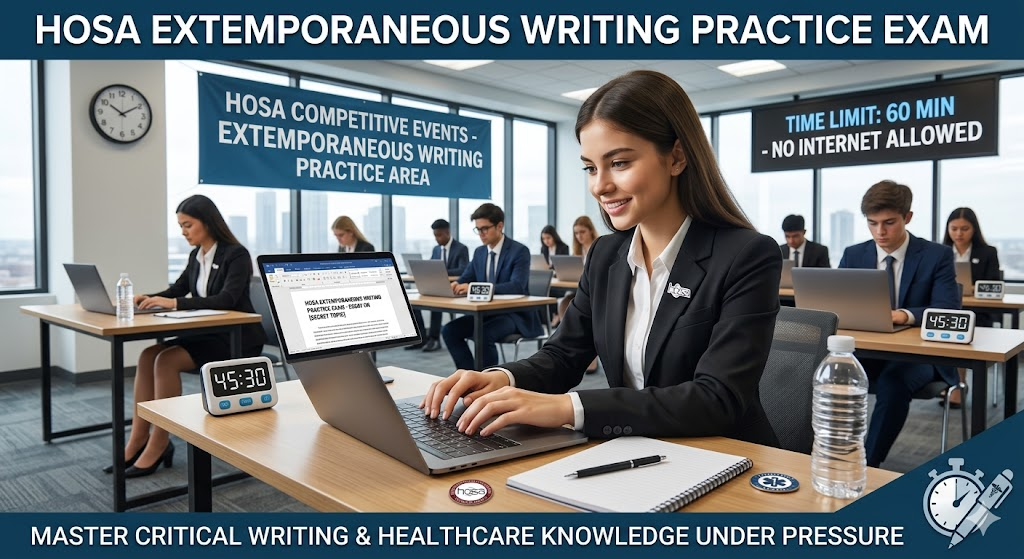
Additional Information
What the Course Entails and Exam Details
This "course" isn't a textbook subject, but rather the development and application of essential skills. The HOSA Extemporaneous Writing event, simulated by the practice exam, entails:
Quick Thinking & Analysis: Candidates are presented with a secret topic, typically a relevant current health issue or relevant HOSA topic, which they must quickly comprehend, analyze, and formulate a cohesive perspective on.
Structured Essay Writing: Participants must construct a well-organized essay with a clear introduction (including a thesis statement), multiple supportive body paragraphs with relevant examples and details, and a concluding summary that reinforces their argument.
Application of Healthcare Knowledge: While the topic is extemporaneous, a strong foundational understanding of current health issues, trends, and ethical considerations is crucial for providing meaningful context and examples.
Effective Communication: Focus is placed on clear grammar, varied vocabulary, proper sentence structure, and the overall fluency and engagement of the writing.
The practice test should simulate these same core elements, providing a timer and potentially a sample prompt for practice.
What to Expect in the Final Exam
While the exact nature of the practice exam you have might vary by provider (e.g., an online simulation, a printable prompt, or guidance on how to practice), it is crucial to understand what the final actual HOSA competition entails to effectively prepare. Here is what you must expect in the actual event:
The Secret Topic: All competitors write on the same secret health-related topic. This topic is not revealed until the competition begins, meaning true extemporaneous thinking is required. The topic might be about a public health crisis, a breakthrough medical technology, an ethical debate in medicine, or the importance of HOSA itself.
Time Limit: Competitors are typically given sixty (60) minutes to write their entire essay on a computer. There might be an additional short window (like 5 minutes) to save and submit their final document to event personnel (e.g., on a provided flash drive or via a specific platform).
Writing Format: The actual competition usually requires essays to be word-processed in a specific format (e.g., Microsoft Word, specific font like Arial 12pt, 1” margins, double-spaced). Make sure your practice reflects this!
Resource Rules: This is a crucial detail. In the real competition, no printed materials, pre-written notes, or external internet access are typically allowed. Participants are generally required to bring their own laptop (and ensure it works on battery, as power isn't provided), pre-format their document, and must save their work without any assistance or resources outside what is potentially provided in the secret topic materials. Always check the most current HOSA National guidelines for the specific rules of the competitive year.
Scoring Rubric: Judges evaluate the essays based on a clear rubric, focusing on:
Thesis & Purpose: A clear, relevant statement and purpose for the entire paper.
Body: Multiple supporting points, effective evidence/examples (crucial in a health context), logic, and organization.
Conclusion: Concise summary and restatement of the thesis in a new way.
Overall Writing: Grammar, spelling, sentence structure, flow, and the use of relevant vocabulary/details.
Formatting Compliance: Adherence to all technical formatting requirements.
High scores, rather than a "passing score," determine ranking in this competitive event. The practice test aims to get you high-scoring skills.
How to Study and Exam Centers
Successfully preparing for the Extemporaneous Writing event requires focused practice and a general, broad approach to knowledge.
Actionable Study Strategies:
Practice Timed Writing: The most critical preparation is simulating the real environment. Find practice prompts (look for past HOSA event materials or create your own diverse list) and give yourself exactly 60 minutes to analyze, outline, and write a full essay, adhering to the formatting rules.
Analyze Diverse Health Topics: Stay informed! Read reputable sources for news on healthcare policy, medical research, public health initiatives, ethical debates, and global health trends. Discussing these topics with peers or mentors can also sharpen your analytical skills. Focus on understanding broad concepts and being able to find examples for them on the spot.
Master Essay Structure: Commit standard essay structure (Intro with Thesis, Body Paragraphs, Conclusion) to memory. Practice writing clear, strong thesis statements and using topic sentences effectively. Work on smooth transitions between paragraphs.
Practice Formatting: Don't lose easy points. Know the required formatting (font, margins, spacing, headers) backwards and forwards. Pre-formatting a template on your laptop, as allowed by real competition rules, is highly recommended.
Seek Feedback: Have teachers, advisors, or peers read your practice essays. Ask for specific feedback based on the HOSA scoring criteria.
Simulate Real Conditions: As much as possible during practice, write with no notes, no internet, and only the allowed computer tools (e.g., basic spell check/thesaurus if available offline, but never internet-based grammar checks). Ensure you can complete the entire process, including potentially saving to a USB, within the time limit.
Exam Centers & Accessing the Practice Test:
The Practice Test: Depending on where you obtained the "HOSA Extemporaneous Writing Practice Exam," you might access it via an online learning portal, as a downloadable document, or through your local HOSA advisor. Always look for official HOSA resources or trusted educational platforms. This guide applies to any suitable practice material you can use.
The Actual HOSA Event: To compete, you must first register as a HOSA member through your school or collegiate chapter. Competitions begin at the chapter or local level, progress to regional or state levels, and potentially culminate at the HOSA International Leadership Conference (ILC). The "centers" for these physical events are typically schools, universities, or large convention centers. Your HOSA advisor will guide you through the registration and qualification process for each level.
Job Opportunities and Career Paths
The skills honed through participation and success in the HOSA Extemporaneous Writing event are directly applicable to a wide range of career paths in the health and communication sectors. Your ability to think critically, communicate complex health information clearly and quickly, and work under pressure will be invaluable. Here are potential career paths and roles:
Medical Writer / Technical Writer: Creating content like clinical study reports, informed consent documents, patient education materials, regulatory submissions, or marketing content for healthcare companies and research institutions.
Healthcare Communications Specialist: Developing and managing internal and external communication strategies for hospitals, health systems, non-profits, or government agencies. This can include writing press releases, social media content, and newsletters.
Medical Journalist: Reporting on health and medical news for newspapers, magazines, television, or online media outlets.
Public Health Advocate / Health Policy Analyst: Researching health issues, analyzing policies, and communicating findings to the public, policymakers, or specific populations to drive positive health outcomes.
Healthcare Administrator / Manager: Roles requiring effective communication, strategic thinking, and the ability to articulate complex operational and policy issues.
Research Assistant / Coordinator: Effectively communicating research findings, writing protocols, and contributing to scientific publications.
Regulatory Affairs Specialist: Ensuring products and practices comply with all relevant healthcare regulations, which involves clear interpretation and precise writing.
Patient Advocate / Navigator: Helping patients understand their conditions and navigate the healthcare system, requiring clear and compassionate communication.
Any Healthcare Clinical Role (Nurse, Physician, etc.): The ability to document effectively, communicate with patients and colleagues under pressure, and quickly analyze patient information is core to clinical practice. Success in this HOSA event demonstrates strong analytical and communication skills beneficial for medical/nursing school applications.
By mastering the skills required for the HOSA Extemporaneous Writing Practice Exam, you are not just preparing for a competition; you are investing in crucial professional competencies that will open doors to impactful and dynamic careers in the vital field of healthcare. Best of luck on your journey!
Frequently Asked Questions
Reviews
5.0
Based on 0 reviews
Leave a Review
No reviews yet. Be the first to review!