
HOSA Health Careers Practice Test
$69.00
- Buy to unlock unlimited access to all Quiz questions and Answers in this Quiz.
- After purchase you can print a PDF of the whole quiz at any point. The PDF will contain the questions and the correct answers.
About this Exam
The HOSA Health Careers Practice Test, though not a single standardized exam, represents a critical step for students exploring or actively pursuing careers in the healthcare industry. It is designed to prepare and assess members of HOSA - Future Health Professionals, a global student organization, for the diverse range of competitive events they can participate in at regional, state, and international levels. These events act as rigorous assessments, combining written knowledge tests and hands-on skill performance evaluations across dozens of health-related fields. Whether you're interested in nursing, emergency medicine, biotechnology, healthcare administration, or specialized therapies, understanding how to approach these competitive challenges and utilize practice resources effectively is essential. This guide is crafted for high school and collegiate students who are passionate about health sciences and eager to demonstrate their competence and leadership potential through HOSA.
Ready to test your knowledge?
Buy Now to Access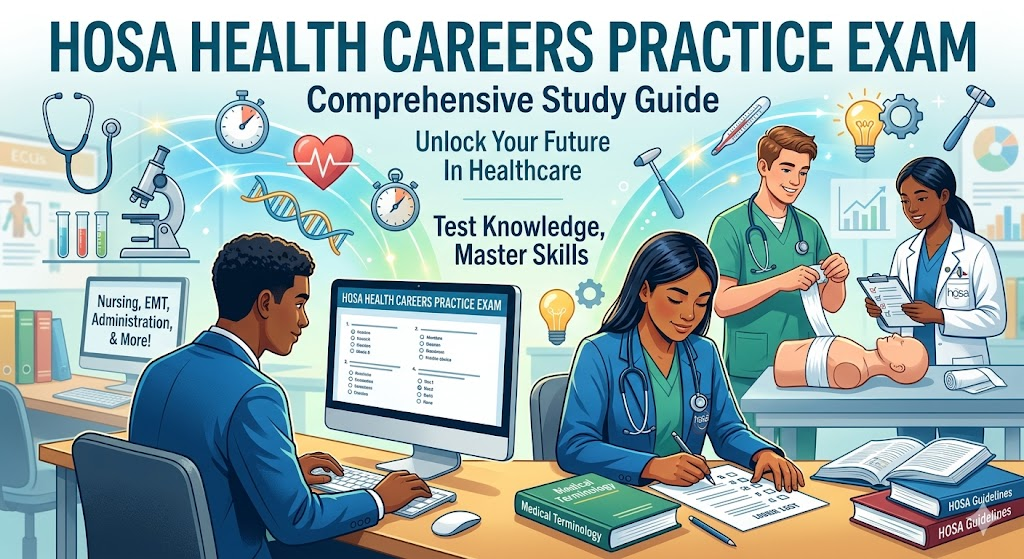
Additional Information
What the Course Entails and Exam Details
Preparing for HOSA competitive events, which this practice test relates to, involves deeply understanding the specific requirements of your chosen category. While not a conventional structured course, success requires dedicated self-study, practical skill mastery, and adherence to official event guidelines. The "curriculum" you must cover depends entirely on the event.
HOSA events are broadly categorized into six divisions:
Health Science Events: Testing general knowledge, medical terminology, health math, nutrition, and pharmacology through comprehensive written exams.
Health Professions Events: Assessing practical skills and knowledge in specific fields like Clinical Nursing, Dental Assisting, Nursing Assisting, Sports Medicine, and Veterinary Science.
Emergency Preparedness Events: Evaluating readiness in areas such as CERT Skills, CPR/First Aid, EMT, and Public Health, often with a mix of knowledge and skill demonstrations.
Leadership Events: Focusing on communication, reasoning, and creativity, including Extemporaneous Writing, Health Career Photography, Healthy Lifestyle, and Prepared Speaking.
Teamwork Events: Requiring collaborative problem-solving and knowledge application in events like Biomedical Debate, Creative Problem Solving, Forensic Science, Health Education, and HOSA Bowl.
Recognition Events: Acknowledging members for their achievements and involvement, with some involving tests like the Healthcare Issues Exam.
The specific knowledge base, technical skills, and resources (including listed textbooks and online materials) for each event vary significantly. It is paramount that you consult the current year's official HOSA competitive event guidelines for comprehensive details on what topics to study and which skills to master. Mastery implies not just recall but the ability to apply and analyze information in complex scenarios.
What to Expect in the Final Exam
The actual assessments you will face in HOSA competitions—the "final exams" your practice prepares you for—take various forms, and details will change based on your selected event and level of competition. However, common formats include:
Written Knowledge Tests: Many events commence with a written, multiple-choice exam, often consisting of 50 to 100 questions. These tests measure knowledge and understanding at recall, application, and analysis levels, often incorporating higher-order thinking. Time limits are typically specified (e.g., 60 minutes for a 50-item test), and tie-breaker questions (which can be a specific question or an essay) are often included.
Skill Performance Assessments: In many events, especially those in Health Professions and Emergency Preparedness, top scorers on the written test advance to a second round. This phase requires you to physically demonstrate specific clinical or technical skills based on given scenarios, evaluated by judges using detailed rating sheets. Skill demonstrations are carefully timed, with strict limits per skill or overall. Scenarios are often kept secret until the evaluation begins.
Key things to understand about the final exam structure:
Variability: Every event has its unique assessment format. Some may only be a test, some only skills, and others a combination. Passing scores (often a combination of test and skill scores to rank, with potential minimums like 70% in skill components to win recognition) and specific time limits are event-specific.
Levels of Competition: Your assessment process will differ from regional to state to international leadership conferences. The complexity, difficulty, and sometimes even the available events can vary at each stage.
Strict Rules: HOSA maintains strict rules regarding official dress code (official uniform or business attire), required supplies (which can include specific kits or tools for skill events, photo ID, pencils), scenario secrecy, and appropriate conduct. Violations can lead to penalties.
Advancement: Success at one level usually unlocks the opportunity to compete at the next. You should expect that the competition intensifies and expectations rise as you advance.
Therefore, the only definitive way to know "what to expect" is to review the current official guidelines for your specific event at the relevant competition level. These guidelines detail the exact point breakdown, skill scenarios to expect, specific knowledge plan, and all pertinent regulations.
How to Study and Exam Centers
How to Study effectively:
To truly prepare for HOSA health careers assessments, you cannot rely solely on generic study materials. Here are actionable strategies:
Deep Dive into Official Guidelines: Make the current HOSA competitive event guidelines your primary resource. This document is non-negotiable, outlining exactly what is expected, the rating sheets judges use, recommended resources, and crucial deadlines/rules. Always study the current year's guidelines.
Master Recommended Resources: Pay close attention to the textbooks and other learning materials listed within your event guidelines. Your test questions and skill expectations are heavily derived from these sources. Use them for comprehensive study.
Practice, Practice, Practice Skills: If your event involves skill demonstrations, find a mentor (teacher, advisor, health professional) to guide you. Practice the skills listed in the guidelines repeatedly until they become natural, focusing on safety, accuracy, and efficiency as defined by the rating sheets. Record yourself to spot areas for improvement.
Utilize HOSA Study Portals and Tools: Explore official HOSA resources, including any online study guides, practice tests (yes, use actual practice tests!), interactive tools, and sample materials provided. Many state associations also offer valuable preparation tools.
Take Mock Tests and Create Scenarios: Obtain practice question banks or create your own based on recommended textbooks. For skill events, create mock scenarios with varying complexities to practice critical thinking under pressure.
Form Study Groups: Collaborating with fellow HOSA members can be motivating, allow for peer-reviewed practice of skills, and provide diverse perspectives on complex topics.
Seek Mentorship: Your HOSA advisor, health science teachers, and healthcare professionals in your chosen field are invaluable sources of knowledge, practical tips, and encouragement.
Stay Informed: Regularly check official HOSA and your state association websites for event updates, deadlines, and information.
Exam Centers:
Unlike standardized professional exams, HOSA assessments are administered through the organization’s structured competition system and are NOT held at public testing centers like Pearson VUE, Prometric, or general online portals.
Regional/Local Competitions: Initial rounds may take place within individual school chapters or at designated regional sites. Logistics are managed internally by HOSA chapters or regional committees.
State Leadership Conferences (SLC): State-level events are hosted at large conference centers, hotels, or educational institutions designated by your specific HOSA state association.
International Leadership Conference (ILC): The pinnacle event, the ILC, is held annually in different major cities, utilizing expansive convention centers and surrounding hotels for all competitive events.
Information regarding specific locations, dates, and registration for these competitive events is disseminated exclusively through your local HOSA chapter advisor and official state HOSA communications. You will not find open registration through external exam providers. All testing and skill demonstrations occur in controlled, official competition environments managed directly by HOSA.
Job Opportunities from the Course
While participating in HOSA is not a direct path to a single job in the traditional sense, the knowledge, skills, and networking opportunities gained through competitive events across the health career landscape are directly applicable to numerous rewarding career paths. Successful HOSA members often leverage their experience to stand out in educational program applications and early career opportunities. The diverse fields covered by HOSA events include, but are not limited to, the following job opportunities and career paths:
Nursing Professions:
Registered Nurse (RN)
Nurse Practitioner (NP)
Licensed Practical/Vocational Nurse (LPN/LVN)
Certified Nursing Assistant (CNA)
Certified Registered Nurse Anesthetist (CRNA)
Emergency Medical Services:
Emergency Medical Technician (EMT)
Paramedic
Community Emergency Response Team (CERT) Member/Instructor
Medical & Surgical Specializations:
Physician (MD/DO)
Surgeon
Physician Assistant (PA)
Sports Medicine Physician
Veterinarian
Clinical & Laboratory Sciences:
Medical Laboratory Scientist/Technician
Clinical Laboratory Technologist
Biotechnologist
Dental Professions:
Dentist
Dental Hygienist
Dental Assistant
Dental Lab Technician
Therapeutic Services:
Physical Therapist (PT)
Occupational Therapist (OT)
Respiratory Therapist
Speech-Language Pathologist
Exercise Physiologist
Massage Therapist
Pharmacy:
Pharmacist
Pharmacy Technician
Administrative & Support Roles:
Healthcare Administrator
Medical Office Manager
Medical Coder/Biller
Health Information Manager
Public Health & Other Specialized Fields:
Epidemiologist
Public Health Educator
Medical Law & Ethics Professional
Dietitian/Nutritionist
Behavioral Health Professional
Forensic Scientist (with health applications)
By excelling in HOSA competitions and utilizing the preparation resources available, you not only prepare yourself for specific events but also build a solid foundation and showcase commitment for future studies and careers across the vast healthcare landscape. This extensive list demonstrates the incredible diversity of impactful roles accessible by leveraging the HOSA experience.
Frequently Asked Questions
Reviews
5.0
Based on 0 reviews
Leave a Review
No reviews yet. Be the first to review!