
HOSA Human Growth and Development Practice Test
$69.00
- Buy to unlock unlimited access to all Quiz questions and Answers in this Quiz.
- After purchase you can print a PDF of the whole quiz at any point. The PDF will contain the questions and the correct answers.
About this Exam
The HOSA Human Growth and Development competitive event is a comprehensive, knowledge-based challenge designed for future health professionals.
It focuses on understanding the complex processes of human life, from conception through to the end of life.
This event is open to middle school, secondary, and postsecondary HOSA members who are passionate about developmental psychology, lifespan studies, and the care of individuals at all life stages.
It’s an excellent way for students to deepen their understanding of health and development, serving as a stepping stone to various careers in nursing, medicine, psychology, and social work.
Ready to test your knowledge?
Buy Now to Access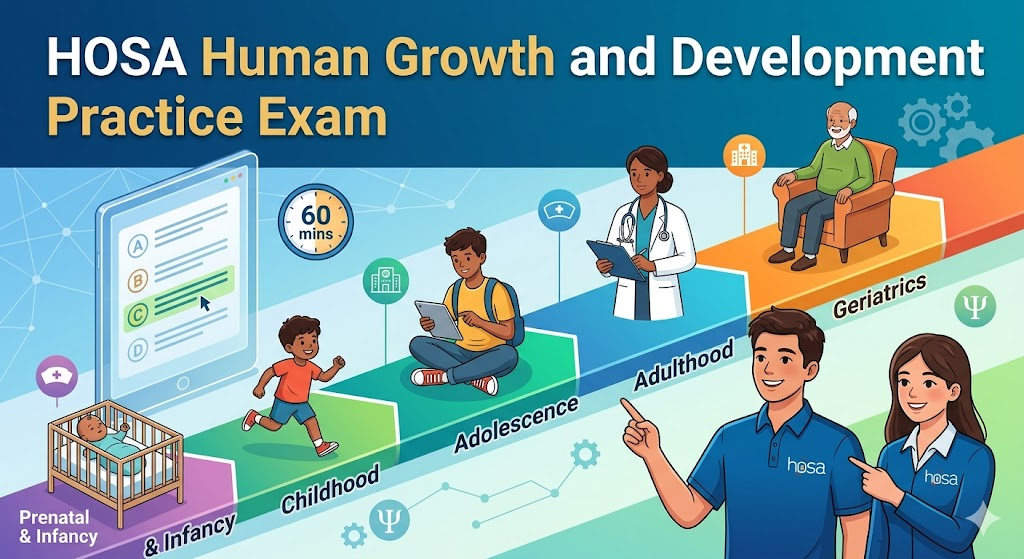
Additional Information
What the Course Entails and Exam Details
This event is not a structured "course" in the traditional sense, but rather a competition based on specific knowledge areas outlined in the HOSA guidelines.
To prepare, you are essentially undertaking a self-guided or classroom-supplemented course on lifespan development.
The written test is meticulously organized according to a fixed test plan, which breakdowns the topics and their weight on the final exam.
The core content areas typically include:
Government, Cultural, and Family Influences (20%): Understanding how social systems, cultural diversity, and family structures impact individual health and development.
Theories of Development (16%): Familiarizing yourself with key theorists like Erikson, Piaget, Freud, and Kohlberg, and their models of cognitive, social, and moral growth.
Prenatal and Infancy (12%): Studying the stages from conception, fetal development, birth, and the critical biological and psychological milestones of the first years of life.
Childhood and Adolescence (22%): Analyzing the rapid changes of early and late childhood, followed by the biological, emotional, and social transitions of puberty and adolescence.
Adulthood (15%): Covering the developmental tasks, challenges, and physical changes associated with early, middle, and late adulthood.
Geriatrics, End of Life, and Grief (15%): Exploring the unique physical, cognitive, and social aspects of aging, along with the dynamics of palliative care, the death process, and the stages of grief.
What to Expect in the Final Exam
The actual competitive exam is a rigorous, written test.
You are expected to understand not only the "what" of human development but also the "how" and "why" behind developmental patterns.
The final competitive event consists of 50 multiple-choice items.
You are allotted a maximum of 60 minutes to complete the test.
In the case of a tie, an additional tie-breaker essay question included in the test will be evaluated.
The test is a pure assessment of your knowledge base; there is no practical or hands-on component.
Your score determines your ranking within your competitive level (middle school, secondary, etc.) at the regional, state, or international HOSA conference.
While individual practice tests will often provide a passing percentage (e.g., 70% or 80%), in HOSA competition, the "passing" score is relative to the other competitors—your goal is to be in the top scoring bracket to advance.
How to Study and Exam Centers
Preparation is the key to success in this competitive event.
The best strategy is to study the content from multiple angles.
Start with the Guidelines: Download the official HOSA Human Growth and Development event guidelines. This document is your most critical tool, listing official reference textbooks and providing the exact test plan breakdown.
Master the References: Focus your studies on the recommended textbooks listed in the guidelines. The test questions are drawn directly from these sources.
Use Flashcards: Create or use digital flashcards to learn definitions of key terms, names of theorists, and specific developmental milestones for each life stage.
Practice, Practice, Practice: Use comprehensive HOSA practice tests, Clep Human Growth and Development resources, or textbooks with sample questions to simulate the testing experience.
Form a Study Group: Collaborative learning is highly effective for testing knowledge, discussing complex theories, and identifying areas of weakness.
Regarding exam centers, it is vital to understand that the actual competitive event does not take place at commercial testing centers like Pearson VUE.
Instead, the Human Growth and Development test is administered within the secure environment of a HOSA conference, which includes:
Regional-level conferences.
State Leadership Conferences (SLC).
The International Leadership Conference (ILC).
Qualification for state and international competition usually requires achieving a top score at the previous level.
Consult your school's HOSA advisor for specific information on where and when your next qualifying exam will be held.
Job Opportunities from the Course
While completing this "course" doesn't provide a certification in a single job role, it unlocks a massive pathway to diverse health and human service careers.
Your foundational knowledge in human growth and development is a prerequisite for specialized education in these fields.
Examples of job opportunities and career paths this knowledge unlocks include:
Pediatrician
Neonatal Nurse
School Counselor
Gerontological Nurse Practitioner
Developmental Psychologist
Occupational Therapist
Speech-Language Pathologist
Child Life Specialist
Family Physician
Social Worker
Psychiatrist
Palliative Care Specialist
Rehabilitation Counselor
Elementary or Secondary School Teacher
Human Resources Specialist in Healthcare
This extensive foundation prepares you to serve patients and clients across the entire spectrum of life, from the beginning of existence to its peaceful end.
Frequently Asked Questions
Reviews
5.0
Based on 0 reviews
Leave a Review
No reviews yet. Be the first to review!