
HOSA Human Heredity Practice Test
$69.00
- Buy to unlock unlimited access to all Quiz questions and Answers in this Quiz.
- After purchase you can print a PDF of the whole quiz at any point. The PDF will contain the questions and the correct answers.
About this Exam
The HOSA Human Heredity event, including the knowledge tested in the HOSA Human Heredity Practice Exam, is designed to immerse future health professionals in the fascinating, complex world of genetics.
This competitive event is part of the broader HOSA Health Science series and is specifically structured for middle school, high school, and post-secondary/collegiate students who demonstrate a strong interest in understanding the principles of human genetics, inheritance, and genetic disorders.
By participating and utilizing practice materials like this exam, students don't just memorize facts; they develop critical thinking skills necessary to analyze real-world biological concepts, preparing them for a future in diverse medical and scientific fields.
The competition aims to identify and recognize students who exhibit exceptional knowledge and analytical abilities in this foundational area of human biology.
Ready to test your knowledge?
Buy Now to Access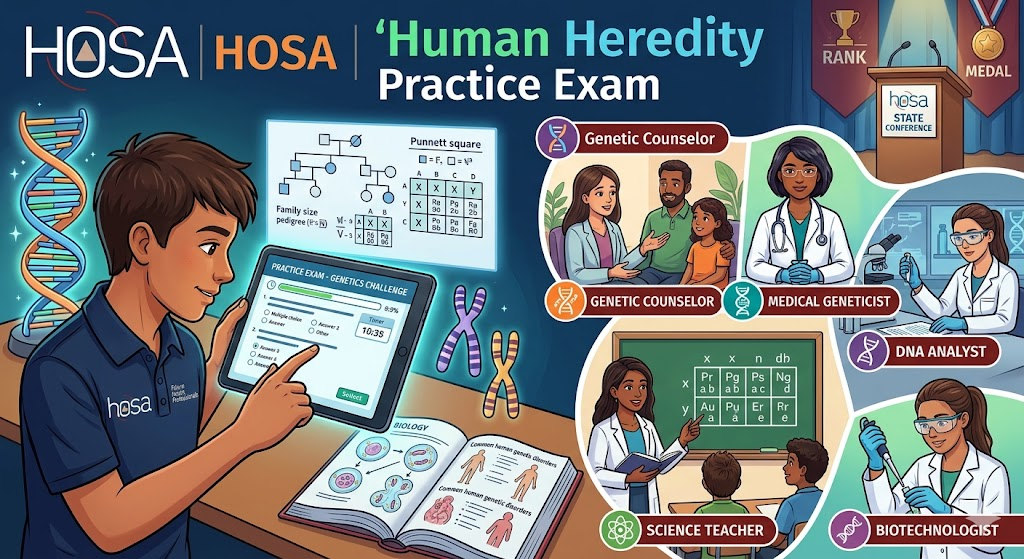
Additional Information
What the Course Entails and Exam Details
While not a standalone course itself, the HOSA Human Heredity Practice Exam and the actual competition it prepares for cover a comprehensive syllabus commonly taught in advanced biology, genetics, or specialized health science curriculum.
The core topics you will encounter include:
Principles of Heredity: Understanding Mendelian genetics (dominant/recessive, co-dominance, incomplete dominance, multiple alleles), non-Mendelian inheritance patterns, pedigrees, Punnett squares, sex-linked traits, and gene interaction.
Molecular Genetics: The structure and function of DNA and RNA, processes of replication, transcription, and translation, gene expression regulation, mutations, and modern biotechnologies like gel electrophoresis, PCR, and sequencing techniques.
Cell Cycle & Division: Deep understanding of mitosis, meiosis (and how it generates variation), gametogenesis, and nondisjunction events and their consequences.
Human Genetic Disorders: In-depth knowledge of common and rare human genetic conditions, their causes (chromosomal, single gene, multi-factorial), symptoms, inheritance patterns, testing methods, and relevant ethical/legal considerations. Topics often include trisomy events, cystic fibrosis, sickle cell disease, Huntington's disease, and colorblindness.
Ethical, Legal, and Social Issues: Exploring the impact of genetic advances, genetic counseling, genetic privacy, and biotechnological applications.
The HOSA Human Heredity Practice Exam serves as a vital diagnostic tool, allowing students to gauge their understanding of these varied and essential topics before competing. It's not just about getting answers right; it’s about identifying areas for deeper study.
What to Expect in the Final Exam
When you move from the HOSA Human Heredity Practice Exam to the actual competitive event, you can typically expect a knowledge-based assessment.
The final event test generally features a structured format:
Format: Primarily a multiple-choice question format, demanding accurate recall and application of complex concepts within a specified time frame. Some events or higher competition levels may include additional tie-breaker components, such as case study analysis or structured short-answer questions. Always check the most current official HOSA guidelines for your competition year and level (local, state, international).
Time Limit: Competitive events have strict time limits. You will likely be given a block of time (e.g., 60-90 minutes) to complete all questions, making time management and rapid, accurate processing crucial. Practice tests like this one are invaluable for developing this skill.
Passing Score/Advancement: HOSA competitive events are scored based on points. High-scoring individuals are ranked, and those in the top positions typically advance from local/chapter competitions to state, and ultimately to the International Leadership Conference (ILC). There isn't typically a single "passing score" in the standard sense but rather a requirement to perform exceptionally well relative to other competitors.
Students are expected to adhere to all general and specific competition rules, which often include restrictions on materials allowed (no outside notes, specific calculator types if permitted, etc.) and strict adherence to academic integrity and conduct standards. Official HOSA guidelines are the ultimate authority on all specific event details.
How to Study and Exam Centers
Preparation is key for success in the HOSA Human Heredity event, and effective use of the HOSA Human Heredity Practice Exam is a cornerstone.
Here are actionable study strategies and essential information about the actual competition locations:
Study Official Resources: The first and most critical step is to obtain and thoroughly read the official HOSA Competitive Event Guidelines for the current year, found on the official HOSA website. These guidelines list the specified textbooks, recommended resources, detailed syllabus (including topic weights), and official rules. Standard high school or AP/IB biology and genetics textbooks are often primary references.
Use Practice Tests Strategically: Take practice exams like this HOSA Human Heredity Practice Exam multiple times. Use them to:
Identify Weak Areas: Note which topics you consistently struggle with and focus your study time on those concepts.
Practice Time Management: Simulating exam conditions to build speed and accuracy.
Review All Explanations: Understand why an answer is correct and others are incorrect – this deepens your conceptual understanding.
Create Structured Study Aids: Make flashcards for key terms (alleles, genotype, phenotype, nondisjunction, etc.), detailed diagrams for cell division, DNA processes, and standard pedigree charting symbols and methods.
Form Study Groups: Collaborating with other students interested in the same event can provide new perspectives, motivation, and a fun way to test each other.
Consult Experts: If you have a science teacher or HOSA advisor, don't hesitate to ask for clarification on difficult topics or pointers on effective competitive preparation.
Exam Centers: The HOSA Event Experience
Unlike standardized certifications or professional licensure, the actual HOSA competitive events are not generally taken at standard commercial testing centers.
Instead, the actual test administration and competition happen at official HOSA conferences and conventions:
Chapter/Local Level: Initial rounds may occur within your school or local chapter.
State Level: Students who qualify advance to state-level conferences, typically held at major event venues, convention centers, or large schools within the state.
International Level: Top state qualifiers earn the opportunity to compete at the prestigious HOSA International Leadership Conference (ILC), held in a major U.S. city each year.
The specific logistics, including testing schedules, locations within the convention center, and necessary materials, are communicated through your HOSA advisor and the official conference documentation for each competitive level. Practice materials like this exam are available through official HOSA channels or authorised preparation platforms online.
Job Opportunities from the Course
While participating in the HOSA Human Heredity event and excelling on the HOSA Human Heredity Practice Exam doesn't grant a direct professional certification, the deep foundational knowledge and skills you develop are powerful stepping stones to a wide range of inspiring careers.
The knowledge and dedication demonstrated by successful HOSA competitors are highly valued. Some of the many career paths and specific job titles that this foundational knowledge unlocks or strongly aligns with include:
Genetic Counselor: Utilizing understanding of inheritance, disorders, and empathy to advise individuals and families.
Medical Geneticist / Physician (Medical Genetics): Specializing in the diagnosis, management, and treatment of genetic conditions.
Genetic Research Scientist: Conducting laboratory research to discover gene functions, disease causes, and potential therapies.
Biotechnologist: Applying genetic principles in industries like agriculture, pharmaceutical development, and forensic science.
Laboratory Technician (Genetics/Biomedical): Performing essential laboratory tests and analyses related to DNA and genetic markers.
Nurse (Specializing in Genetics): Providing patient care and education specifically related to genetic health conditions.
Health Educator: Designing and delivering programs to promote understanding of genetic health and preventative measures.
Science Teacher (Biology/Genetics): Inspiring future generations of students to explore the wonders of life science and genetics.
Bioinformatics Specialist: Combining biology, computer science, and information technology to analyze genetic data.
Pharmaceutical Researcher: Developing new drugs and treatments based on genetic insights and molecular targets.
Forensic Scientist (DNA Analyst): Applying genetic testing techniques to support legal investigations.
Epidemiologist: Studying the patterns, causes, and effects of health and disease conditions, including genetic factors, within populations.
Public Health Official: Developing policies and programs related to genetic screening, health promotion, and disease prevention.
Your dedication in preparing for the HOSA Human Heredity competition is a significant investment in a future where you can truly make a difference in healthcare, research, and science. Embrace the challenge, utilize every study resource effectively, and let this journey be the foundation of an impactful career. Good luck with your study!
Frequently Asked Questions
Reviews
5.0
Based on 0 reviews
Leave a Review
No reviews yet. Be the first to review!