
HOSA Nursing Assisting Assessment Practice Test
$69.00
- Buy to unlock unlimited access to all Quiz questions and Answers in this Quiz.
- After purchase you can print a PDF of the whole quiz at any point. The PDF will contain the questions and the correct answers.
About this Exam
The HOSA Nursing Assisting Assessment is a premier competitive event designed for Future Health Professionals. This comprehensive examination evaluates the knowledge, critical thinking, and hands-on skills required to excel as a Certified Nursing Assistant (CNA). It is specifically tailored for secondary and postsecondary/collegiate HOSA members who are pursuing a career in nursing or related long-term care fields.
By engaging with this assessment, students demonstrate their mastery of essential patient care concepts, safety protocols, and ethical responsibilities. Earning recognition in this HOSA event validates a student’s preparation for the demanding yet rewarding role of a nursing assistant, bridging the gap between classroom learning and clinical practice.
Ready to test your knowledge?
Buy Now to Access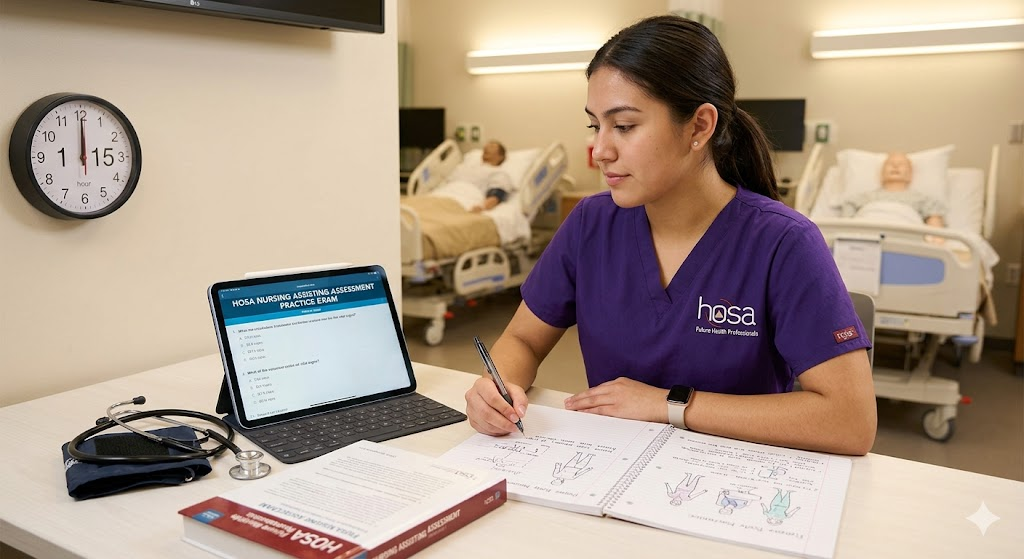
Additional Information
What the Course Entails and Exam Details
Preparing for the HOSA Nursing Assisting Assessment requires deep knowledge across several core domains. Candidates are expected to understand the full scope of practice for a nursing assistant within various healthcare settings, focusing heavily on long-term care, home health, and acute hospital environments.
The competencies covered include, but are not limited to, fundamental nursing skills (such as measuring vital signs and assisting with mobility), infection control practices, safety and emergency procedures, communication techniques, documentation, and respecting client rights. The material aligns with the standardized training required for state CNA certification across the United States.
What to Expect in the Final Exam
The HOSA Nursing Assisting Assessment generally consists of two distinct rounds of evaluation. Round One is a written, multiple-choice test that assesses theoretical knowledge. Candidates must answer questions covering the domains outlined above within a specific time limit, often 60 to 90 minutes.
Achieving a qualifying score in Round One advances competitors to Round Two, which is the practical skills performance evaluation. In this round, candidates are required to perform randomized procedures (such as handwashing, making an occupied bed, or transferring a patient) in front of judges, following strict, standardized rubrics. A "Critical Step" failure in any skill typically results in a non-passing score for that skill, emphasizing the need for meticulous practice.
How to Study and Exam Centers
Effective study for this assessment requires a balanced approach of theory and practice. Utilize official HOSA competitive event guidelines, which provide the specific rubrics used by judges. Study standardized CNA textbooks, focusing on rationale for every step. Practice Round One by taking numerous practice tests that mimic the multiple-choice format and content distribution.
For Round Two, hands-on practice is essential. Review the skill rubrics, then perform the skills repeatedly with peers or instructors acting as patients until the sequences are fluid and accurate. Pay extreme attention to safety precautions and "Critical Steps." Since this is a HOSA competition, the assessment takes place during Regional, State, and the International Leadership Conferences (ILC) at specific testing sites designated by HOSA. Round One might sometimes be proctored online through authorized school testing portals.
Job Opportunities from the Course
While this assessment is a competitive event rather than a direct licensing exam, preparing for and succeeding in it equips students with the exact knowledge and skills required to challenge state CNA certification. This competitive experience makes candidates highly attractive to employers.
The foundational skills mastered through HOSA Nursing Assisting unlock various job opportunities in healthcare, including:
Certified Nursing Assistant (CNA)
Licensed Nursing Assistant (LNA)
Patient Care Technician (PCT)
Home Health Aide (HHA)
Geriatric Nursing Assistant (GNA)
Hospice Aide
Restorative Nurse Aide
Resident Assistant (RA) in Assisted Living
Frequently Asked Questions
Reviews
5.0
Based on 0 reviews
Leave a Review
No reviews yet. Be the first to review!